Pages

Friday, July 4, 2014

A Visit to Kichijoji

I traveled to a neighborhood called Kichijoji(吉祥寺) for the first time the other day. Kichijoji is located in Musashino, one of the suburbs of Tokyo. This is an older part of town, and it has a pretty rich history.

History


For those that have been following my blog for a while, you may recognize the ending of "-ji" there in the name. This final character is used to name temples, and Kichijoji itself roughly translates to "The Temple of Lucky/Auspicious Omens." This Buddhist temple was moved to Bunkyo on the orders of Tokugawa Ieyasu - the first shogun of the Tokugawa shogunate and the man credited with the expansion and reconstruction of much of traditional Edo (what is now Tokyo). Bunkyo is a ward within Tokyo that today holds the Tokyo Dome, the Headquarters of the Judo community, and the University of Tokyo Hongo Campus.

As was prone to happen in those days, a small town built up around the temple. It was therefore named Kichijoji-Monzenchou (吉祥寺門前町), literally "The town built around Kichijoji." Traditional city planning measures allowed homes to be built very close together. Even today, you can see older areas of the city that have only centimeters of space between the buildings. Homes and shops were made to be light in order to withstand the frequent earthquakes in the area. They were therefore built out of wood. Due to the high volume of wooden buildings in a small space, coupled with the dry summers and winters here in Tokyo, the city was very prone to large and destructive fires. The most famous of which was the Great Fire of Meireki in March 1657. This fire lasted three days, claimed the lives of over 100,000 people, and destroyed up to 70 percent of the city. By the time the fire was extinguished, the temple and its surrounding town were destroyed.

A new era of reconstruction began. The shogunate decided to repurpose the land for daimyo residences. The previous residents of Kichijoji-Mozenchou in Bunkyo were moved to the present-day Kichijoji in Musashino. Although this present-day neighborhood does not hold the Kichijoji temple, it did keep the name as a tribute to the original town.

Highlights


Inokashira Park
By far one of the most popular things in the area is Inokashira Park. This park is busiest in spring due to its large number of cherry blossom trees, but it is enjoyed year-round by Tokyo residents for its beauty and greenery.

Inokashira Park Spring, J. Peterson, Wikimedia Commons ©

Side Alleys
Called Yokochou (横町) in Japanese, these backstreets and side alleys hold a variety of small bohemian-style shops and restaurants. If you are looking for a place to relax and enjoy the traditional side of Tokyo, this is definitely it. Due to its distance from the city center, you can find things a bit cheaper here. I found a great pair of running shoes for roughly 5,000 yen. You would normally have to spend between 8,000 to 10,000 yen to find the same item in other parts of Tokyo. I even found a small shop that sold only handmade goods. There were handmade linen tablecloths, handmade wooden spoons, and handmade cups and plates.

Harmonica Alley
This is one of Kichijoji's most famous yokochou. Here you can find small bars where you can sip beer or hoppy, a favorite of older Japanese businessmen. Hoppy has a taste similar to beer, but it is made with shochu and contains about 1% alcohol. It was especially popular in the past when beer was considered too expensive for the general populace.
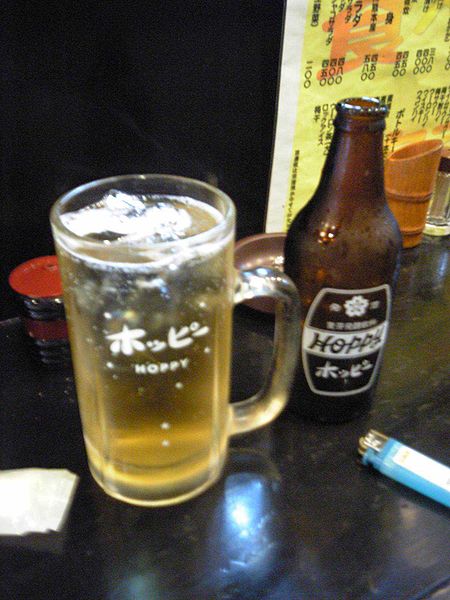
Hoppy, Hykw-a4, Wikimedia Commons ©
The air smells great here due to the wide variety of restaurants, one of which is the ever-popular yakitori (kebab) bar. I also found a small tsukemono-ya, or pickled foods shop. I was all for buying bettarazuke, which is a slightly sweet-tasting pickled daikon. It is a something Tokyo is famous for, but Tai wasn't in the mood, so I'll stop by another day. All in all, Harmonica Alley is very similar to Sangenjaya in Setagaya Ward with its high number of restaurants and local atmosphere.

Sun Road
A covered shopping arcade, this was one of my favorite spots in all of Kichijoji. It really reminded me of Kyoto's downtown covered Shijo Street near Nishiki Market. By far one of the most interesting places here is a small croquette shop called Satou Kichijoji.  If you click this video (Japanese-only), you can see the meat croquettes that have made it so popular. This shop was amazingly busy. I think we discovered it around 2:00, and there was still a line of 50 people waiting to buy meat croquettes. When we left around 7:00, the line was longer if anything. In fact, it was featured on TV the other day. Despite the shop's small size, it sells 3,000 meat croquettes a day.

The other place I really enjoyed was a traditional geta shop. Geta are the Japanese wooden clogs. This shop had ones that were handmade from bamboo and tatami. As well as ones that were wooden. They had everything from the traditional-style geta that are worn with kimono to modern-day styles that are more comfortable for every-day use. We spent a while talking to the shopkeeper about the different styles as this kind of shop fairly rare today.

Geta, Haragayato, Wikimedia Commons ©

Atré
Finally, if you're looking for something a bit more upscale, there are the department stores in the area. I'm particularly fond of Atré, because it has such a eclectic variety of goods. This one had a small chopstick shop, a variety of florists, a stationary and bag shop, among others.

Conclusion


All in all, it was a great day at Kichijoji. It was very easy to see why it is so popular among all age groups. With its easy access to Inokashira Park and its vibrant community, Kichijoji is consistently rated the number 1 place that people want to live in Tokyo. Even I felt that if I wasn't so happy living in Setagaya Ward, that I would be happy to move to Kichijoji in the future. People were very friendly and it definitely had a small-town feel, something you don't get often in urban Tokyo. I know that I'll definitely be going back to eat those delicious croquettes and maybe enjoy a drink or two in Harmonica Alley with the local residents.

Tuesday, July 1, 2014

The Job Search

Whew! It's been a while since I last posted up on here. I have much to discuss, but we'll keep this post relatively short. It's already been 2 years since I started living in Tokyo. The time has flown by. In that time, I started a new job straight out of school here, moved into a new apartment twice, and traveled around to Kyoto, Nikko, and random onsen. I'll post up on here how to find an apartment if anyone is ever looking, some of the great hot spots in the area, and general life updates. For now, I am just going to provide a brief explanation of the current situation.

I had a great experience under my previous company, where I worked for two years as a marketing assistant. I had the chance to meet some wonderful people, gain some great marketing experience, and get a bit of an introduction to the sales environment here in Japan. I've decided to pursue my dreams of finding a way that I can use both my English and Japanese skills and try to work/support companies globally, so I recently decided to resign in search of something new. For those who do not know the job market here, or are wondering about my situation from this point forward, no worries. Job hunting is much the same everywhere, you search online and contact recruiters to find jobs that interest you and then you send out a number of resumes.

Japan requires you to fill out what is called a Rirekisho and a Shokumu-keirekisho.

What's a Rirekisho?
This is basically your personal information and educational history starting from high school. I found this interesting as we try to avoid mentioning our high school at all costs once you graduate college in the States. You also include a short reason for applying and any qualifications you may have. Finally, you have to attach a picture of yourself. Normally you handwrite this. As my Japanese handwriting has been called "cute" for its perfect bookish-looking nature, I elected to handwrite mine. (We both know my handwriting in English doesn't leave much to be desired either. ;))

What is a Shokumu-keirekisho?
This is what we would consider a resume in the English sense. This includes all of your work history. Though it can also include short essays about your skills and what you can contribute to the company.

Is the situation any different for non-Japanese?
The short answer is "no." You still have to take all of the character, reading, logic, and mathematical tests that any Japanese person has to. These are all written in Japanese. Without a doubt, this is the biggest hurdle for non-native speakers of the language. I took a test the other day that was 40 extremely difficult to read words that would stump even native college-level speakers of the language followed by 40 famous Japanese historical figures, and then 3 essays in 30 minutes. Needless to say, I didn't score well. Hopefully, the company will throw these out if you do well enough in the interview, though there is no guarantee.

Does this affect your visa?
Yes, and no. Officially, my visa is tied to employment. I sponsored myself last time, but as long as I find employment in 3 months, I get to keep my 3-year visa. If I don't, I have to go talk with the government and see what they say. This is a new change implemented by the June 2012 residency system. It used to be that once a permanent resident got a visa, it didn't matter what happened to your employment status during the time, but now we are required to report everything. The Immigration Office was very understanding when I went to speak with them. They just asked me to sign a paper and wished me luck.

What happens after 3 months?
It used to be that you would get told to return to your country for a period of time (e.g. 1 month), and then return on a tourist visa. However, the government is trying to increase the number of foreign workers in Japan and with the 2012 law, no one is really sure what happens yet.

In short, that's the situation. I'm looking for something new, visiting new companies and meeting new people. It's a great experience, but I certainly would like to find something soon.  I have the funds to stay here long-term. To those that may ask for me to return to the States, keep in mind that I still have friends who graduated college 2 years ago and have yet to find full-time positions. The job market is difficult everywhere, but the opportunity to work overseas directly out of college and gain experience is a great chance that I can't pass up.

The world is globalizing rapidly and we can't afford to only remain within our comfort zone. I really love living here, learning new things, and making a career for myself that I can be proud of. Everyone goes through this stage in their life at some point, some earlier than others. We all may take different paths, but the end is the same. I'm searching for happiness not just in my career but my community as well. I'm hoping to build something here. Let's explore it together.

Tuesday, January 15, 2013

Snow Day in Tokyo

It snowed in Tokyo yesterday. I woke up to find myself in a winter wonderland, and it snowed all day. This was pretty good timing because yesterday was Seijin no Hi (成人の日). Essentially, this is a day for all those that have turned, or are about to turn 20 years old within the past year. Each ward/city puts on a celebration where the governor and other important officials speak. The new adults wear traditional clothing. Unfortunately, due to some drinking issues after the ceremonies, attendance has been declining.

Tokyo got about 7 cm of snow over the course of the day, and some places got as much as 13 cm. (For reference, 7 cm is about the height of your hand if you are of average height.) I spent the day hanging out watching my favorite show Aibou - a detective drama - with Tai. We did clear the snow from the trees and sidewalk though. We didn't want his or his grandmother's trees to break. I also didn't want to break our necks when everything turned to ice - which was about 2 hours later. I'm really glad we cleared a path because when we went out for dinner, the streets were a mess. Slush was all over the streets, and I managed to step in more than one puddle. By the end, my boots held more water than the road. When we got back to his house, I ended up borrowing some of his boots so that I could walk home in dry shoes. Although his feet aren't that much bigger than mine, his boots are mysteriously huge. I looked like a strange rendition of Popeye in these giant brown work boots clunking up the streets of Tokyo. Over all, it was a lot of fun, and I'm glad we got to enjoy the snow on our day off.

The streets were still a bit icy on my way to work today, but it was all in good fun. Ice-skating in heels is an interesting but thrilling challenge. By the time I returned home, the roads were fairly clear. Surprisingly, no station in Tokyo predicted this huge snow storm. They were all saying that we would just have rain, so no one was prepared. The non-essential trains halted service, and the core trains continued but with delayed service. There were no high-speed trains like normal. The roads went to ice, and the sidewalks were pretty dangerous. Thankfully, the police were patrolling to help out anyone who got stuck and everyone pitched in to help clear the streets to make things safer. Overall, it was a lot of fun, and Tokyo was exceptionally beautiful covered in snow. Children made snow men, which are made up 2 balls instead of 3 like the American version). Others went sledding. I even saw a girl carrying a snowboard on the bus home. It was nice to see people slow down and enjoy the day.

Saturday, January 12, 2013

Of Tokyo Trains and Rush Hour

One of the things to remember whenever traveling to Tokyo is that you should never take the trains during rush hour. Schools and companies start work at 9 a.m., which means that this normally falls between 7:30~9:15. The reason for this is that most people do not own cars. If they do, they do not drive them to work normally. Parking is too expensive in a major city such as Tokyo. The trains are almost always on-time (Over 8 seconds means they're late). That means that everyone takes the trains.

Depending on the line the degree of crowding varies. However, it is not uncommon for trains such as Yamanote Line and Toyoko Line to run at 200 or even 300 percent capacity during rush hour. This is due to what I call the 'city mindset.' In the city mindset, you must never be late for anything. That means if you know that you have to take a certain train, regardless of how crowded it is, you will take that train. Most days this results in a fairly normal level of crowding where people are tightly packed, but you have a small little bubble around you of space. Other days, this logic flies out the window.

Large transfer stations normally hire what they call oshiya (押し屋). The word comes from the verb osu, meaning "to push" and the word ya (store, or in this sense, a position). So, the oshiya is someone that the train company has hired to push people until they fit into the train so that the train can depart on time.

The question you are probably asking is "Why? Why don't they just take the next train?" And that's where the city mindset comes in. The train is already running at 150 or 200 percent capacity. What's one more person? The problem with this way of thinking is that 20 other people waiting to get in the same door as you are thinking that exact same thing. So instead of saying, there's 100 people in that car, and I'll be the 101st person, you are now likely to become the 120th person.

Here's a video below to illustrate my point. (Note: This video is not mine.)
Tokyo Oshiya

As you can clearly see in that video, the train is packed. You can't even see in because the windows are fogged up from people's breath. It's absolutely ridiculous how many people are in that train already, and all of those people want to get in. In fact, there's even a guy who arrives late who tries who get in. (Luckily they turn him away).

The oshiya's job is not to be rude or to force people in. Rather, he's trying to make sure that the train runs on time. There are trains every couple minutes during rush hour. Normally, as soon as one train leaves, the next arrives. This is because it takes a bit longer than normal to board because of the sheer number of people needing to get to work. The oshiya helps everyone to make sure that their bags fit and to ensure that everyone is safe so that you don't lose anything going into the tunnels. They also help to open the door for anyone that may have something trapped and make sure that there's no one who (un)intentionally falls onto the tracks. They're really just there for everyone's security. Unfortunately, at major stations, this is not an uncommon rush hour sight. There are even words to describe this feeling. The most common is manin-densha (満員電車), meaning a packed train. Another is sushi-dume (すし詰め), meaning packed in like sushi.

The feeling in the train is probably akin to feelings of claustrophobia. You arrive at the platform to find a girl against the window on the door nearest you. And as messed up as it is, the longer you're here, the more you think, "Well, this is gonna' suck, but I gotta' get on that train." The idea of taking the next train is just unfathomable. You don't want to be late you see. Ironically, by choosing to get on this train, you are contributing to the messed up schedule. You will make your train late; therefore, the next train will be late, and so on and so on. But you don't want to wait the 5 minutes that it takes for the next train to leave either, so you choose to take the current one.

You all flow toward the train like some massive wave of people. And you squish in. The rule is, is that if you can find room for your feet, then you can stay. You can contort your body into all shapes and sizes to get on that train. Lift your elbows up, suck in your stomach, and just endure. It will be a long ride, but at least you're on your way. On the worst days, that girl that was plastered against the window will now be on the opposite side of the train, with the other side of her face plastered against the opposite door.

Meanwhile, you sit there with your chest hurting from the mass of people pressed against you and praying that you breathe normally soon. Many of Tokyo's trains were used for shipping of coal and livestock in the past. The most-used lines have been fixed so that they are comfortable, but every now and then you'll find a section that's still a little rough where you want to hang onto something (hint: Toyoko Line). If there's anything good that comes from these rush hour trains, it's that you can't fall over. You are literally packed in too tightly to fall. In fact, your feet aren't even below you sometimes. Your left foot may be extended way toward the front, and your back foot is somewhere on the right. And where your feet should be is where someone else's feet are. But you don't really have to worry about that. You don't need feet. If it's crowded enough, the surrounding people will keep you upright.

So, how do you survive the trains during rush hour?
1. Don't take them. Go early or go late. Five minutes makes a huge difference in these settings.
2. Don't be afraid. Just get on the train and everything else will follow. You leave shame at the station entrance.
3. Always face outward regardless of what door you're exiting from. If you face inward, you will be looking directly into someone else's face, and that makes you both uncomfortable. At least when everyone's facing the same way, you can pretend to breathe your own air. (Note: This is also very important for men who do not want to be accused of sexual harassment to women.)
4. Don't make eye contact with anyone. Avert your eyes up or down to avoid that awkward moment. This will also help with trying to breathe your own air.
5. Wrap a scarf or something around your mouth/nose. The key is to drown out the smell of the sweaty people next to you, or to try to avoid the overpowering smell of perfume/cologne from someone who chose a little incorrectly that morning. The smell of yourself will calm you into thinking that you can survive this 10 minutes in transit hell.
6. Don't resist the flow of people. As of the time the train takes off, you are a rag doll. Follow the wave of people and it will be easier to endure.
7. Even if it's not your stop, if you are by the doors, get off. Someone will be needing to get out behind you, and they cannot go through you. If you ever have trouble getting off, a simple "Sumimasen. Orimasu" (Excuse me, I'm getting off) will suffice.

I hope this helps and good luck surviving rush hour. Remember, if you have the choice to travel at another time, take it. No one will punish you for choosing to avoid the infamous Tokyo rush hour traffic.

Tuesday, January 8, 2013

New Year's Food

I went back to work this Monday after a nice long New Year's break. I went to a temple called Kawasaki Daishi for the annual New Year's Visit. I also went up to a place called Chichibu in the countryside to see Tai's family. It was a lot of fun, and I'm glad I had a break.

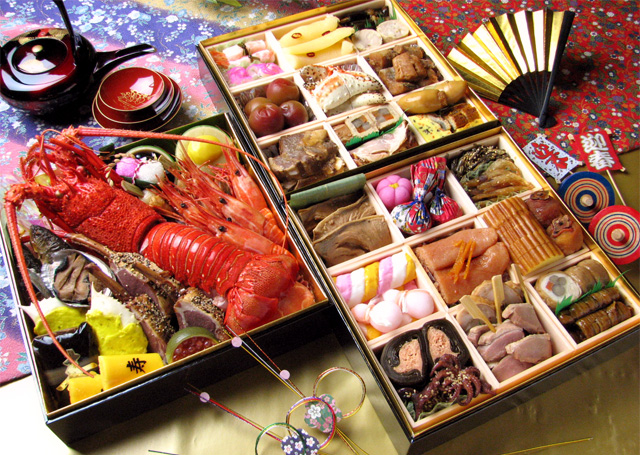
On New Year's Eve, people go and eat a soba noodles. This tradition is called toshikoshi soba (年越しそば). Although there are many different ways to eat soba, we ate it with tempura. I also ate a lot of what are called osechi-ryouri (御節料理). This is traditional New Year's food. You eat pretty much all day New Year's Day, and then you continue to eat the leftovers for another day or two.

There are a variety of osechi-ryouri. I've listed a few below that seem to be the most common.

  • ozouni - Hot soup with mochi inside. You have to eat it quickly in small bites or it hardens and you can't swallow
  • kuro-mame - Literally, black beans. These are quite sweet
  • kuri-kinton - Sweet chestnuts. These are yellow and have a sweet paste around them
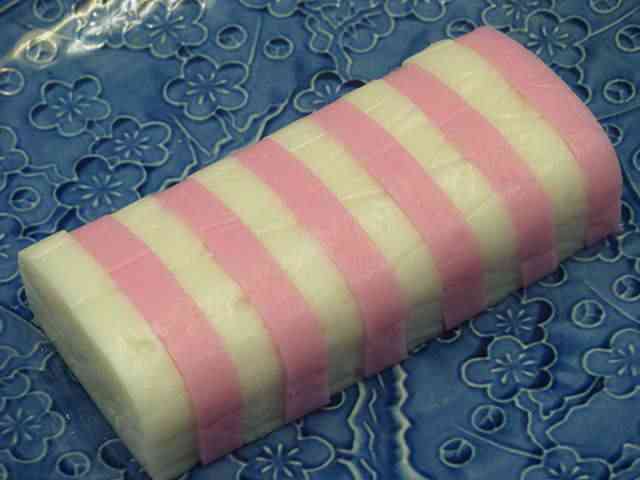
  • kamaboko - Not necessarily a new years food, but those pink fish circles
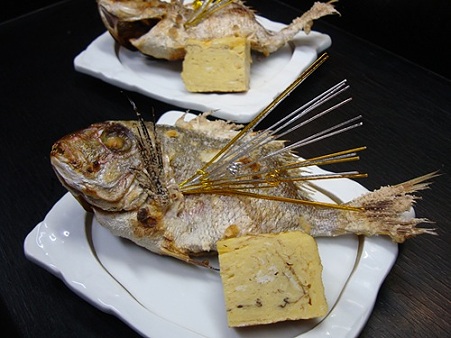
  • tai - This is snapper. It's cooked whole and is eated due to the fact that it sounds like omedetai, a word meaning Congratulations
  • ebi - Shrimp
  • kinpira - a type of cooking style mainly used for vegetables. often sour
  • kuzonoko - herring roe, supposed to increase fertility (They're a little salty for my taste)
  • Tataki-gobou - not really sure how to describe this. It's called the great burdock root in English, but we don't really see it much in the U.S. It's a bit spicy on New Year's
  • datemaki - an egg, but it's rolled...it's hard to translate
  • konbu-maki- rolled seaweed
  • chorogi - A root that is pickled and typically dyed red for the New Year
  • konnyaku - There really isn't an English word for this one. It's called konjak, but that still won't sense to many. It's kind of squishy and doesn't have much taste on its own. It gets flavor from whatever it's cooked with.
Osechi ryouri are normally arranged in nice lacquer boxes like this or this.

Disclaimer:
None of the pictures in this post belong to me. All rights belong to their original owners.

Monday, December 17, 2012

Election

There was a general election held yesterday. The elections are held on a weekend so that everyone has the chance to vote without missing work or school. People are eligible to vote at 20 years of age here. There are 3 elections held at a time.

The current ruling party called the Democratic Party of Japan (DPJ), or 民主党 in Japanese, was defeated by the Liberal Democratic Party of Japan (LDP) - or 自民党. The LDP has basically ruled Japan since 1955 except for the past three year period. The names are fairly close in English, which makes distinction between them difficult. The DPJ is more liberal; the LDP is more conservative.

The head of the DPJ - at least for now, is Prime Minister Noda, though he will likely step down after the results of this election. The LDP is headed by Shinzou Abe. Abe favors the continued use of nuclear energy, and has been vocal in his support of the Senkaku Islands. He has proposed changing the Japanese Constitution to allow for Japan to develop both a military and nuclear weapons.

Does his party's election really mean that people support Abe though? This is up for some debate. Japanese politics is largely dysfunctional. Leaders change every couple years, sometimes more often than that. There is largely the feeling that one's vote does not count, and the politicians are all so hopeless that people do not want to vote at all.

For example, the candidates will neglect to wear suits, their comments will be completely off-the-wall, and voters are left wondering who exactly is the so-called 'lesser evil' among their choices. Therefore, this is just my opinion but I doubt that the DPJ will go through on all of its intentions. It is well aware of the fact that it won because people dislike the LDP, not because they like the DPJ. Japan is also in a perilous state economically. It has to rely on foreign economies for imports/exports, so it cannot just completely do away with its foreign relations.

What this election means, if anything, will be seen in the coming year. Japan's leadership changes so frequently that nothing is definite yet.

Monday, December 10, 2012

Earthquake

I apologize for the late post. There was an earthquake off the coast of Japan on Friday. It was magnitude 7.3, but it was shindo (震度) 4 here in Tokyo. The earthquake occurred while I was still at work around 5:18 p.m. It was fairly strong up on the 7th floor, and it reminded many of my coworkers of the 3.11 quake. Overall, nothing fell over and we didn't suffer any damage, so no worries. The quake only caused a 1m high tsunami as well, so everything was fine. Honestly, that's more what we worry about here. Whether or not the earthquake will cause a tsunami.

The trains stopped probably for about 10 minutes, but they were running again quickly. The schedule was a bit off though. Although that sounds like something that you shouldn't worry about in the U.S., it is a big problem here. Most people do not own cars, and the majority of the population relies on the train system because it is punctual and the most efficient way to get to work. Shutting down the trains on 3.11 caused millions of people to have to walk hours home in the cold. Many people just ended up going to Red Cross shelters to spend the night until the trains could run on limited service again.

Japan normally doesn't measure its earthquakes by magnitude by the way. Although it is useful to understanding the original strength of the quake, we tend to use something called shindo (震度) here. This is literally the degree of the quake, or the quake's strength at your location. So, for example, most quakes are shindo 2 or 3 here in Tokyo if you feel them. These are barely noticeable. You might notice a piece of paper shaking slightly, or water moving, or something that hangs will swing, but unless you are really looking at something, you can ignore it with only a touch of vertigo.

Shindo 4 like the other day was what many people would consider as an earthquake. Although we were able to stand up, it was preferable to sit down. Computers would not fall off the desk unless they were close to the edge, but things would shake violently. Cabinets rattle, etc. Shindo 4 is not something you ignore. Places further up north felt shindo 5, which cause books and such to fall off shelves.

For more information about the earthquake strength system here, you can refer to the Wikipedia article here.

Of NTT

This post is about NTT, which is a telecommunications company here in Japan. When I signed up for internet, I had make a contract through NTT as well as OCN, which I believe is the service provider. Oddly enough, I get three mailings every month. Bills from both NTT Finance and NTT Communications well as information from OCN. If that sounds confusing to you, don't worry. I don't really understand it either.

The reason for this post is that when I signed up, they were running a special campaign. Sign up for internet when you buy your washer, fridge, and other appliances, and we'll dock money off both our internet service and all the appliances. I already mentioned in a previous post that I had gotten my washer, fridge, rice cooker, and hair dryer all for 30,000 yen (roughly 450 dollars under the current exchange rate). My internet bill also had all kinds of free unnecessary services, free telephone, etc. that totaled to about 2,000 yen a month. For a few months, everything was peachy. I bought good appliances for cheaply and I had cheap internet that easily rivals the US speeds. Then, the campaign ended last month. I couldn't cancel the services before the campaign ended, or I would end up paying a huge fee.

Last month, my internet/phone bill skyrocketed to 5,000 yen. This month it was 6,000 yen. Fed up with paying for services I wasn't using, I tried to cancel the services. This is easier said than done though. After wading through a dozen documents with five or six different usernames and passwords along with almost a dozen different phone numbers to call, I admitted that I had no idea what I doing. I asked Tai to call OCN for me, but he was promptly turned down. They had no idea what he was talking about, and and said to go to NTT.

Tai being considerate and having promised me that he would take care of it, tried to call NTT, but they put him on hold forever and basically he was told that he wouldn't pass the "verification test." So I called myself. The conversation went something like this:

Representative: "Hello, this is NTT Financial Services. My name is X. How can I help you?"
Me: "Yes, hello. This is my account information. I want to cancel some services that I'm no longer using. Can you help me with that?"
Representative: "Of course. First, we'll have to verify your identity."

This was the part I was worried about. Verifying your identity in Japan is kind of like nailing jello to a tree. Unless you have the exact information that they want, you will never ever pass. This is because they give you like hundreds of pieces of paper with different usernames and passwords. You also have to sign everything with your personal seal. If you don't have the seal, they'll just send you away until you find it. This is a major problem for people that have many seals. So, here I am all worried, and what do they ask for? My customer ID number, my phone number, my address, and then, my personal favorite: "Are you the person who owns this account?" I answered yes, and that was it. My account verification was me saying, "Yes, I am Michelle." Only in Japan is that considered an acceptable form of verification.

We continued to the reason for my call, which was canceling the services. Before I cancelled the services, I asked her to explain each one. This took about 5 minutes. Then, I cancelled the ones I didn't want. Easy-peasy. Before I could get too confident though, she asked one final question.

Representative: "It says here that you have a couple of boxes for the internet and phone."
Me: "I have one box for the internet, yes. I do not have a box for the phone. Is there something you need?"
Representative: "No, you definitely have two boxes. We need you to return the phone box for us."

Now, that's odd. I know I only have one box. And I told her so. Over and over and over again. This took roughly 20 minutes. She said, "Maybe you have a box in your genkan (entry way)?" No, no box. "Maybe it's under your bed?" No, no box. I only have one box. "Maybe it's somewhere that you've never seen before?" My apartment is not large. I only have one box. "If you could just go and look at the boxes' numbers for me, I could look them up?" Unfortunately, I couldn't fulfill her request because 1. I only had one box. And 2. I was at work.

She thought about this for quite a while, and then, you would think this wouldn't be a problem since we were talking in Japanese and I said the same exact thing in many different ways, but it took roughly 20 minutes for her to have a "a-ha" moment.

Representative: "You only have one box."
Me: "Yes, that's what I've been saying. I only have one box."
Representative: "Then that means you must have box where both things are in one box!"

Perhaps this service is new. I'm not sure. But it was the correct conclusion. She notified me that I would have to return that box. The fact that she shut the service off for the internet wasn't enough. They needed to send me an all new modem to replace my current one. After realizing at this point that logic was pretty futile, I agreed and asked when I had to be at my apartment for the maintenance person to come by. "Oh, oh, that's not necessary," she assured me. "We can just send you the new box by mail, and you can send your current box back to us by mail."

Now, that's all well and good, and it's actually pretty convenient. However, there was one little issue. The last time I got a modem from NTT, the guy saw my Mac, and his eyes went huge. Surprise. He didn't know how to work a Mac. But that wasn't a problem, he assured me. "You have the CD?" he asked in his gruff voice. I did. "Use the CD." He said.

I know this will really surprise you, but that CD didn't work. Macs can read NTT's CDs. They show up in little Wingdings - boxes, exclamation points, hearts, clovers, etc. No words. The reason for this, is that Macs are supposed to be able to hook up automatically, but mine doesn't. I have no idea why. So, I set myself up with a PPoE server because that's the only way I could get it to connect. Whether or not this is correct, I have no idea.

This time, I didn't want to relive that moment, so I asked the representative if she could send a representative this time to set it up. In front of me. Using my Mac. "I'd love to-" she wheedled, "But you just cancelled the Remote Support Service. If you want to keep it on for another month-."

"If I don't cancel the service, someone from your company will come set it up for me?" I clarified.

"No, we don't do that."

"Then what is the Remote Support Service?" I asked again.

"Well, you can call us..." she continued.

"Can't I just call you without the Remote Support Service?"

"Yes," she agreed.

"Then cancel it." Why I would keep a service that I can get for free, when they do not even come to my apartment, I don't know. So I cancelled it. And I got my box, and it was also a bear to set up. I set it up with PPoE again. It's a mystery. But it works. In short, NTT is probably the most unhelpful company ever.

Thursday, December 6, 2012

Of NHK

So over the past couple months, I've been visited been NHK three times. NHK is the Japanese national broadcasting company. It's a public company, and they easily have the pushiest staff I've ever met in Japan. A typical visit from NHK begins with the sound of your doorbell. Pin-pon. Thinking that it could be anyone, you pick up the intercom. You're already doomed.

At first, the NHK people seem really nice. "I'm from NHK," they explain. "I've come to talk about the broadcasting fee and your contract." I thought that was awful curious because I have no TV. When I explained that this, the staff was literally dumbfounded. "How can you have no TV? You must have a TV." I told him I have no TV, and that I do not have time to watch TV. Although doubtful, he left me alone.

I received another visit about two weeks later. The fact that it's always a different person makes NHK difficult to deal with. This person was just as pushy, insisting that I was required to pay by law. When I asked him how I could pay for something that I cannot receive, he became confused. I explained to him that I told his coworker two weeks ago that I did not have a TV. He took about 10 minutes to explain that I must immediately pay him once I get a TV.

So, what's with this? This is a public television company, but acts like a scamming company. The reason for this, is that from what I understand, NHK cannot turn off its services. Anyone can receive NHK as long as they have a TV equipped to receive broadcast services. Due to recent scandals, some people have refused to pay, which has resulted in some lawsuits forcing them to pay for the services that they receive. Regardless of whether or not they watch NHK has no bearing on the payment. You have a TV; you can receive NHK. Therefore, you must pay for NHK.

Honestly, it seems like a rather ridiculous system. They company should have a way of turning off its services to those who do not watch to watch. Since the government has a strong influence over the company though, this isn't possible.

Why is NHK important, you might ask. NHK has no commercials, and it is a frequent source of the news. During 3/11, I watched NHK in my dorm in Kyoto. NHK broadcasted in Japanese, English, and I think Mandarin as well.  It provided the most up to date news, which is why people watched it.

For those reading this blog who live in Japan, there is no way to avoid paying the fee unless you do not own a TV. Even then, you will have to convince NHK of this, which from my own experience so far has been pretty futile. I'll just continue to tell a new person every week that I don't have a TV.

Tuesday, November 27, 2012

The Politeness Factor

It's been over a month since I last posted on the blog, and for that, I'm sorry. Although I realize that any sort of writing is better than no writing at all, I couldn't find an interesting topic to write about. I'll try to keep up with the blog better for now on.

I often thought about it before I came to Japan, but I didn't think about writing about what I would term the 'Politeness Factor' until a letter from a certain family member  came yesterday.

When I started studying Japanese, I noticed just how awkward the language sounded when it was translated to English. There's "honorable" this and "humble" that. There seems to be no end to the act of raising your partner's status while engaging in self-deprecation on your own side. And therein lies the question, "Does Japanese really sound like that? Does it always sound like you're speaking in what English would consider the 15th century, when you're calling people 'Lord' this and "honorable' that?" And the answer is No, it doesn't, if I'm forced to choose. Much of the language is based on set phrases, just as we have in English.

For example, when you meet someone, or when you are asking for something, you say the phrase "Yoroshiku onegai itashimasu." Although there is truly no equivalent phrase in English, it translates roughly as "Please take care of me" and "Please do this for me." This is merely a superficial translation, but it would be the same in English as saying "Nice to meet you." We don't really think about the meaning of "Nice to meet you" when we say it. Not saying it is rude. The same applies to Japanese.

Let's take another phrase, "Osewa ni natte orimasu" is said when you answer the phone or when someone has done something for your benefit. Failing to this phrase is also rude. Although the original meaning has been lost in some ways, it is still necessary to say it.

"That's fair, but it doesn't cover the need to change your words when you speak to someone higher or lower to you. And what's with all the 'sama' this and that?" you might ask. And that's where the Politeness Factor gets a bit more convoluted.

Let's take one word 'to go' (in Japanese, this is pronounced iku). What a simple word. How can this become difficult? And the answer is, very easily. Let's say I'm speaking with a friend, and I want to say that I'm going to the convenience store. I would use the simplest form of the verb and just say, "Konbini wo iku." But what if I'm speaking to someone a little older than me, or someone that I'm not as close to like his parents. Then, I would say "Konbini wo Ikimasu." These both mean the exactly the same thing, and up this point, Japanese is easy. However, let's say I'm speaking to my boss, or a customer, or someone that I perceive as high status, such as a doctor or the President. In this case, I want to be a bit more polite. To do this, I change the verb to mairimasu. It still means go, but it's a bit more academic and much more humble. Our new sentence is "Konbini wo mairimasu." All of this gets thrown out the window when you start talking about the other person. Then you need one more verb, and this one is to elevate their status. If the doctor is going to the convenience store, then I'll say Konbini wo irasshaimasu. This is where Japanese gets difficult. All of these sentences mean that I (in the first 3) or the doctor (in the last sentence) are going to the store, but the level of politeness differs.

The question is, "Why is it necessary?" Parents have to teach their kids this sort of language. Its full of irregulars, and they cannot pick it up on their own. They normally teach the kids right before they enter the workforce, so in your early 20s, you learn how to sound polite. If it's so difficult, wouldn't it be easier to just eliminate it? Unfortunately, this is not possible. Although dislikes learning it, it's seen as necessary. It's the difference between saying "Buh-bye" and "Have a good day" to a customer on the phone.

The simplest explanation I can give is that all of this depends on the Politeness Factor. If you are talking with someone you do not know, or someone that you perceive as high status, you want to show your respect for them. You speak differently to your family than to a business partner, and the same is true here. It is better to err on the side of politeness than to speak too casually to someone. The same applies in English. These senior-subordinate relationships are much less strict in the U.S., but that doesn't mean that we ignore them. You don't say 'Hey' to your boss; you say 'Hello.'

If you don't know how high of a status someone is - and by the way, you cannot ask what someone does in their job here because income is directly related to job status. It would effectively be like asking how much money someone makes - then, you have to speak politely. Being too polite is rude, but speaking politely is always appreciated no matter the culture. This is what I mean by the Politeness Factor. So, is it difficult to learn? Without a doubt. But is it necessary? Yes. Absolutely.

Tuesday, October 9, 2012

Of a Lack of Dryers

So I was thinking the other day about my first impressions when I came to Japan. Sometimes I forget what things used to be like, where everything new and exciting. It was really more of an adventure at first. Now, I've gotten used to my life here. And I still try new things, but it's more of the way that you try to do things in a city that you've lived in for a while. Anyway, back to the point, I was hanging up my laundry to dry yesterday when a memory came back to me.

I remember when I first came to Japan, I wasn't able to tell wealthy neighborhoods from poorer neighborhoods. Common signs in the States of wealth really don't apply here. For example, dryers are not common in Japan. I've seen them at coin laundries, but never in a home. Most people just hang their clothes to dry up on a pole outside, even in winter.

In the US, if you look up and see row and upon row of apartment buildings and houses with clothes hanging outside, you would normally assume that the area is not wealthy. But it's normal for here. Japanese homes just don't have the space for a dryer. There's also the belief that dryers shrink your clothes. Since the Japanese tend to buy very fitting clothes, they do not want to shrink them.

So the question is how do you tell so-called "wealthy" neighborhoods from their more humble counterparts? The answer to this is the types of stores, building materials, and city layout. Stores do not have to be super "chic" per say, but they do have to sell quality goods. Western stores like Zara, Banana Republic, Chanel tend to be in better areas. This is due to the fact that they have to make a profit due to the high import duties on their products, so they tend to go places like Ginza and Roppongi. However, if you go to Kyoto, the Gion district is one of the most expensive in Japan. The district is old and does not host any "fashionable" stores. Rather, it sells some of the highest quality teas in the country. It prides itself on its traditional roots, and people will pay for the experience.

The second method is by looking at the building materials. Most buildings are now built with flexible steel and other earthquake-proof materials. However, there are still a few traditional wooden houses. These traditional areas are highly prized because they have survived the bombings and previous fires. The techniques to make them have also be lost in the generations. If we look at more modern architecture, buildings with large windows and an open layout are more prized. Rent is expensive here, so if you find large buildings, you know that you're in a nice neighborhood. Family homes that have a car are also a sign of a very well-to-do neighborhood.

Finally, the last thing to consider is the city layout itself. Greenery is a very good sign of the economic health of the neighborhood. Along the train tracks in Kyoto, the neighbors work together to maintain the flowers for their block. Arashiyama is the former entertainment region for the old nobility. It has a large lake and it is surrounded by mountains. In Tokyo, areas like Sangenjaya and Daikanyama are considered upper-class. These areas have widespread green spaces and are well-kept. They are also located in the center of the city near train stations.

All in all, there are many signs of wealth in Japan. You only have to get used to looking to notice them. Although there are far more that I haven't named, it is because in some ways it's difficult to put a finger on it. Over time, you just learn. The important thing to realize is that wealth is not an indication of whether the neighborhood is safe or not. Since you don't find gated communities or the like here, people can walk anywhere. As long as you act normally, the majority of Japan is safe.

Tuesday, October 2, 2012

Typhoon

We had a pretty strong typhoon here over the weekend. It caused the most damage in Okinawa, where 250 mph winds tossed cars around like they were toys. The majority of houses lost power on the island, and there's definitely some cleaning up to do.

When the typhoon reached Tokyo, it was still fairly strong. Wind gusts were up to 75 mph, though they tended to hang around 30-40 mph on average. I stayed inside during the day when it was still sunny to study. At night, I headed over to the movie theater to watch Snow White and the Huntsman with Tai. The movie is pretty actually; I recommend it.

Due to the wind though, the second movie wasn't showing. So we headed back, and ate udon for a while at a restaurant. The entire time we ate, the windows howled outside. The doors and windows rattled, and rain came down in droves. I waited for a break and managed to get back to my apartment just as the winds kicked up again.

By Monday, everything was clear, but there was trash everywhere. Signs and boxes had been thrown around all over the streets. Tokyo is pretty good about getting everything cleaned up. By today (Tuesday), you couldn't even notice that there was the largest typhoon that Tokyo has felt in a long time.

This morning a fairly large earthquake struck off the coast as well, registering in at a 6.2. I woke up to it actually, but it was only a 3 in Tokyo by that point. There was another smaller earthquake later in the day. Overall, Japan is having some strange weather.

Two weeks ago, we were still 80 degrees and sunny. Then it rained for two straight weeks and dropped down into the 60s. The day after the typhoon the weather is always hot and sunny, so that's good. I just wish it would last a little bit longer.

Sunday, September 23, 2012

Rainy Update

It's been a little while since I last updated the blog, but I certainly didn't forget about it. I got busy with some things for work, and the blog was truthfully lower on the priority list. Tokyo has been under a rainy spell lately. No bad earthquakes (knock on wood), but quite a few instances of guerilla rain. This is fairly unusual for the region. Tokyo does get rain, but it tends to be the kind that drenches you throughout the day sans lightning.

I've been busy trying to prepare myself for fall and eventually winter by buying some other clothing. Unfortunately, most shops are still selling summer clothes at large discounts to prepare for the next season. Although I'm perfectly capable of shopping in department stores, the clothing is often marked up exceptionally high, and I'm trying to be a little prudent with my funds at the moment.

I received a really fantastic gift the other day from Tai's grandmother. She bought me a laundry rack. I'll be able to keep it outside normally, but I can move it inside if I want to be able to dry clothes when it's raining or cold. It's definitely exciting though. Now, the only thing I really need to buy for my apartment is a comforter for the winter. I'll get to that once it gets a little colder since they aren't being sold yet.

Japanese class is going well, but I need to study more. I'm thinking that I'll try to get a little more studying done before I slip into another lazy afternoon nap. I'm off to go be a little productive. Take care!

Tuesday, September 11, 2012

Of a Delicious BBQ

I went on a little trip with my coworkers on Sunday up to a place called Katsuura in Chiba prefecture for a BBQ. The trip overall was a lot of fun, and I was finally able to see some green again. No matter how much I like Tokyo for its convenience and variety of things to do, I'm still from a country with wide green fields and beautiful tree-topped mountains. Katsuura was really beautiful though, and I was finally able to spend some time near the ocean. The water was a beautiful blue, and the weather was perfect for a cook-out.


I was also able to meet some really wonderful people while I ate some fantastic food. Although I won't load pictures of people up for privacy reasons, I can share what we ate. The culinary adventure began with some Japanese lobster (伊勢エビ). They were live and freshly caught. Interestingly enough, the Japanese lobster does not have giant pinchers, so you're free to pick them up without worrying too much about getting hurt. We ate them raw first, and they were surprisingly sweet. I didn't know you could have lobster sashimi, but it was fantastic. After that, we cooked them and ate them properly.


After the lobster, we started eating some type of shellfish called sazae in Japanese. I honestly don't want to call these in English. Wikipedia suggests Turbo cornutus but I find it hard to believe we don't have more generic name for this animal. Basically, it's a type of sea snail though. We cooked it with salt and soy sauce, so it had a hard coating on the top of it. It was good, but not my favorite. We also ate ikayaki (grilled squid) and the most delicious of them all awabi, or abalone. I feel like I had eaten abalone once before, but it definitely didn't taste like this. Since it was freshly caught, the taste was phenomenal. I was told that the reason may be because there are two types of abalone: red and black. Honestly, I just think it was because abalone is extremely expensive, so I haven't really grown accustomed to it. 

The other things in the picture below are pumpkin (kabocha), eggplant (nasu), beef, and ham.


And last, but definitely not least, we ate something I had never tried before. We encased a large type of tai (or sea bream) though it may have been ishidai (striped beakfish) in a mixture of salt and egg whites and put it on the grill. The salt formed a protective shell around the fish, which we had to break later. This type of cooking is called shiogawa, or salt pan grilling. I was assured that I was not the only one who had seen this for the first time. It ended up tasting like it had been steamed, and all of the flavor was locked in since the juices started oozing out later. It really didn't taste salty at all.


Overall, it was a really wonderful event, and I'm glad I got the chance to meet some new people and to spend some time with my coworkers outside of work. I'm off to study and sleep.

Saturday, September 1, 2012

Territory Dispute - China

As you all may well know by this point, Japan has been involved with some territorial disputes over the past century. Although these are nothing new to the region, the situation has escalated recently. It all boils down to Japan's imperial times when it wanted to claim land to expand its national resources. Japan is in the precarious position where the only resource it has is fish, and even that is iffy with the recent overfishing and the 3.11 disaster.

Two different situations are escalating at the moment. The first is the issue with China. Japan claims the chain of eight islands as part of its territory. Located in what the Japanese call the Japan Sea, the islands are called the Senkaku Islands. They were found to be uninhabited and subsequently added to Okinawa prefecture in Southern Japan. In the 1970's, Japan announced that the Senkaku Islands were a prime fishing location and that they might have significant oil/gas deposits. China calls the islands the Diaoyu Islands, and insists that they have been used for centuries for fishing.

In September 2010, a Chinese fisherman tried to land on the island. He crashed into two Japanese coast guard vessels and was soon arrested. China cancelled a planned trip by 1,000 Japanese students to China in anger. Japan eventually released the fisherman and his crew, but insisted they not try to land on the islands again.

On August 15, 2012, the situation has escalated further. 14 people from Hong Kong sailed to one of the Senkaku islands and tried to land on it. 7 people managed to get to land. The Japanese Coast Guard released their video of the event. It shows a Coast Guard vessel firing water cannons and Hong Kong activists throwing bricks.

Chinese media has been very critical of the event and has asserted that the Japanese law is "worthless" and not meant to be followed since the lands are claimed by China. There are talks of boycotting Japanese products in China, though whether this will be successful, no one knows. Chinese activists have reportedly burned cars in protest. Another man stole the Hinomaru flag off of the Japanese ambassador's car after two vehicles boxed him in. The Chinese government has denounced the way which the Coast Guard handled the issue. It is also trying to reign in its own citizens before they further complicate the issue.

In contrast, Japanese activists have traveled to the islands to raise the Hinomaru flag on the island to reassert Japanese sovereignty over the land. Activists are stationed on top of a large van in Shibuya, shouting nationalist slogans that the islands belong to Japan and that people should stand up for the territory.

The Tokyo Metropolitan Government has tried to do a survey of the Senkaku Islands, but this proposal was rejected. Instead, the government has offered to buy three of the islands for 2 billion yen from the Kurihara family, who owns the property.

Sources:
"China-Japan Islands Row" (BBC)
"Ishihara's Senkaku survey Request gets thumbs down" (Japan Times)
"Japan Coast Guard releases footage of Senkaku clash with Chinese activists" (Japan Times)
"Chinese media hail activists" (Yomiuri Shinbun)

Monday, August 27, 2012

Of TEPCO's Rates

I received a really disturbing pamphlet the other day from the Tokyo Electric Power Company, or TEPCO for short. As we are all aware by this point, TEPCO is responsible for the Fukushima Daiichi Reactor crisis. Thanks to TEPCO, there are now huge swaths of land in the northern part of Japan that are unusable and will remain so for many decades to come. Most of this land was used as farmland, so Japan's rice and other crops have been severely affected. Although we often hear that the the fish is safe to eat, and not to worry about our food source because the government will prevent tainted products from entering the chain, there is still cause for concern. The government admitted that they found fish containing several hundred times the legal limit off the coast of Japan the other day. Farmers are still forced to dispose of anything that exceeds the legal radiation limit (i.e. beef and milk). Therefore, when I received this little pamphlet the other day, I'll admit I felt feelings of remorse over the crisis yet again and more than a tinge of anger.


For those of you that don't read Japanese, let me briefly summarize what this letter says. 
Information About Your Rising Electric Bill: Thank you for using our company's service. It's been over a year since the Fukushima Daiichi Nuclear Reactor crisis, and we apologize for troubling everyone. However, in order to clean up the radiation, we will be raising the bill for households by 8.46%. This will take effect immediately from September 1, 2012. We apologize for asking you to help us share the burden. TEPCO is under new management. The government has given permission for this fee to be enacted.

Now, there are a few reasons why this letter raises some concerns. Although households in Japan have known for some time that rates are going to be raised, the process by which TEPCO is going forward with this is unacceptable. Households obviously objected to the rise because TEPCO destroyed the northern part of Japan, and quite frankly, people here would rather they go under trying to fix things. The idea of "sharing the burden" was not left up to consumers, who already have donated massive amounts to the area to help in the rebuilding process. However, TEPCO going under is really not an option; they have been taken over by the government because TEPCO going bankrupt could lead to mass power outages in the Tokyo area. The government already forced TEPCO to diminish its workers' salaries by 30 percent, as well as the salaries of upper management, but that alone isn't going to placate anyone.

The second concern is that TEPCO's letter is the most unapologetic letter I've ever read. It basically conveys a feeling of arrogance. "The government said we can raise rates by this amount, so we will." There is clear lack of responsibility in the accident. If TEPCO truly wants its consumers to respect it again, it"s going to have to do more. We know that this "fee for radiation cleanup" is really a permanent fee that will eventually go to TEPCO's profits. TEPCO's employees are working long hours to try to fix the mess, and honestly, I respect the average worker there. But the upper tiers of management are a mess.

The final thing is that this only emphasizes TEPCO's high-and-mighty attitude. TEPCO has maintained this attitude of victimization the entire time. They were forced to release video about the accident, but they have conveniently "lost" the sound. They claimed there was no sound to begin with, but this is obviously untrue because parts of the video do have sound. This has protected from further government penalties. Knowing this, consumers have gotten so irritated with the company, if there was a way to switch to another electric provider, we would.

The fee only further penalizes people who have been so kind in their donations and volunteer time. Although we will all the pay the fee (businesses will pay a higher fee up to 15%), we certainly do not agree with the company policy itself. Although this often lies unspoken in the hearts and minds of many people here, I felt it was at least important to document it as we wait for further TEPCO nonsense.


Sunday, August 12, 2012

Summer Vacation

The concept of summer vacation is not a new one for the United States. It is normally associated with school children finishing their classes for the year and spending a month or two playing in the sun at the pool with friends. There is also the occasional family vacation, something that every kid looks forward to.

In Japan, summer vacation is not limited to students. Companies also engage in the mandatory practice. The time is normally set automatically. Everyone in the company takes a certain time off to go spend time with family. This leads to lots of closed restaurants at this time of year. Normally a skeleton staff will remain to answer phone calls and assist customers. In smaller companies, people will choose their dates and take off accordingly.

Companies normally try to give off during the week of the Obon Festival. This festival is for visiting the family grave. Although it varies slightly by region, it normally occurs in August.

This idea of paid time off is done for a couple reasons. First, it`s mandatory by law. This is to prevent the overworking of employees. Second, it gives everyone some spare time off to take a vacation and relax during the summer heat. Overall, it`s a pretty nice perk.

Saturday, August 4, 2012

Current Nuclear Situation

It`s been a while since I`ve written anything that relates to the 3.11 earthquake but I felt like now is a good time. I`m currently stuck inside with a mild case of bronchitis, so this will at least give me something to do.
What`s the current nuclear situation?
There is considerable and understandable resistance to further nuclear power in Japan. Despite this, the Oi reactors have  achieved criticality and are back online. The government is pushing for the restart of further reactors. The reason for this is that without these reactors, Japan would have a severe power shortage. This would lead to unexpected blackouts as Japan nears its hottest days of the year. With a large elderly population, this can`t be allowed to happen or there will be high losses due to heatstroke in homes.
What area has the most severe power shortage?
Right now, that is the Kansai area (Osaka, Kyoto, etc.) Thanks to the Oi reactors, the threat of widespread blackouts has decreased, but people are still being asked to decrease about 10-15% of energy consumption. Tokyo is relatively okay, but companies have become warmer to around 28 degrees Celsius. That`s about 82 degrees Fahrenheit. Plants are still shutting down to conserve energy on days. You`ll see signs everywhere in Japan for energy conservation (setsuden). The lights have been dimmed and certain gates may be closed.
What happened to TEPCO, the company that caused it all?
TEPCO has had most of its shares bought by the government. That means that it is now a government-controlled entity. Although the idea of letting TEPCO fail was tempting, and many people supported the idea, it was not seen as feasible. It could have seriously reduced power to many homes, so the government took over. Nevertheless, TEPCO is now embroiled an a controversial deal to raise rates on all of its consumers to fund reconstruction efforts and recoup losses. It tried to raise rates to 15% for consumers, and I want to say 30% for businesses, but the government said the increase in consumer rates was not permissible. TEPCO has been ordered to cut pay for all of its workers by 30%. It has been approved to raise rates on consumers by 8.47%. It will take effect this month I believe.
How are reconstruction efforts going? 
Reconstruction is going well. Businesses are reopening and allowing tourists to come in. There are still many people living in temporary housing though, and people in the worst hit areas may not be able to return home for another decade or more. People still think about the affected areas and donate money though the donations have slowed as time has passed.
What about the Olympics?
 The Japanese Olympic team has dedicated their performances to the disaster-hit region in an effort to show that Japan can rise from such a terrible tradegy back to the world stage. Around 10 percent of the athletes are from or related to the area through education, etc. I know of at least one story where an athlete was training in the area when the tsunami hit. People are very supportive of the Olympics so far.

Monday, July 30, 2012

Of a Luxury

I bought myself a luxury this past weekend: a bed. An honest-to-goodness bed. It's great to have a bed for more reasons than I can count, but what's so great about my bed is that it's here in my room where I can sleep on it.

It's nothing fancy mind you, but I love it purely for its simplicity. It looks like this by the way. One of the wonderful things about this bed frame is that there's a ton of storage. If you scroll down that page a bit and look at all the possible pictures, I think you'll be impressed. There are two large 32 cm tall drawers that pull out. These can hold all sorts of cool things, like clothing, or books.

On the opposite side are these removable planks from the top. I have to take off the mattress to get to it, but this is for that stuff you almost never use. Like suitcases. Or the large winter cover on the bed once I buy one.

I have to say the favorite thing about my bed though is that I get to sleep on a mattress. You don't realize how much of a luxury a mattress is until you don't have one. Granted, I borrowed a futon, so I wasn't sleeping directly on the floor. I was really grateful for that futon, but Japanese style and American style futons are completely different. American style futons are couches that can pull out to be beds. They're cheaper than a standard couch, but they offer (mainly-college students) versatility. A Japanese style futon is like a roll-out mattress. It looks like this. They're normally about an inch thick, and it's just enough so that you aren't sleeping on the floor.

Thus, the reason that I'm happy about this bed of mine. I even bought a mattress sheet and a pillow case. I don't have a normal sheet yet (those things are unnaturally hard to find). So, I'm just using my Miami blanket until I find something better. Once it gets better, I'll buy myself what is also called a futon, but is a comforter in English.

I'm going to go sleep in this great bed!

Thursday, July 26, 2012

Of the Humble Rice Cooker

My humble rice cooker has already proved useful. If not for it, I really don't know what I'd do. Although it is possible and fairly simple to cook rice in a pot, it tastes better from a rice cooker. The sheer importance in Japan makes it necessary some money on your rice cooker. 

This value placed on rice is due to history. In the past, rice was a prized commodity. When the shogun, or traveling bands of samurai took over a town, they would claim the rice from the locals. The amount and quality of your rice was a sign of your wealth. During the famines, people would often eat only a couple grains of rice as a meal. Since food was so scarce, every grain was prized. This tradition continues today in the Japanese language. The word for cooked rice and meal is the same, gohan (御飯). In a rice bowl, every grain must be finished. No matter how difficult it is to get out. 

Today, there a few varieties of rice. The first is the standard unwashed rice. This rice is still covered in starch and needs to be washed before it can be eaten. The second type is pre-washed rice, or musenmai (無洗米). It's not necessary to wash this rice, but you can still do so to get rid of any remaining starch. Musenmai is normally slightly more expensive due to its convenience. There is also mochi. Mochi is a type of sticky, soft rice. It is smaller and is formed into the numerous sweets that are so popular here. Although brown rice exists here, white rice is more popular. It's believed that it tastes better, and to be honest, I think it's perceived as clean and appealing to the eye.

Rice is normally served plain in a small rice bowl, or chawan (茶碗). The chawan is valued for both its beauty and its simplicity. Mine is pictured below. Although you will at times see sesame seeds and some dry flavoring on top called furikake, it's not common to add sauce since this "dirties" the rice. It's considered fairly childish.


This brings us to the actual topic of this post, which is the rice cooker. Rice cookers have become popular in recent years as people have become busier. There is now a decent portion of the population that cannot cook rice in a pot. The rice cooker, or suihanki (炊飯器) has really perfected the rice-making process.

You note that mine is currently open since I'm letting it dry. Of course there are things to consider such as size, but there are a couple aspects to a rice cooker that are important. The first is the pot or nabe. The pot should be somewhat thick and made of metal. This prevents the rice from burning, or the pot from melting. If you want your rice to be moist and fluffy, this is an important aspect. The second thing that's important is this little piece on top. It's removable. The steam rises up through this lid. If you leave it in the cooker, the rubber will be moldy and the metal will rust. Japan is just an exceptionally humid country. Therefore, if you remove it and wash it every time, your rice cooker will last you decades.


The next part that I wanted to cover is the degree of customization. There's a standard setting, a quick-cook, a musenmai setting, options for brown rice and barley/wheat and mochi, as well as setting like okayu. Okayu is rice porridge, it's normally eaten when you feel ill. You can also set the rice cooker to start at a certain time or to delay it if you're ready to eat yet.

The simplest way to cook delicious rice is to wash it with water first. You need to get all the dirt and starch off the rice for it to be light and delicious. You should then add the water and let the rice sit in the pot for 20 minutes. This lets the rice absorb the water, so it will cook evenly and remain moist. Finally, you can start cooking the rice. When you're done, if you don't eat all of it, put it into a container or separate it into meal-size portions of plastic wrap. If you'll eat it within a day or two, it's fine to put in the fridge. Rice freezes well though, so you can put it into the freezer without any problem. Enjoy the rice!