Pages

Showing posts with label history. Show all posts

Friday, July 4, 2014

A Visit to Kichijoji

I traveled to a neighborhood called Kichijoji(吉祥寺) for the first time the other day. Kichijoji is located in Musashino, one of the suburbs of Tokyo. This is an older part of town, and it has a pretty rich history.

History


For those that have been following my blog for a while, you may recognize the ending of "-ji" there in the name. This final character is used to name temples, and Kichijoji itself roughly translates to "The Temple of Lucky/Auspicious Omens." This Buddhist temple was moved to Bunkyo on the orders of Tokugawa Ieyasu - the first shogun of the Tokugawa shogunate and the man credited with the expansion and reconstruction of much of traditional Edo (what is now Tokyo). Bunkyo is a ward within Tokyo that today holds the Tokyo Dome, the Headquarters of the Judo community, and the University of Tokyo Hongo Campus.

As was prone to happen in those days, a small town built up around the temple. It was therefore named Kichijoji-Monzenchou (吉祥寺門前町), literally "The town built around Kichijoji." Traditional city planning measures allowed homes to be built very close together. Even today, you can see older areas of the city that have only centimeters of space between the buildings. Homes and shops were made to be light in order to withstand the frequent earthquakes in the area. They were therefore built out of wood. Due to the high volume of wooden buildings in a small space, coupled with the dry summers and winters here in Tokyo, the city was very prone to large and destructive fires. The most famous of which was the Great Fire of Meireki in March 1657. This fire lasted three days, claimed the lives of over 100,000 people, and destroyed up to 70 percent of the city. By the time the fire was extinguished, the temple and its surrounding town were destroyed.

A new era of reconstruction began. The shogunate decided to repurpose the land for daimyo residences. The previous residents of Kichijoji-Mozenchou in Bunkyo were moved to the present-day Kichijoji in Musashino. Although this present-day neighborhood does not hold the Kichijoji temple, it did keep the name as a tribute to the original town.

Highlights


Inokashira Park
By far one of the most popular things in the area is Inokashira Park. This park is busiest in spring due to its large number of cherry blossom trees, but it is enjoyed year-round by Tokyo residents for its beauty and greenery.

Inokashira Park Spring, J. Peterson, Wikimedia Commons ©

Side Alleys
Called Yokochou (横町) in Japanese, these backstreets and side alleys hold a variety of small bohemian-style shops and restaurants. If you are looking for a place to relax and enjoy the traditional side of Tokyo, this is definitely it. Due to its distance from the city center, you can find things a bit cheaper here. I found a great pair of running shoes for roughly 5,000 yen. You would normally have to spend between 8,000 to 10,000 yen to find the same item in other parts of Tokyo. I even found a small shop that sold only handmade goods. There were handmade linen tablecloths, handmade wooden spoons, and handmade cups and plates.

Harmonica Alley
This is one of Kichijoji's most famous yokochou. Here you can find small bars where you can sip beer or hoppy, a favorite of older Japanese businessmen. Hoppy has a taste similar to beer, but it is made with shochu and contains about 1% alcohol. It was especially popular in the past when beer was considered too expensive for the general populace.
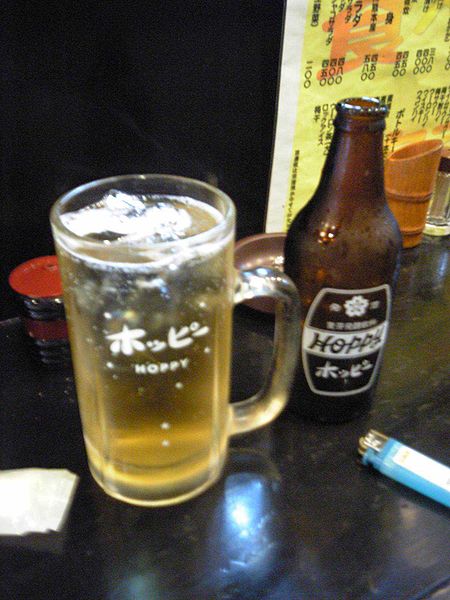
Hoppy, Hykw-a4, Wikimedia Commons ©
The air smells great here due to the wide variety of restaurants, one of which is the ever-popular yakitori (kebab) bar. I also found a small tsukemono-ya, or pickled foods shop. I was all for buying bettarazuke, which is a slightly sweet-tasting pickled daikon. It is a something Tokyo is famous for, but Tai wasn't in the mood, so I'll stop by another day. All in all, Harmonica Alley is very similar to Sangenjaya in Setagaya Ward with its high number of restaurants and local atmosphere.

Sun Road
A covered shopping arcade, this was one of my favorite spots in all of Kichijoji. It really reminded me of Kyoto's downtown covered Shijo Street near Nishiki Market. By far one of the most interesting places here is a small croquette shop called Satou Kichijoji.  If you click this video (Japanese-only), you can see the meat croquettes that have made it so popular. This shop was amazingly busy. I think we discovered it around 2:00, and there was still a line of 50 people waiting to buy meat croquettes. When we left around 7:00, the line was longer if anything. In fact, it was featured on TV the other day. Despite the shop's small size, it sells 3,000 meat croquettes a day.

The other place I really enjoyed was a traditional geta shop. Geta are the Japanese wooden clogs. This shop had ones that were handmade from bamboo and tatami. As well as ones that were wooden. They had everything from the traditional-style geta that are worn with kimono to modern-day styles that are more comfortable for every-day use. We spent a while talking to the shopkeeper about the different styles as this kind of shop fairly rare today.

Geta, Haragayato, Wikimedia Commons ©

Atré
Finally, if you're looking for something a bit more upscale, there are the department stores in the area. I'm particularly fond of Atré, because it has such a eclectic variety of goods. This one had a small chopstick shop, a variety of florists, a stationary and bag shop, among others.

Conclusion


All in all, it was a great day at Kichijoji. It was very easy to see why it is so popular among all age groups. With its easy access to Inokashira Park and its vibrant community, Kichijoji is consistently rated the number 1 place that people want to live in Tokyo. Even I felt that if I wasn't so happy living in Setagaya Ward, that I would be happy to move to Kichijoji in the future. People were very friendly and it definitely had a small-town feel, something you don't get often in urban Tokyo. I know that I'll definitely be going back to eat those delicious croquettes and maybe enjoy a drink or two in Harmonica Alley with the local residents.

Sunday, May 29, 2011

Of Typhoons

Today is day 1 of the typhoon. It's supposed to hit bad tonight, but right now it's just raining incessantly. It honestly feels like normal Kyoto weather. For any of you who haven't been to Japan, let me just tell that Kyoto is like Japan's version of Seattle. If it isn't raining, something's wrong. Honestly, I'm still wondering how Kyoto isn't a tropical rainforest yet. With regard to the weather though, there are a couple things that are different. The rain is blowing sideways. It's like when you turn on the TV, and you see the rain and you go, "Wow, I'm glad I don't live there." Oddly enough, I live here, and it isn't that bad. In fact, it's kind of fun except for the fact that you can't really go out. And if you do have to go out, it's miserable. The other thing that's different is that the river next to my room is pretty high. It's probably around a meter and half so far. I'm really thinking to go take a picture.

So, the question is, "What do you do on a typhoon day?"

For me, it's probably things that aren't that interesting. I'm sitting inside reading articles about the Meiji Era (明治時代), 1868-1912. I actually have a presentation on it this Tuesday. For those that are a little lax in their 1800's history, think post-Commodore Perry. This is the time when Japan opened up to the rest of the world. Therefore, I'm researching things like wars, the constitution, reforms, and so on. Since I don't know about every third word I read right now, it's killing my head. In the good news, I'm learning lots of new words.

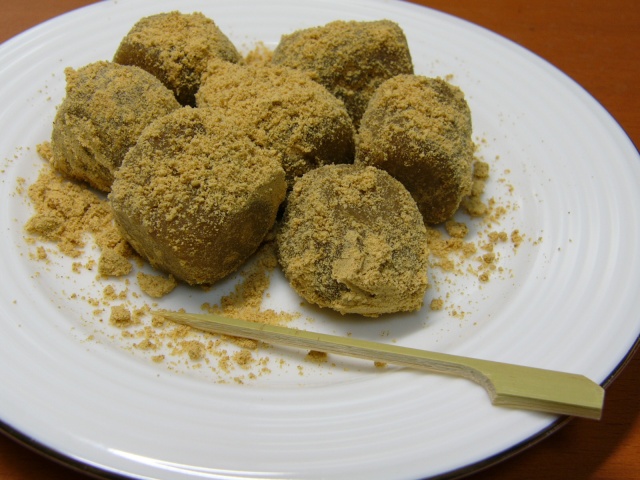
I'm eating rainy food as well. I woke up this morning and made ochazuke, making sure to put some salmon in there for personal enjoyment. And although it's not rainy food, I also ate something called warabi-mochi (わらび餅). Sometimes it's like a gelatinous-type mochi, but the one that I bought is a little different. It's actually honest to goodness mochi, filled with an (あん), or sweet red-bean paste. Normally, I don't really like an, but it's great in this. Warabi-mochi is quite popular with kinako (きなこ)powder over-top. Kinako powder is a sweet soybean flour. Wiki actually has these labeled as dango, which I guess the ones that I ate technically are, but they were still labeled warabi-mochi in the store. Unfortunately, the taste is a little difficult to explain, but you'll just have to take my word for it that they're delicious.

The typhoon is supposed to get much worse tonight at 9 and be bad through tomorrow. Of course, I have class, so I'll be going there.

Thursday, May 5, 2011

Of the Tomb of Go-Uda

Two posts today. I'm feeling generous.

I went on an adventure through Arashiyama (嵐山) the other day. Arashiyama is one of those places that you can spend hours in and still not even know everything about it. In fact, the first time I went, I ended up in touristy Arashiyama, and I wondered, "Why would anyone care for this place? It's a tourist trap." But then I began to explore more, and what I've found has actually peaked my interest.

Western Arashiyama is certainly full of tourists. There are people pulling the carts, and you can buy gifts for your friends and family that are seemingly "classical" Kyoto: Fans, sweets, etc. But if you know where to go, you can find more than that. Arashiyama has some of the best umeshu (梅酒), or plum wine in Kyoto. It also has numerous onsen, or hot springs, spread throughout the mountain. In the past, Arashiyama was a natural retreat for the esteemed and wealthy. There are old temples and shrines designated as World Heritage Sites hidden among its bamboo forests and old red-bark trees.

Eastern Arashiyama is virtually empty. Although it is still filled with the old temples and shrines, it is primarily a farming area now. The rice paddies are a verdant green, and it's not unusual to see herons and hawks diving into the lake around to catch fish.  Perhaps most interesting is when you pass these farms, and hike up into the mountain that is rather aptly named Storm Mountain. When we started our hike, we were at ground level, but as we progressed, we rapidly entered a mist just below the clouds. I separated from my friends for some pure hiking and went into the bamboo forest around us.


As time passed, I realized that I had turned onto a trail that was more for wild boar, or other game than was really meant for people. It was literally so narrow that I could barely stretch my arms out, and there were numerous instances of bamboo and such torn up. Although it was of course fun to travel down it, I was alone, and didn't feel like meeting any snakes, pigs, or bears, so I turned back in order not to worry my friends too much. We continued our hike up the mountain and eventually came out onto a clearing with to large ponds and a hinamatsuri (ひな祭り). It's far past hinamatsuri, it was in March, and to still have it set up was to say the least, a bit strange. We looked at it for a minute, and then walked past the koi ponds and further up the mountain.


There had been a small family feeding the koi, but now we were alone. Just as Mathilde had suggested before, we were standing in front of the imperial tomb of Emperor Go-Uda (後宇多天皇陵). From what I was able to gather about his history just from searching online (I haven't found anyone who knows of him yet), he was the second emperor by the name of Uda, and he was the 91st emperor of Japan. He succeeded Emperor Kameyama and preceded Emperor Fushimi. He ruled over three eras, the Bunei (文永), the Kenji (健治), and the Kouan (公安) during the 1200s. His tomb's official name is Rengebuji no misasagi (蓮華峯寺陵), meaning approximately the Lotus Flower Ridge Imperial Tomb.


It was surprising. Only here where you have such a blend of ancient and modern culture do you run into imperial tombs which are nestled among the forest. Completely quiet, you wouldn't even know it was here unless like us, you were just exploring. Even then, it'd be somewhat of a miracle to find it. And so with that, it was another treasure to add to the memories that I've made here in Kyoto.

Tuesday, May 3, 2011

Of Golden Week

It's Golden Week(ゴールデンウィーク), which means basically it's a week of holidays here in Japan. Golden Week is not so much holiday in and of itself, but rather it's known as being a period of rest. Businesses will often close during this time, and actually I think my post office is closed again. If I need to mail anything, I'll have to go to Kyoto Station (京都駅).  Back to the point, Golden Week is also called Oogon-shuukan (大金週間 literally golden week), Oogata-renkyuu (大型連休, large holiday), or just GW for short. Typically, families will make trips during this time, and it's a good time to meet up with people who are far away that you don't see very often. Actually, places like Hawaii normally boom during this week with the flood from Japanese tourists. This year, however, more people are going up to Touhoku (東北) to try to boost the economy up there.

Golden Week officially starts on April 29 and it goes till May 5. April 29 is celebrated as Shouwa Day (昭和の日), and it is meant to be a reflection on the late Emperor Hirohito's reign. May 3 is Constitution Memorial Day (憲法記念日). On this day, people are supposed to remember the 1947 Constitution of Japan. This gave Japan a parliamentary system of government, and basically created the emperor into a figurehead. This constitition is also known as the Postwar Constitution (戦後憲法) or the Peace Constitution (平和憲法), due to its Article 9 which prevents the Japanese from waging war, or in effect, having a military itself. Therefore, the Self-Defense Force is really an extension of the police force here in Japan. The article itself (taken from Wikipedia because I don't have the Japanese Constitution on hand) reads as following:
第九条 日本国民は、正義と秩序を基調とする国際平和を誠実に希求し、国権の発動たる戦争と、武力による威嚇又は武力の行使は、国際紛争を解決する手段としては、永久にこれを放棄する。
二 前項の目的を達するため、陸海空軍その他の戦力は、これを保持しない。国の交戦権は、これを認めない。 
The English translation if you're curious is here:
ARTICLE 9. Aspiring sincerely to an international peace based on justice and order, the Japanese people forever renounce war as a sovereign right of the nation and the threat or use of force as means of settling international disputes. (2) To accomplish the aim of the preceding paragraph, land, sea, and air forces, as well as other war potential, will never be maintained. The right of belligerency of the state will not be recognized. 
Green Day (みどりの日) is celebrated on May 4.  It's a day to be close to nature.

Finally, we have Children's Day (子供の日). Originally called Boy's Day (端午の節句) it's a day to celebrate children and think of their happiness.  On this day, the carp streamers (鯉幟) are risen to show the male children in the family. This is done in the hope that the boy will become a strong and healthy man. A picture is here. The black carp is the father. The pink one, I believe, is the mother. And the blue one is the boy.

For this reason, Golden Week ends up being a lot of fun. You get to hang out with people, and spend some quality time not working. It's a good change, though of course I'm still busy studying from the JLPT and trying to improve language-wise. Tai's of course still job-hunting. I'm off to Arashiyama for a few hours. Take care!

 Source:
Article 9

Tuesday, February 8, 2011

Fushimi Inari Taisha (伏見稲荷大社)

For months, I've been asking friends, boyfriend, everyone that I meet to go with me to Fushimi Inari Taisha  (伏見稲荷大社). The normal answer is something the lines of, "Michelle, it's on the edge of Kyoto. It's too far. It's a full day trip. Go another day." So for months, I've given in. But finally, with a couple month break, and nothing better to do than to spend time with friends, experience Japanese culture, and work on my language skills, I finally had the time to convince both Jazmin and Kengo to go with me the famous shrine.

For those of you that aren't familiar with the name, Fushimi Inari is a shrine devoted to the god Inari, who is the god of fertility, rice, agriculture, etc. in Shinto. The shrine itself is known for being one of the biggest in Kyoto, and definitely one of the biggest, if not the biggest, shrine to Inari in Japan. It's most famous though for the fact that it has a row of red torii gates, which lead around the mountain. These are donated by companies especially for good fortune. The whole focus on Fushimi Inari began in 965 or so in the Heian period. During this time, the Emperor Murakami decided to have all official documents reported to the gods. Fushimi Inari was of course included in the list of important shrines. Inari is also tied closely with foxes because these were believed to be Inari's messenger of choice. It has been hypothesized that this is due to the fact that during the planting and harvesting seasons, foxes would move into the farms to search for more food, etc., and this eventually came to be associated with the god Inari. Whether this is true or not is still up for debate though.

So with the history lesson over, let's move to some pictures.

We decided to walk the mountain trail, which takes about 2-3 hours, because we honestly had nothing better to do. Unfortunately for Kengo, he had run earlier in the morning, so walking up thousands of steps didn't sound like the best idea to him. Luckily though, we were able to persuade him, so we headed off up to Mount Inari.
The beginning of the walking adventure. Note how there are no steps here.
Over time, it got to be more like this, which is when we realized our mistake. We had already climbed so many steps by this point that it would been pointless to turn back. In fact, I think Kengo ran it for a while, but then he realized that it was getting steeper and the steps weren't stopping, so we waited for a bit.
At the top of the mountain. Note all the small sub-shrines surrounding the main shrine.

As we were walking back, it started to get darker. We grabbed some dinner, which was a classic kitsune-udon (きつねうどん), which is a fried tofu slice inside a bowl of udon noodles.

Overall, it was a really great day.

Michelle

Friday, January 21, 2011

Valentine's Day and White Day

I really apologize for the delay in blog updates lately. I've been swamped with exams, papers, and tests, so I haven't had the time. But I'll make it up to you in the coming months. The first semester is officially over, and I only have one more report to write. I'm doing it on Japan's problem of 高齢的 or an aging society. There's a ceremony tonight which I'll be going to to show everyone off and then we're all going to a 飲み会 (nomikai), which is really just a really big drinking party.

Since it's been so long, this post will be a light-hearted and yet cultural one. Congratulations.

It's nearing that time of year as we all know. The time when hearts pop up everywhere, things mysteriously become pink, and the stores start selling chocolate like it's going out of style. Yes, it's almost time to think about Valentine's Day. Valentine's Day is pretty much the same world round. Hang out with your special someone, give them a gift or two, and spend your time in blissful love. So I'm sure, you're asking, "Michelle, why are you writing this post?" And you know what? Hold your horses. I'm getting there.

Valentine's Day in Japan is special too, which is why this post exists. Contrary to the States, in Japan women give men chocolate and gifts. Imported around the late 1950's, there are three main types of chocolate giving.

  1. 本命チョコ (honmei-choko) - Literally "true feeling" or "genuine sentiment" chocolate, this is the chocolate you give to your loved one. This chocolate can be bought, but it's tradition to make your own. Normally this is elementary, middle, and high school children, but university students also participate. This chocolate can be anything from your standard type chocolate to things which are chocolatey like cookies, cakes, muffins, pastries, etc. Heart shapes are suggested though.
  2. 義理チョコ (giri-choko) - Called "obligation/duty" chocolate, this is the chocolate that you give to your boss, male friends, or anyone that you feel doesn't have a girlfriend and therefore deserves to get chocolate out of pity. Your goal is not to let any man feel left out. This does not need to be anything extravagant but it is required to fill the obligation.
  3. 友チョコ (tomo-choko) - This is what we call "friend" chocolate. Basically, girls are sad that they don't get any chocolate on Valentine's, so they send chocolate to each other. 

If one feels particularly close to a person, then a gift of some kind normally accompanies the chocolate. This is particularly true of 本命チョコ (honmei-choko).

Of course, except for 友チョコ (tomo-choko), women seem to be left out of this mix. But fear not, for a month later, the men return the favor. This happens on ホワイトデー (White Day), which was said to be brought to Japan by a marshmallow company, therefore giving the day it's name. Set a month after Valentine's Day, on March 14, men send women that they're interested in or by obligation a gift. However, they are not required to return a gift to all the women that sent them chocolate. If it's chocolate or sweets, the color white is preferred, though other gifts are acceptable. These gifts are either equal in value or priced slightly higher it seems.

Michelle

Saturday, December 11, 2010

Kobe Luminarie

I decided to take a little trip the other day to Kobe for a really interesting experience. Kobe is known for a variety of things: Its beautiful ocean, its beef, and most importantly as the site of the Great Hanshin Earthquake in 1995. This earthquake occurred on January 17, 1995, and although it hit the entire region, Kobe was hit the hardest. It took thousands of lives and did trillions of dollars in damage. When you visit Kobe today, you would not even think of this tragedy. It's revived into a bustling city, but the memory of it is still fresh in people's minds. So, I took a few trains with some friends for 600 yen, and we were there in and hour and half.

Every year since the Great Hanshin Earthquake, Kobe holds a festival called the 神戸ルミナリエ (Kobe Luminarie). Basically, lights are strung around the city for 2 weeks, and it's free for anyone to enter. Donation boxes throughout the area go toward not only providing the light show, but also go toward helping those in need in case of another earthquake.

You walk in through a line of lit up trees as you approach the picture below. I'll be honest. I've never seen anything like this before, and it's amazing.


Keep walking and you get to go underneath all those arches.


There are entire structures built out of lights.


Even though there were a lot of people, things moved pretty quickly. We were able to move around with no problems whatsoever, and it was amazing. We also had the best からあげ (karage) I've ever had as well as something new called ベービーカステラ (baby kasutera), which was essentially little dough balls. 

Anyway, all in all, it was a great trip, even though we were only there for a few hours. Next time, we'll go see the ocean and visit Chinatown. I already can't wait to go back. For now, here's a picture of Kobe at night.


Later!

Michelle

Tuesday, December 7, 2010

Of Burakumin

Although I had intended for this to be a happier post infused with some good old-fashioned humor, plans have changed. Instead, I'd like to cover the controversial topic of 被差別部落民, hisabetsu-burakumin. For those of you who have been to Japan, you'll know that this is more than a little difficult to find information on. In fact, the Japanese purposefully will avoid the topic unless you are very close friends. In that case, you will get an honest answer, but the topic will still be somewhat taboo. Luckily, at a university, you are able to learn about such things in class, and then you may talk to your fellow classmates on the subject. Broaching it with someone else though is definitely not recommended.

Burakumin roughly translates to "the sect(ion) of fallen people." These are descendants from Japan's feudal outcast group. Like in many traditional caste societies, the lowest group was compsed of the 穢多 (eta), or those who worked with animal carcasses. These people were therefore tanners, butchers, etc. People with severe diseases such as leprosy could also be put into this group sometimes. They were often segregated from the cities since their work was considered unclean. This therefore led to the stigma that they themselves were unclean.

Interestingly, the Buddhism perpetuated this myth. Although Buddhism normally promotes acceptance of all people, and especially encourages those to feel sympathy toward and help those of lesser status, the case was different for the burakumin. This is because Buddhism, along with Shintoism holds the belief that killing anything will cause a sort of stain. These people therefore were condemned to wander from place to place, separated from the rest of the "clean" society.

The burakumin have been discriminated against in multiple ways. Beside being forced to live in buraku settlements, they were also discriminated against when seeking employment or marriage. When applying for a job, individuals are required to submit their koseki, which in the past was a history of the family lineage, but now just includes the immediate family and the address of the household. Based on the address, employers could check to see if their potential employee was a burakumin or not. If they were, they would immediately be dropped from the prospective employees. The same could be said for marriage investigations. If the individual was found to be a burakumin, the marriage would be cancelled.

In 1871, the burakumin caste system was abolished, and the burakumin were officially freed. Since then, it has been made illegal to discriminate against someone based on whether or not their ancestors were burakumin. Still, even today it was rare for someone to admit to that past. Although things have changed much from their past, that social stigma is hard to forget, so many will keep it a secret.

Although much of the social stigma has faded, it is still an uncomfortable topic for many Japanese. Without a doubt, they have become ashamed of such past treatment. Although some discrimination does still persist among other minority groups, this is mostly hidden from daily view. Unless one is a member of that group and they are in particular parts of the country, the likelihood of encountering discrimination has faded. Of course, it would be wrong of me to say that it has vanished altogether. It is the same with my home country. It is true that things are gradually improving, but there is still a long way to go.

Michelle

Thursday, September 30, 2010

The Senkaku Islands

I know I just updated yesterday, but something has been in the news for a few days now, and I haven't reported on it, so I felt I should acknowledge it here. Some of you may have heard of the recent problems with China and Japan. If you haven't, I'll try to enlighten you here. There are a group of islands called the Senkaku Islands by Japan and the Diaoyu Islands by China. They're south of the Ryukyu Islands in Japan and located in the East China Sea. For people a little lacking in their geography, no worries, here's a map: Senkaku Islands Location.

These islands were never really a problem in the past. Japan acquired them through the treaty at the end of the First Sino-Japanese War from China. During that treaty, China handed over Taiwan and the surrounding islands to Japan. At the end of World War II though, Japan was forced to give Taiwan and other territories it had acquired from China back to China. Therefore, China claims that the islands are actually part of China.

Japan claims that they have been controlling the islands since 1895 though, and since the islands were uninhabited up until 1895, they are therefore under Japan's control. Since Japan had already made the islands into Japanese territory prior to the return of Taiwan to China, Japan argues that they were not included in the prior treaty and that they are part of China.

Taiwan also makes a claim on the islands, but for simplicity's sake, let's just stick with Japan and China for now.

So, we have China and Japan both claiming the islands. Before the 70's, there was no conflict over the Senkaku Islands. In 1969 though, it was announced that there was possibly oil on the islands, and suddenly the dispute broke out. This is also history though. The recent reason for the problem has arisen due to a recent Chinese fisherman who decided to go to the islands. Since he was in what Japan considered its waters, Japan arrested him. Before managing to arrest the fisherman though, he had run into two Japanese Coast Guard boats. The fisherman and his crew were arrested on September 7. Japan released the crew and the boat on September 13. However, Japan refused to release the fisherman.

China of course became angry and demanded the fisherman's release. Japan refused, stating that it was a domestic incident. China then took a dramatic move that no one here expected them to take. They suspended all rare earth exports to Japan indefinitely. By rare earth, we're talking precious metals here. Japan, kind of needing those, was still trying to contain the fisherman, but decided to finally release him. China resumed the exports within two days. However, relations are continuing to sour. The fisherman is being heralded as a hero in his country, and both China and Japan are standing strong.

China is demanding an apology from Japan and stating that if they receive their apology, they will ignore the entire incident. They are also asking for Japan to help pay for the damages to the fisherman's boat. Japan, on the other hand, is asking for an apology and requesting that damages be paid to the Coast Guard's boats. Japan, really wanting to expand trade in China is definitely feeling pressure, but I don't think it's likely that they will give in easily. China is trying to exert its power, so they also will not give in easily. It's really like two little kids arguing over something trivial, but at this point, nothing can be done.

I bring all of this up though because 1. This is going to mark how foreign relations proceed from this point between China and Japan. And 2. It has started to affect the student population. 1,000 Japanese students were supposed to go to China for some sort of world summit. Everything was set, and they were ready to go. This summit is in 2 weeks. About 2 days ago though, China decided to revoke all of their visas. At this point, it is not known if the students will be able to attend the summit or not.

We'll see what happens from here, but at the moment, things aren't looking good.

Michelle