Pages

Showing posts with label food. Show all posts

Friday, July 4, 2014

A Visit to Kichijoji

I traveled to a neighborhood called Kichijoji(吉祥寺) for the first time the other day. Kichijoji is located in Musashino, one of the suburbs of Tokyo. This is an older part of town, and it has a pretty rich history.

History


For those that have been following my blog for a while, you may recognize the ending of "-ji" there in the name. This final character is used to name temples, and Kichijoji itself roughly translates to "The Temple of Lucky/Auspicious Omens." This Buddhist temple was moved to Bunkyo on the orders of Tokugawa Ieyasu - the first shogun of the Tokugawa shogunate and the man credited with the expansion and reconstruction of much of traditional Edo (what is now Tokyo). Bunkyo is a ward within Tokyo that today holds the Tokyo Dome, the Headquarters of the Judo community, and the University of Tokyo Hongo Campus.

As was prone to happen in those days, a small town built up around the temple. It was therefore named Kichijoji-Monzenchou (吉祥寺門前町), literally "The town built around Kichijoji." Traditional city planning measures allowed homes to be built very close together. Even today, you can see older areas of the city that have only centimeters of space between the buildings. Homes and shops were made to be light in order to withstand the frequent earthquakes in the area. They were therefore built out of wood. Due to the high volume of wooden buildings in a small space, coupled with the dry summers and winters here in Tokyo, the city was very prone to large and destructive fires. The most famous of which was the Great Fire of Meireki in March 1657. This fire lasted three days, claimed the lives of over 100,000 people, and destroyed up to 70 percent of the city. By the time the fire was extinguished, the temple and its surrounding town were destroyed.

A new era of reconstruction began. The shogunate decided to repurpose the land for daimyo residences. The previous residents of Kichijoji-Mozenchou in Bunkyo were moved to the present-day Kichijoji in Musashino. Although this present-day neighborhood does not hold the Kichijoji temple, it did keep the name as a tribute to the original town.

Highlights


Inokashira Park
By far one of the most popular things in the area is Inokashira Park. This park is busiest in spring due to its large number of cherry blossom trees, but it is enjoyed year-round by Tokyo residents for its beauty and greenery.

Inokashira Park Spring, J. Peterson, Wikimedia Commons ©

Side Alleys
Called Yokochou (横町) in Japanese, these backstreets and side alleys hold a variety of small bohemian-style shops and restaurants. If you are looking for a place to relax and enjoy the traditional side of Tokyo, this is definitely it. Due to its distance from the city center, you can find things a bit cheaper here. I found a great pair of running shoes for roughly 5,000 yen. You would normally have to spend between 8,000 to 10,000 yen to find the same item in other parts of Tokyo. I even found a small shop that sold only handmade goods. There were handmade linen tablecloths, handmade wooden spoons, and handmade cups and plates.

Harmonica Alley
This is one of Kichijoji's most famous yokochou. Here you can find small bars where you can sip beer or hoppy, a favorite of older Japanese businessmen. Hoppy has a taste similar to beer, but it is made with shochu and contains about 1% alcohol. It was especially popular in the past when beer was considered too expensive for the general populace.
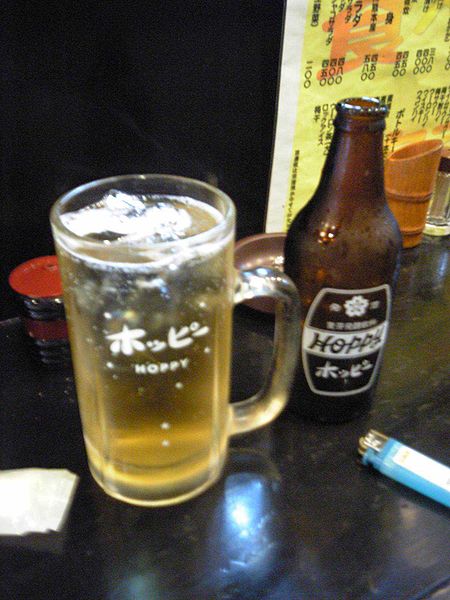
Hoppy, Hykw-a4, Wikimedia Commons ©
The air smells great here due to the wide variety of restaurants, one of which is the ever-popular yakitori (kebab) bar. I also found a small tsukemono-ya, or pickled foods shop. I was all for buying bettarazuke, which is a slightly sweet-tasting pickled daikon. It is a something Tokyo is famous for, but Tai wasn't in the mood, so I'll stop by another day. All in all, Harmonica Alley is very similar to Sangenjaya in Setagaya Ward with its high number of restaurants and local atmosphere.

Sun Road
A covered shopping arcade, this was one of my favorite spots in all of Kichijoji. It really reminded me of Kyoto's downtown covered Shijo Street near Nishiki Market. By far one of the most interesting places here is a small croquette shop called Satou Kichijoji.  If you click this video (Japanese-only), you can see the meat croquettes that have made it so popular. This shop was amazingly busy. I think we discovered it around 2:00, and there was still a line of 50 people waiting to buy meat croquettes. When we left around 7:00, the line was longer if anything. In fact, it was featured on TV the other day. Despite the shop's small size, it sells 3,000 meat croquettes a day.

The other place I really enjoyed was a traditional geta shop. Geta are the Japanese wooden clogs. This shop had ones that were handmade from bamboo and tatami. As well as ones that were wooden. They had everything from the traditional-style geta that are worn with kimono to modern-day styles that are more comfortable for every-day use. We spent a while talking to the shopkeeper about the different styles as this kind of shop fairly rare today.

Geta, Haragayato, Wikimedia Commons ©

Atré
Finally, if you're looking for something a bit more upscale, there are the department stores in the area. I'm particularly fond of Atré, because it has such a eclectic variety of goods. This one had a small chopstick shop, a variety of florists, a stationary and bag shop, among others.

Conclusion


All in all, it was a great day at Kichijoji. It was very easy to see why it is so popular among all age groups. With its easy access to Inokashira Park and its vibrant community, Kichijoji is consistently rated the number 1 place that people want to live in Tokyo. Even I felt that if I wasn't so happy living in Setagaya Ward, that I would be happy to move to Kichijoji in the future. People were very friendly and it definitely had a small-town feel, something you don't get often in urban Tokyo. I know that I'll definitely be going back to eat those delicious croquettes and maybe enjoy a drink or two in Harmonica Alley with the local residents.

Tuesday, January 8, 2013

New Year's Food

I went back to work this Monday after a nice long New Year's break. I went to a temple called Kawasaki Daishi for the annual New Year's Visit. I also went up to a place called Chichibu in the countryside to see Tai's family. It was a lot of fun, and I'm glad I had a break.

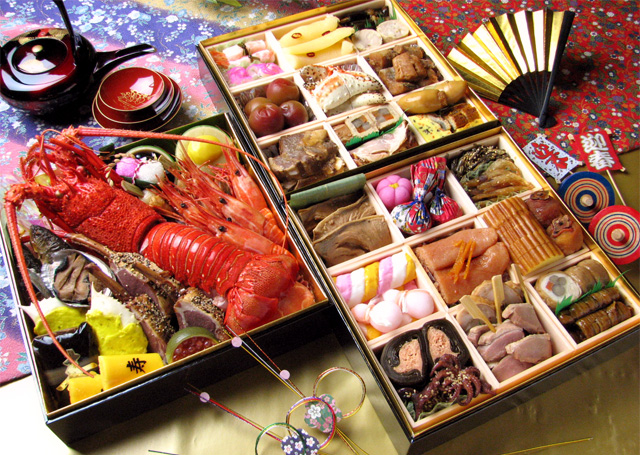
On New Year's Eve, people go and eat a soba noodles. This tradition is called toshikoshi soba (年越しそば). Although there are many different ways to eat soba, we ate it with tempura. I also ate a lot of what are called osechi-ryouri (御節料理). This is traditional New Year's food. You eat pretty much all day New Year's Day, and then you continue to eat the leftovers for another day or two.

There are a variety of osechi-ryouri. I've listed a few below that seem to be the most common.

  • ozouni - Hot soup with mochi inside. You have to eat it quickly in small bites or it hardens and you can't swallow
  • kuro-mame - Literally, black beans. These are quite sweet
  • kuri-kinton - Sweet chestnuts. These are yellow and have a sweet paste around them
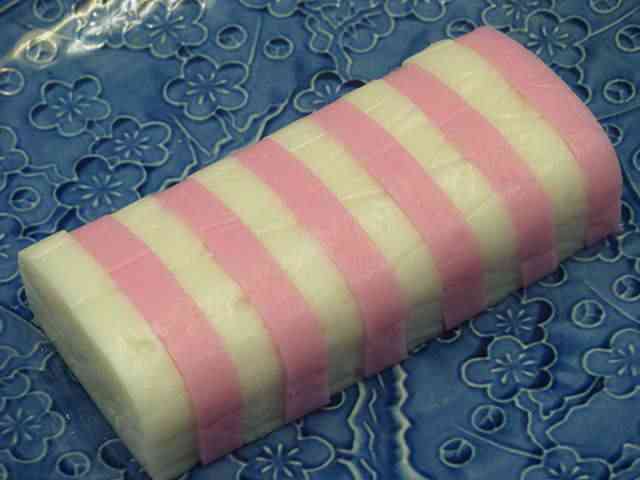
  • kamaboko - Not necessarily a new years food, but those pink fish circles
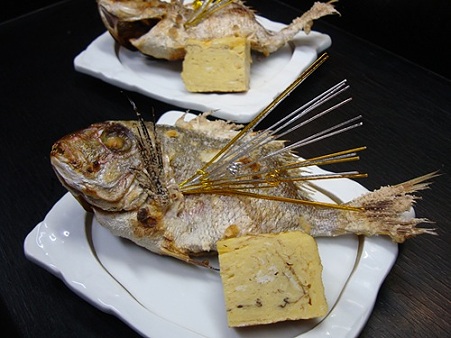
  • tai - This is snapper. It's cooked whole and is eated due to the fact that it sounds like omedetai, a word meaning Congratulations
  • ebi - Shrimp
  • kinpira - a type of cooking style mainly used for vegetables. often sour
  • kuzonoko - herring roe, supposed to increase fertility (They're a little salty for my taste)
  • Tataki-gobou - not really sure how to describe this. It's called the great burdock root in English, but we don't really see it much in the U.S. It's a bit spicy on New Year's
  • datemaki - an egg, but it's rolled...it's hard to translate
  • konbu-maki- rolled seaweed
  • chorogi - A root that is pickled and typically dyed red for the New Year
  • konnyaku - There really isn't an English word for this one. It's called konjak, but that still won't sense to many. It's kind of squishy and doesn't have much taste on its own. It gets flavor from whatever it's cooked with.
Osechi ryouri are normally arranged in nice lacquer boxes like this or this.

Disclaimer:
None of the pictures in this post belong to me. All rights belong to their original owners.

Tuesday, September 11, 2012

Of a Delicious BBQ

I went on a little trip with my coworkers on Sunday up to a place called Katsuura in Chiba prefecture for a BBQ. The trip overall was a lot of fun, and I was finally able to see some green again. No matter how much I like Tokyo for its convenience and variety of things to do, I'm still from a country with wide green fields and beautiful tree-topped mountains. Katsuura was really beautiful though, and I was finally able to spend some time near the ocean. The water was a beautiful blue, and the weather was perfect for a cook-out.


I was also able to meet some really wonderful people while I ate some fantastic food. Although I won't load pictures of people up for privacy reasons, I can share what we ate. The culinary adventure began with some Japanese lobster (伊勢エビ). They were live and freshly caught. Interestingly enough, the Japanese lobster does not have giant pinchers, so you're free to pick them up without worrying too much about getting hurt. We ate them raw first, and they were surprisingly sweet. I didn't know you could have lobster sashimi, but it was fantastic. After that, we cooked them and ate them properly.


After the lobster, we started eating some type of shellfish called sazae in Japanese. I honestly don't want to call these in English. Wikipedia suggests Turbo cornutus but I find it hard to believe we don't have more generic name for this animal. Basically, it's a type of sea snail though. We cooked it with salt and soy sauce, so it had a hard coating on the top of it. It was good, but not my favorite. We also ate ikayaki (grilled squid) and the most delicious of them all awabi, or abalone. I feel like I had eaten abalone once before, but it definitely didn't taste like this. Since it was freshly caught, the taste was phenomenal. I was told that the reason may be because there are two types of abalone: red and black. Honestly, I just think it was because abalone is extremely expensive, so I haven't really grown accustomed to it. 

The other things in the picture below are pumpkin (kabocha), eggplant (nasu), beef, and ham.


And last, but definitely not least, we ate something I had never tried before. We encased a large type of tai (or sea bream) though it may have been ishidai (striped beakfish) in a mixture of salt and egg whites and put it on the grill. The salt formed a protective shell around the fish, which we had to break later. This type of cooking is called shiogawa, or salt pan grilling. I was assured that I was not the only one who had seen this for the first time. It ended up tasting like it had been steamed, and all of the flavor was locked in since the juices started oozing out later. It really didn't taste salty at all.


Overall, it was a really wonderful event, and I'm glad I got the chance to meet some new people and to spend some time with my coworkers outside of work. I'm off to study and sleep.

Thursday, July 26, 2012

Of the Humble Rice Cooker

My humble rice cooker has already proved useful. If not for it, I really don't know what I'd do. Although it is possible and fairly simple to cook rice in a pot, it tastes better from a rice cooker. The sheer importance in Japan makes it necessary some money on your rice cooker. 

This value placed on rice is due to history. In the past, rice was a prized commodity. When the shogun, or traveling bands of samurai took over a town, they would claim the rice from the locals. The amount and quality of your rice was a sign of your wealth. During the famines, people would often eat only a couple grains of rice as a meal. Since food was so scarce, every grain was prized. This tradition continues today in the Japanese language. The word for cooked rice and meal is the same, gohan (御飯). In a rice bowl, every grain must be finished. No matter how difficult it is to get out. 

Today, there a few varieties of rice. The first is the standard unwashed rice. This rice is still covered in starch and needs to be washed before it can be eaten. The second type is pre-washed rice, or musenmai (無洗米). It's not necessary to wash this rice, but you can still do so to get rid of any remaining starch. Musenmai is normally slightly more expensive due to its convenience. There is also mochi. Mochi is a type of sticky, soft rice. It is smaller and is formed into the numerous sweets that are so popular here. Although brown rice exists here, white rice is more popular. It's believed that it tastes better, and to be honest, I think it's perceived as clean and appealing to the eye.

Rice is normally served plain in a small rice bowl, or chawan (茶碗). The chawan is valued for both its beauty and its simplicity. Mine is pictured below. Although you will at times see sesame seeds and some dry flavoring on top called furikake, it's not common to add sauce since this "dirties" the rice. It's considered fairly childish.


This brings us to the actual topic of this post, which is the rice cooker. Rice cookers have become popular in recent years as people have become busier. There is now a decent portion of the population that cannot cook rice in a pot. The rice cooker, or suihanki (炊飯器) has really perfected the rice-making process.

You note that mine is currently open since I'm letting it dry. Of course there are things to consider such as size, but there are a couple aspects to a rice cooker that are important. The first is the pot or nabe. The pot should be somewhat thick and made of metal. This prevents the rice from burning, or the pot from melting. If you want your rice to be moist and fluffy, this is an important aspect. The second thing that's important is this little piece on top. It's removable. The steam rises up through this lid. If you leave it in the cooker, the rubber will be moldy and the metal will rust. Japan is just an exceptionally humid country. Therefore, if you remove it and wash it every time, your rice cooker will last you decades.


The next part that I wanted to cover is the degree of customization. There's a standard setting, a quick-cook, a musenmai setting, options for brown rice and barley/wheat and mochi, as well as setting like okayu. Okayu is rice porridge, it's normally eaten when you feel ill. You can also set the rice cooker to start at a certain time or to delay it if you're ready to eat yet.

The simplest way to cook delicious rice is to wash it with water first. You need to get all the dirt and starch off the rice for it to be light and delicious. You should then add the water and let the rice sit in the pot for 20 minutes. This lets the rice absorb the water, so it will cook evenly and remain moist. Finally, you can start cooking the rice. When you're done, if you don't eat all of it, put it into a container or separate it into meal-size portions of plastic wrap. If you'll eat it within a day or two, it's fine to put in the fridge. Rice freezes well though, so you can put it into the freezer without any problem. Enjoy the rice!


Friday, June 29, 2012

Apartment Round-Up

I'm planning to make an apartment decision tomorrow. The realtor worked hard to find me a couple other apartments to compare with, so I will look and make a decision afterwards. Even after I make a decision, it will take approximately a week to complete all of the necessary paperwork to move in. I've already offered to start paying rent to the family here, but they insist that I take my time and make a proper decision. I truly am blessed to have found such wonderful people no matter where I go in the world.

I visited the one apartment I'm interested in again today. I'm thinking I'll take the loft apartment if I don't see something I like better tomorrow. I'd like the space, and I might just put a little roll-out futon up there to sleep, leaving the main room for clothing and a table. I discovered that both apartments have a small balcony today, which is great. I can dry clothes!

I also went to the Company today to try to find the way there and to properly introduce myself. I went with Tai's mother, because she's already learned I have no sense of direction. Those who know me here have changed my surname to Maigo (meaning a lost/stray child). Not surprisingly, even with his mother we got hopelessly lost and asked the local fire station and a dry-cleaning shop for directions. The Company is located in Ebisu, which is a very nice business district located in Shibuya, Tokyo. The area has tons of restaurants, some famous. It is popular for Yebisu (pronounced Ebisu) Garden, which is a popular drinking area. Sapporo's headquarters are located here. Before anyone gets the idea I'm focused on alcohol here, I want to mention that this is the first thing people comment about when I work in Ebisu. It truly is a nice area though, and it has lots of fun little shops. I look forward to looking through them whenever I'm not in work.

After having been here already for study abroad, there is very little about Japan that surprises me now. I normally just accept everything I see. I don't always understand it, but I accept it. Today, I had a rare "only-in-Japan" moment. I was watching a informational show, where a popular actor goes around and tries lots of food from famous local shops and he went into a shop that specializes in sushi. Not just any sushi though. It's understandable that you want to have the freshest fish possible, so special shops will let you choose your fish, and then make your meal appropriately. In this episode, the actor chose squid (ika). As the chef plunged his hand into the tank to catch the squid barehanded, a familiar song began playing. I've never thought of the song "Dude Looks Like a Lady" applying to catching squid Mr. Miyagi-style, but it was oddly catchy.

I'm off to go eat some eel (unagi) now.

Sunday, May 29, 2011

Of Typhoons

Today is day 1 of the typhoon. It's supposed to hit bad tonight, but right now it's just raining incessantly. It honestly feels like normal Kyoto weather. For any of you who haven't been to Japan, let me just tell that Kyoto is like Japan's version of Seattle. If it isn't raining, something's wrong. Honestly, I'm still wondering how Kyoto isn't a tropical rainforest yet. With regard to the weather though, there are a couple things that are different. The rain is blowing sideways. It's like when you turn on the TV, and you see the rain and you go, "Wow, I'm glad I don't live there." Oddly enough, I live here, and it isn't that bad. In fact, it's kind of fun except for the fact that you can't really go out. And if you do have to go out, it's miserable. The other thing that's different is that the river next to my room is pretty high. It's probably around a meter and half so far. I'm really thinking to go take a picture.

So, the question is, "What do you do on a typhoon day?"

For me, it's probably things that aren't that interesting. I'm sitting inside reading articles about the Meiji Era (明治時代), 1868-1912. I actually have a presentation on it this Tuesday. For those that are a little lax in their 1800's history, think post-Commodore Perry. This is the time when Japan opened up to the rest of the world. Therefore, I'm researching things like wars, the constitution, reforms, and so on. Since I don't know about every third word I read right now, it's killing my head. In the good news, I'm learning lots of new words.

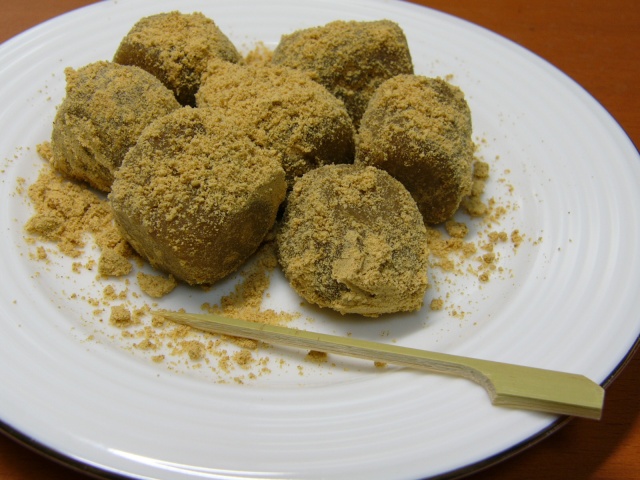
I'm eating rainy food as well. I woke up this morning and made ochazuke, making sure to put some salmon in there for personal enjoyment. And although it's not rainy food, I also ate something called warabi-mochi (わらび餅). Sometimes it's like a gelatinous-type mochi, but the one that I bought is a little different. It's actually honest to goodness mochi, filled with an (あん), or sweet red-bean paste. Normally, I don't really like an, but it's great in this. Warabi-mochi is quite popular with kinako (きなこ)powder over-top. Kinako powder is a sweet soybean flour. Wiki actually has these labeled as dango, which I guess the ones that I ate technically are, but they were still labeled warabi-mochi in the store. Unfortunately, the taste is a little difficult to explain, but you'll just have to take my word for it that they're delicious.

The typhoon is supposed to get much worse tonight at 9 and be bad through tomorrow. Of course, I have class, so I'll be going there.

Thursday, May 5, 2011

Of A Cooking Life Lesson

Yesterday, I decided I'd make something delicious. It was going to be a pork dish with some ginger and other ingredients, but mainly ginger. And let me just say, that it looked fantastic online. With that said, the same was not true of my cooking. You know, normally, I make things up, sometimes use recipes, and I almost always end up with something delicious, or at least edible. Last night's dinner was edible, and that's about where it stopped.

Someone had spilled something in the fridge unfortunately, coating most things in some sort of stick junk. I cleaned it up, but certain ingredients could not be salvaged. That's where dinner started.

From there, I looked at the remaining ingredients, and said, I can make this work. And it's true, I could, if I had one ingredient more. Unfortunately for me, I had no idea what that ingredient was. I stared at it, searched for it in dictionaries, Googled it, but to no avail. The ingredient simply would not turn up, and so, in classic Michelle style, I decided it must not be important. Any ingredient that doesn't turn up easily can't possible be useful. I figured it was one of those optional things. Unlike baking, cooking has optional ingredients. This is the point at which I should've figured my logic was less than logical. And here was the beginning of the end.

So I made my dish, added the ginger, added the few vegetables I had left over, and made my sauce to cover my pork in. I taste the sauce, and I realize, why, that's a tad salty (keep in mind it's mostly soy based with a little rice vinegar. So I add some stuff, and hope for the best, tasting it all the while. I finally finish my dish, and taste it, and it's....edible.

Three guesses as to what I left out. I went back to Google, still no dice. Asked SoJeong, she guessed it was some sort of stock, but she wasn't sure. Asked Tai today, and yes, it was chicken stock. I left out chicken stock. Do you know how important of an ingredient that is? I bet my dish would have been awesome if I'd had it.

In other news, I made some genuine American hamburgers with a touch of basil, rosemary, onion, and garam marsala with a side of the famous rosemary potatoes for dinner tonight. I even had some fresh pineapple. It was much better.

Source:
にんにく豚飯 (クックパッド)

Sunday, April 24, 2011

Of Tea

My name is Michelle Mego, and I have a tea obsession.

I seem to remember hearing somewhere that admitting you have a problem is first step to getting over it. But I'd just like to challenge that commonly held belief. Admitting you have a problem by no means if the first step to getting over it. The first step is realizing that your problem is actually a problem. I've admitted I have tea addiction since I came to Japan, and it's really the strangest thing because I didn't even like tea in the States. However, I'm not ashamed of it. I love tea. I drink so much tea it isn't even funny. I think I keep the tea companies in business. Lipton, Kirin, and the other tea companies just look at me and go "Well boys, even if everyone else stops drinking tea, at least this lady will keep us in business."

You know, the other day, I drank a liter. That's right, a LITER of lemon tea in a couple hours. Do you know what I discovered at that time? Lemon tea is still delicious after drinking a liter of it. But do you know what else? Tea's a diuretic. I was so sick after that time, and that's when I vowed to myself that I will control my addiction. I will not be ashamed of downing large portions of tea, but I will prevent myself from becoming sick over drinking tea.
And now I'm beginning to wonder why on earth I deprived myself of this deliciousness for so long. 20 years of my life I went without tea. And from years 20-21, I have learned the joy and benefits of drinking it.

I suppose this is all besides the point though, so in classic form, I'll provide some info on tea. I'm sure everyone that reads this blog is an intelligent human being and has already learned the pleasure that comes out of tea-drinking, but just in case you haven't heard of one or two kinds, I feel as if it is my duty to share it with you. (I know, maybe I should work a tea company. I'm a great sales rep when I feel like it.)

Tea is taken very seriously in Japan. Certain regions, and even cities are known for specific types of tea. It's customary to serve certain types at certain times of the year or at certain occasions. Some take some getting used to, but they're all delicious. If they're from Japan, they're called Nihoncha (日本茶), or Japanese Tea in general. Although, they're sometimes also referred to as Ryokucha(緑茶), this word refers more to green tea, since it is literally the characters for "green" and "tea." This list isn't limited to just Nihoncha, but it is a basic summary of teas that you'll find here. Here are just a few.

  1. All fruit tea - Japan has a wealth of this. I can't even imagine why we don't get it so much in the States. Let's get kids hooked on tea instead of soda and other ridiculously unhealthy drinks. It's better, and delicious. So far, I've seen and tried lemon, apple, and muscat. There's also yuzu, and acerola lemon which I haven't gotten the chance to try yet.
  2. Mugicha(麦茶) - This is barley tea. I admit, the first I had it, I was a bit surprised, but I've really grown to like it. Also, thanks to this wonderful tea, I've learned how to drink beer. I still don't like beer, but I'll continue to drink mugicha, and eventually in time I'll get there. Although this is normally served cold in the summer, I have seen it served hot in the winter as well. It's pretty refreshing actually, so I'd recommend it.
  3. All green tea/Ryokucha (緑茶)- There are so many types of this. I could write a post just on green tea (ocha). This comes in a variety of ways, starting with tea leaves, to tea powder, and so on. The types of green tea are so specific that there are words for tea which is grown in a mountain's shade and always remains in a sort of mist, to green tea leaves which are harvested in the sun. It's extremely specialized. I recommend trying them all because they all taste different.
  4. Oolong - This is served sometimes at restaurants, and particularly at nomihoudai (all-you-can-drink) institutions. Often, you're given a choice for your first drink: beer or oolong. I always choose oolong.
  5. Koucha - Of course we have the black teas. This is quite popular abroad, so I don't feel the need to go into them here.
Here's a basic list of the types of green tea if you're curious. These are either called ocha (お茶), or ryokucha (緑茶), or sometimes nihoncha (日本茶).
  1. Matcha (抹茶) - I think this is what most people of think of when they hear "green tea." It is the powdered form, which is vigorously whisked with a tea whisk (chasen 茶筅). Different schools of tea, masters of tea, and regions each have their preferred type. This is what is used in the tea ceremony. Well-made matcha is characterized by its even green color on top. There should not be powder on the bottom of the bowl, and the top should also have a nice layer of foam. Matcha is grown in the shade, and it has been found to have numerous antioxidants. It's now being put in a variety of things like sweets as well. Slightly bitter, it is very relaxing to drink. It is also fairly expensive depending on the quality.
  2. Sencha (煎茶)- Sencha is different than matcha in the respect that the leaves are not actually in the tea. I would say a fair amount of what is commonly drunk today is sencha rather than macha. This tea, because it does not have the leaves, is a clear green color. It is grown in the full sun. Sencha is normally hot in the winter, but cool in the summer. You will find the majority of people drinking this in their homes.
  3. Gyokuro (玉露)- This is slightly different than sencha in that it's grown in the shade for 20 days. This is translated approximately I guess as jewel dew, or something along those lines. Gyokuro is pretty expensive, so I've never tried it, at least, I don't remember trying it, and I'm pretty sure it's one of those things that you'd remember.
  4. Kabusecha (冠茶)- This one is a little more difficult. It's like "covered tea." From what I understand, it's basically gyokuro in that it's shaded, but it's only shaded for 1 week before its harvested. Apparently it leads to a milder taste.
The list goes on, but I'm going to stop here because I'm getting into teas that I've never heard of.

Michelle

Of Japanese Delicacies

It's rained for the past three days, and it's beginning to affect my mood. Since it's supposed to rain all next week as well, I'm beginning to wonder if we're entering the rainy season. It's supposed to be in June and July, but it seems to be a little early this year. In a way, it'd be good to get it over now. At the same time though, the weather is fairly nice, so it'd be wonderful to enjoy the cool weather without getting soaked. I really need to learn that whole bike with one hand and hold the umbrella with the other thing. Although illegal, it is exceptionally convenient and looks pretty impressive. Since I can't even manage to bike safely with two hands though, I'll have to continue to learn that first though. I managed to get a lot done: paper written, speech planned, kanji and grammar studied. I'd actually planned to have a drink or two today after working so hard as well. I had my drink nice and cold, and it was going to be delicious, but since the rain was ruining my otherwise cheerful mood, I decided I'd put it off to another day.

I actually need to get back to studying, but I decided first to enlighten everyone on some Japanese delicacies.

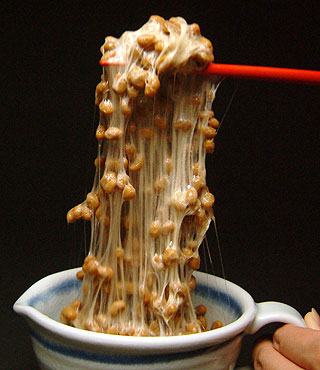
  1. Nattou (納豆)- These are literally fermented soy beans. It's characterized by its smell, which I feel is closest to something along the lines of tire grease, if there is such a thing. It's also very sticky, and clumps together. Despite this, nattou is delicious. Normally eaten in the Kantou region, where it is found often as a breakfast-type food, nattou has gained due popularity. It tastes like beans, really really delicious beans, and everyone should enjoy them. It's especially good with kimchi or tabasco. The most fun part of eating it is that you get to whip it up with mustard and some other stuff like what was previously mentioned. Pictures can be found here and here.
  2. Umeboshi (梅干し) - Pickled plums are another favorite, especially in the Kantou region. Served sometimes with a little salt, they are extremely refreshing, if a little sour. They can be served on their own, in the ball form, or a raisin-like form, or they also be used to make umeshu (梅酒), which is pickled plum alcohol. A picture is here.
  3. Tsukemono (漬け物 )- This is just pickled foods. Kyoto is famous for them, and actually they are deemed Kyouzuke here for that reason. They come in a variety of types: everything from eggplant on. 
  4. Uni (ウニ)- Sea urchin. I had this recently actually at Tai's house. To be honest, I eat most of these Tai's house, except for tsukemono. He doesn't seem to be too fond of that one. I can't really describe uni. The only thing it tastes like is uni. It can be eaten either as sashimi or sushi though. It looks like this though.
  5. Tofu (豆腐)- Kyoto is known for its tofu. We have more tofu shops than anywhere else in Japan I think. It also come cooked in a variety of ways. Unfortunately, I'm still not really fond of it, not due to its taste, but its texture.
  6. Fugu (ふぐ)- Blowfish/Pufferfish. I still haven't tried this one actually. There's actually a season for this, so I haven't been able to try it yet. Since it is potentially lethal though, it must be prepared carefully by extremely skilled and licensed chefs.
And actually, not a delicacy, but something worth adding as a recent personal favorite is
  1. Ochazuke (お茶漬け)- This is something else that I had at Tai's the previous weekend, but I'd just like to add it to the list of absolutely delicious food in the world. It's a relatively simple dish. You fill a bowl with hot white rice, pour in some green tea, and top with nori (seaweed), nattou, fish, or other simple spices. You have to eat it quickly so that the rice does not absorb all of the tea and become soggy, but it's a great meal, and it's really healthy for you. This isn't a completely standard recipe, but I found one that you might enjoy abroad here.
Take care all.

Michelle

Sunday, April 10, 2011

Of Sushi

Another bright and sunny day here in Kyoto. Spring has finally arrived, and it's beautiful. With that in mind, classes started the other day. Things are going well so far. I'm in B class. They go from F to A, A being the highest before you're put into seiki level, which is when you can take classes in Japanese with Japanese students. As is, I can take classes in English with them, but not their normal Japanese classes. Not gonna' lie, understanding is fine, so I may sneak into a couple this semester anyway if I get the chance. As is, right now I'm taking a Comprehensive Japanese class, a Listening & Speaking class, a Writing course, as well as International Organizations (which focuses on NGOs, etc.), Political Economies of East Asia (comparing Japan, China, Korea), possibly a Women's Studies course which is focused on women in war (I know. Not my specialty, but interesting), and last but not least, hopefully a International Management course (which looks at the logistics and marketing strategies of an international corporation). Overall, a pretty decent schedule if I do say so myself.

To answer a quick question that was posted in comments, classes will continue as normal. Kansai is in fact so fine that nothing will change whatsoever with regard to classes. We may take in some more students though who are refugees. Therefore, no worries with class schedules changing unless something major strikes Kansai. The rest of Japan is obviously a bit more affected. According to Tai, Rikkyo University is only taking in two international students this semester because the rest cancelled due to fears of going to Tokyo. I'd like to say that I'm personally proud of those students and especially one of them since he is also from Miami.

What people aren't understanding abroad is that Japan is quite a big country. The problem is that it's normally compared to California. People therefore get a little nervous because California is only 1 state in a country of 50 of them. However, Japan is also relatively the same size as Italy. Because Italy is a country and not a state (by the American English definition of course), people suddenly become much calmer. Therefore, I'd like to propose comparing Japan to Italy in size for the rest of time.

Due to the belief that Japan is a small country, people are refusing to buy fish from Japan. I understand as much as the next person that when you hear about radioactive materials being dumped into the ocean, the last thing you want to do is go eat fish. Most of Japan's fishing is done farther away from the coast though. This is due to past overfishing problems. But Michelle, you might say, fish swim. They can swim close to the coast. And yes, they can. I don't deny it. But if you're concerned about that, then don't eat fish that live close to shore. Those that live out in deeper waters should of course be checked, but if they make it into your markets, they are safe. Japan's economy depends on exports. They will be responsible in this.

In order to prevent more radiation from escaping to the ocean though, TEPCO has installed steel barriers and silt fences. Although I'm not sure about the effectiveness of this, we can only trust them for now.

I love me a good plate of sushi and honestly, if I can eat it here, then you can eat it thousands of miles away. Furthermore, most sushi restaurants abroad are actually switching to fish from other places. Even Japan is not necessarily making sushi from locally caught fish at times. If you're eating salmon sushi for example, it much more likely that it will be from Norway, and your tuna will likely be from Spain. The term sushi (寿司) refers to fish that is offered with vinegared rice. It is a preparation style, and in no way requires the fish to be harvested from Japanese waters. The only requirement of that fish is that it must be of an exceptionally high quality to serve raw. If it is not, you could end up making your customers sick. 

So, this begs the question, which is sushi? In the West, it often refers to what is called makizushi (巻寿司) here in Japan. This is the rolled sushi. It is rice, fish, and sometimes vegetables wrapped with rice in a piece of nori (海苔) or seaweed. A second of type of sushi is nigirizushi (握り寿司). This is hand-formed sushi which is a bit of rice, some wasabi, and fish or something on top. There is also oshizushi (押し寿司), which is literally "pressed sushi." This is specialty in Osaka, where a block-type sushi is formed. There is also inarizushi (稲荷寿司), which is a wrapper made of fried tofu filled with sushi rice. It was believed to be a favorite of the god Inari. I actually find this to be quite sweet, and normally reserve it as a dessert-type sushi for this reason. Second to last, we have chirashizushi (ちらし寿司), which is literally a "scattered sushi." This is when the fish is put on top of rice in a bowl. Lastly, there is narezushi (熟れ寿司), which I actually haven't had yet, but it's been fermented. Considering that Kyoto is known for it's fermented foods, I'll have to check it out.

So, now that we got cleared up. Please don't put your local sushi restaurant out of business. Go support them. It's delicious, and you should at enjoy it when you know its safe.

Oh, and before I go, I'd just like to state that I want a subscription to NIKKEI Shinbun so bad. Because I currently don't have a subscription, their newest articles right now are locked. I have to figure out the cost of it, but I think it'd be nice.

Sources:

Monday, March 21, 2011

Of March 21

So I should probably have something to report about the reactors today. Let's see. They're cooling down. And some radioactive iodine was supposedly found as well in the air, but this should be solved quickly hopefully. The amount is minimal, but it's not sure what effect it will have.

It also apparently was a national holiday today. I know this because things were either closed or closed exceptionally early. It think it was the spring solstice.

In other news, I had delicious sushi today. And it was delicious. A nice assortment and for a reasonable price as well down by Loft.

Michelle

Tuesday, February 22, 2011

Of McDonald's

Called マック(Makku) in Kantou and マクド(Makudo) in the Kansai region, McDonald's is a mysterious entity in and of itself in Japan. It's menu changes frequently to include items such as: the teriyaki burger, the German sausage burger, the American Miami burger, the cheese fondue burger, and last but certainly not least the prawn burger.

In recent years, KFC has managed to convince the Japanese that it is normal to eat chicken for dinner, so there are huge lines outside of KFC's at this time. But this year, McDonald's seems to have tried to compete and developed the iCon. For around 1700 yen, the iCon included
-four "Juicy Chicken Selects"
-ten "Chicken McNuggets" + sauce
-two "Shaka Shaka Chicken" (chicken and powder is put into a bag and then shaken)
-"Mega" size french fries
-three cell phone key chains

In Kyoto, the large red signs go against zoning laws, so McDonald's has been forced to change its signs to brown. To be fair though, the majority of McDonald's that I've seen throughout Japan have been black since it seems to be a little more fashionable.

McDonald's consist of multiple floors, hundreds of tables, and are routinely packed. Despite this, McDonald's has become a favorite hangout for most exchange students. In most of Japan, if you stay too long in a place, the staff will ask you to buy something else. You may not simply take up room when you are a non-paying customer. At McDonald's though, this rule does not apply. You can stay in McDonald's as long as you like without buying a single thing (though it is common courtesy to do so). McDonald's is also open later than any other place I've been to (aside from karaoke, bars, and other night-life type activities.)  Therefore, although I'm not necessary a fan of McDonald's, I say cheers. In some sort of odd way, McDonald's has become a place that attracts the young in Japan. And not just that, it's quickly turning itself into a fount of knowledge. Since it doesn't kick out the tons of foreigners who flock into its mist, exchange students go there until the wee hours of the morning to rest before the trains start up again after a long night of drinking, or it is used as a place to study for the countless tests that seem to pile up.

Cheers McDonald's. You've done well.

Michelle

Monday, February 21, 2011

Of why restaurants must hate foreigners

So we've decided something among our not-so-frequent trips to restaurants in the area and around the rest of Japan. Restaurants must hate foreigners. I'm not saying this in a mean sort of way but in a completely understandable sort of way.

It begins with just walking in.
Shopkeeper: "Irasshaimase! (Welcome to our store!)"
And then they see you and pause. "Oh crap," they must be thinking. "Will they speak Japanese? What will we do if they don't speak Japanese?"
So they ask you a little slowly, "Nanmeisama desu ka? (How many people?)"
"Futari desu. (Two.)"
The relief on their faces! They've navigated the first hurdle and they now lead you to your table...
But when they get there, they stop. Oh no. What will happen now? They're stuck at a quandary. To offer the English menu or to just give a Japanese menu. They decide it's better to offer the English menu. You turn it down, saying that Japanese is just fine, and if anything, their face becomes a mixture of relief and confusion. Who is this strange foreigner who prefers a Japanese menu when they no doubt speak English? (It is believed by most Japanese that if you are foreign you must speak English by the way...)

As soon as the menu is set in front of you, your waiter whips out his trusty pad and waits for your order. In some sort of odd skill that I haven't seem to find out how they do it yet, inevitably, every Japanese person can order within the span of about three seconds. But you know, those pesky foreigners, we like to spend a good five minutes to look at the menu, and discuss with our companions what we should order. Meanwhile, your waiter looks like he's about to pee himself as he shifts from foot to foot in anticipation.

Finally, you order your meal, and while you're waiting, another foreigner walks in and gives you what we have affectionately come to call the "gaijin nod." The gaijin nod is a mysterious thing. It's your acknowledgement of the other person who is not Japanese in a sort of "hey, we'll band here together brother" but you also realize that you are in no way related and do not have permission to talk to that person. Inevitably though, they'll strike up some conversation with you about where you've been, and if you have any suggestions on the rest of the city. This act of striking up a conversation with a stranger who is not at your table further confuses the staff.

Your meal arrives and the real fun begins. If this restaurant never or rarely sees foreigners, they cannot help but stare in an odd sort of fascination. "Will they know how to eat it?" and "Will they be able to use chopsticks?" seem to be the most prevalent questions here. The answer to both question is normally yes of course, and if not, you'll try your best in order to avoid embarrassment.

In another amazing feat of skill, the Japanese can manage to eat their food quickly. Though this is probably due to relatively a lack of talking and just focusing on food. But you know, we like to linger on our food outside of Japan. So we take half an hour to eat what most Japanese would be done with in 10 or 15 minutes. We also like to drink more than one cup of tea while we're eating. Asking for that extra cup is sometimes painful and exceptionally difficult to receive, but we do it with such frequency that the serving staff doesn't seem to know what to do. Add on the extra half hour that we spend talking to each other when our meal is finished, and it's no wonder restaurants begin to feel ambivalent to foreigners...

Michelle

Tuesday, January 11, 2011

Of Christmas & New Years Part II

Well, it's that's time again. The time when I keep my promise and write part II of my adventures over the holidays. Because I'm supposed to be studying for a test, writing essays, and preparing for exams, and instead I'm procrastinating with this blog, you all should feel very special. No worries, don't feel guilty. Just special. I'm enjoying the procrastination as much as you are.

December 31st, also known as New Year's Eve, is a pretty relaxed day in Japan. People continue to make their New Year's foods, osechi-ryouri (おせち料理), but these are just the final preparations. Once the clock hits about 8 or so, the real fun begins. I can only really describe it as in the States during the Macy's Day Parade on on New Year's when we sometimes have singers as they count down to the New Year, there's that sort of thing here. Put on by NHK, top singers from around the country are invited. Depending on their gender, they are put into either the red (female) or white (male) team. They then compete with their top song of the year, and people vote for one or the other at the end. The event, which is called Kouhaku (紅白), goes on until 11:45. Almost everyone watches it, and although there are times when you're sleepy, I admit that it is pretty fun.

At 11:45, all programs switch to the New Year's celebrations, which means that they go to temples and such. At midnight, bells around the city can be heard. These bells, which will be rung 108 times to signify the 108 earthly temptations/desires that one must overcome in order to reach nirvana (enlightenment) in Buddhism. It's tradition at this time to all get back in normal clothes, and trek to the neighborhood shrine. Once there, you make an offering and a wish/prayer for the new year. (At this point, I was the only foreigner in the temple, so it was a little interesting.) After this, a nice gentleman walks up and hands you amazake (甘酒), literally "sweet sake/rice wine." It's called sweet for a reason, and I don't recommend drinking a lot of it, but somehow I seem to have had 3 to 4 glasses of it that night. Luckily, it's not very strong, so there were no bad effects. Amazake is only drunk at the New Year though, so families will make their own, and you end up drinking a ton of the stuff. When you're done drinking amazake, or maybe while you're drinking amazake, you eat soba (おそば), which is a type of thin noodle. On New Year's Day though, it's called toshikoshisoba (年越しそば), literally "End of the Year Soba."

The next day, you wake up and deliver a round of "Happy New Year!" (明けましたおめでとうございます) to everyone you meet. You partake in a little bit of sake, literally a drop, giving thanks and welcoming the New Year. At this point, we went to another shrine and took some arrows with us. Used to ban evil from the household, you throw these away and get new ones for the new year. We also got omikuji (おみくじ), which is a sort of fortune. They can either be good or bad. If they're good, you take them home with you. If they're bad, you tie them to a tree or rope and leave them there so you won't bring the bad luck home with you.

After we returned home, we finished preparations and then ate dinner with the extended family. It was a great night, and I seem to remember more amazake, sake, whiskey, wine, and beer being passed around. Otoshidama (お年玉) was also given, which translates as a New Year's monetary gift that you give children.

In the next few days, we went to Kawasaki Daishi (川崎大師), a really famous temple. We ate dinner off the street vendors there, and I got to have my favorite baby castella (べービーカステル) for dessert. Taisuke bought them for me, and I got an entire bag for only 500 yen! It was the best 500 yen a person has ever spent. I don't need nice things, just baby castella for the rest of my life. Unfortunately, I was pretty stuffed at this point, so I ate a few and put the rest inside my jacket for future snacking. Some people hide keys or rings or useful things in their breasts. I hide baby castella. Every five minutes, I'd unzip my coat, take them out, and eat one. Then, I'd put them back where they'd be nice and warm. I got some strange looks from the Japanese people around me, but it was worth it. They just didn't understand my joy.

Finally, we went to the Rice Bowl, which is the biggest football event in Japan. The top university team plays against the top company team. The company teams are basically the Japanese equivalent of the NFL. This year it was Ritsumeikan Panthers against the Obic Seagulls. The Seagulls won, but it was still a lot of fun.

We also went to DisneySea, which is the only DisneySea in the world. It's owned by a Japanese company actually, and everything is centered around the volcano in the middle. It's not so much focused on the rides as it is the scenery, so we had a great time.

I should probably get back to studying, so I'll update again another time.

Michelle

Friday, January 7, 2011

Of Christmas & New Year Part I

So I took a little trip to Tokyo for the holidays. It was a great experience to see people and to also experience a little culture and some traditions as well. Of course, I'd like to post the entire experience here, but it could probably make up a book, so instead I'll do the highlights in a series of posts.

First off, I went and saw a really cool movie called 相棒 (Aibou), meaning "Partners." It was based on a very popular TV series here in Japan, which I believe is on its ninth season now. The series is about a couple detectives, who are extremely smart. In fact, they're despised most of their division because they tend to just take cases they want and never take cases that they are assigned. However, since they always solve their cases, they're never fired. The movie is focused on a hostage situation, and the results that come from it. I'm not going to lie. It was not exactly easy to understand, but it was very good for my Japanese. I did get a fair amount, but by no means everything. Since it was a suspense-type movie, there was lots of plot twists and such, so although I did get most of the key stuff, by no means did I get everything. However, I watched a lot of the TV series after as well, and it was a blast. I'm really happy I got to see it, and for anyone interested who speaks Japanese, I'd strongly recommend it. You can find the movie's website and trailer here: Aibou Official Website.

After that, I went with Taisuke to Yokohama(横浜). Yokohama is really a beautiful port city. Not only does it have a lot of history - for those history buffs out there, you'll remember it as the place where Commodore Perry's Black Ships landed to open up Japan to the rest of the world - it also is extremely modern and a lot of fun explore. We went obviously in the hopes of seeing the ocean, but also to see Yokohama's famous Chinatown. It's the biggest in Japan, I believe. Although it was a little cold, the trip was definitely worth it!

Yokohama's Famous Skyline
We went on a huge pier to go look at the sea, and I snapped this picture
There was also an outdoor ice skating rink. Although I'm really lousy at it, it was a blast! I can't remember the last time I went ice skating, and this is by one of the main monuments. That big red warehouse is famous for being a big red brick warehouse. I don't know why it's famous though.
Chinatown. We had some delicious Chinese food here.
Making mochi for the new year. This is rice that has been hammered into a sticky substance kind of like goo. It's very delicious and is one of the many osechi-ryouri (おせち料理), or one of the traditional New Year's foods.

We also went to Chichibu( 秩父), a country town outside of Tokyo. It took us about 2 hours to drive there, and it was probably my favorite part of the trip! Tokyo is really a convenient city since it's so big you can find anything and you can get anywhere quickly, but it's also very crowded, especially around the holidays. So, it was really nice to get out of Tokyo and into the country for a little bit. It was my first time in the country in Japan, and I'm so happy I got to go! While I was there with Taisuke and his family, I got to meet his extended family and we also went exploring. Got to love exploring!

We went off and climbed the mountains behind his grandparents' house. It was great to go hiking again and to get some fresh air. We were able to see everything below us, the houses, the scenery, and the river flowing through it all. I can't even begin to describe how beautiful it was!

Some sort of farm. We thought it might be for rice, but rice doesn't grow in the winter, so we're not sure what it was.

Because they had just rerouted the river, we did go and play by it, but it was really cold. So we ended up walking on the original riverbed instead for most of it, skipping rocks in puddles, and playing on the ice patches. It was really interesting to see the original riverbed, since the rocks were worn smooth over time.

In classic Mego style, I realized that I'd never played with bamboo before, so Taisuke and I set off on an adventure to go gather some. Although we saw something that I thought was bamboo, it was only sasa (ささ), which is a type of bamboo, but it's not the big kind. Rather, it's only a thin flexible type that can't really be used for what we wanted. So we hike to where there was a bamboo forest, takebayashi (竹林) ,
in the past, but it had been cut down. Luckily, all of the bamboo was still there, so we sorted through the piles to collect a good one. This piece of bamboo is about 15 feet (3 meters) long. And we carried it down the mountain and back to the house. Taisuke, in his "I can make anything with a pocketknife" attitude, announced that he would teach me how to make cups and chopsticks. While he was at it, he'd make a flower vase for good measure.
The finished product after a couple hours work.

Since it was really very cold, we decided to head back inside to warm up under the kotatsu. A kotatsu is a type of table which has a heater underneath. It also has blankets fastened to it to keep the heat in. Basically, you sit with your legs beneath is, curl up, talk with people, and more than likely, take a nap. I found them absolutely fascinating since it was my first experience with one, so I kept checking underneath to see how it worked. There's a little switch that you flip on, and it heats. There's no worries about getting burned or anything, since the heater is covered, but you definitely stay warm. 
The kotatsu and one of the rooms in his grandparents' house. Their house is designed in the traditional fashion, so it's really beautiful. The floor is tatami mats and wood.

Unfortunately, the Chichibu dialect (秩父弁) is extremely difficult to understand, so I felt bad because I couldn't understand everything his grandparents said, but it was a lot of fun, and I'm glad I was to go. Here's a final shot of everyone, excluding his mother because she was taking the picture at the time.

And that's the end of the first few days.

Michelle

Tuesday, November 16, 2010

Ritsumeikan Gakuensai

The 立命館学園祭 (Ritsumeikan Gakuensai) occurred over the weekend. This is a really big school festival, and when I say really big, I mean huge. Basically, every organization sets up a stall and does something for the festival. Here we have the SKP buddies (Study in Kyoto Program) trying to sell their delicious corn soup. Business was a little slow at the time, so we have Juri posing with a Free Hug sign if you buy the soup. Keep in mind it's really cheap, like 150-200 yen. The idea was for all of their foreign friends to hold these signs because "Ooh la la. Free hugs from foreigners." Amazingly, it was a superb market strategy and the soup sold quickly.


Organizations like the wrestling club and the judo club were also present. Remember the previous post? Yeah, they got their rink set up and wrestled for days. The judo club did demos and taught some.

I enjoyed the a capella circle though. They were really good!


And to top it off, we had some serious dancing going on a gigantic stage. I was only here for like 2 minutes though because I was getting hungry.


Here are some pictures of the stands and an advertising duo in Stitch and Tigger costumes.


Other cool things included crafts like making your own pottery, caricatures, and live spray paint art.

In other news, the leaves are beginning to change color. If the weather stays nice, I'll load some pictures of that up soon.

Also, unfortunately, not all news can be good news. Due to the recent attempted terrorist attacks on the US, Japan is having to take some fairly strict measures. Getting in and out of Japan is getting to be a little more difficult. The screening process is taking more time than usual, even for native Japanese and permanent residents. Packages cannot be shipped to the US if they weigh more than 1 pound now as well. This is surely a temporary measure, but no one is sure how long it will last. So I apologize to anyone who wanted something. I currently can't ship anything to anyone in the States.

Michelle

Monday, October 18, 2010

Arashiyama and Nabe

The other day, instead of studying, I decided to go exploring with Jazmin to Arashiyama. Arashiyama is one of the famous parts of Kyoto, which in Kyoto, says something because all of Kyoto of Kyoto is pretty famous. So, Arashiyama is really famous for temples, and the more traditional arts in the city. But we didn't go to temples really because frankly, I'm a little templed-out at the moment. Instead, we went to one of the very famous bamboo forests behind one of the temples.


Beautiful, isn't it? I admit, it's my first time to really see bamboo, so I was super pscyhed. I can't imagine having to chop any of this stuff down, it's ridiculously strong. And this bamboo is easily the size of a small plate.

After our random explorations outside of the normal touristy zone, we ended up going to a friend's house to make nabe. Nabe is extremely delicious. Basically, you put a bunch of stuff in a pot and then let it cook for a little while and then serve directly from that pot into people's bowls. Ours was full of deliciousness. It went something like this:

1. Start with a soybean milk base for the broth
2. Add pork
3. Add yam noodles
4. Add mushrooms
5. Add carrots
6. Add cabbage
7. Add fried tofu

And let me just say to you that it really doesn't look as delicious translated. There are so many bad connotations with those words that I just put up there, but you know what? Try to ignore them. And think of the feeling you get when you walk into the house and you've had that bowl of spaghetti sauce or something boiling on the stove all day, and you think, "Wow, I'm home, and this smells so delicious." That's the feeling you get with nabe.

And now just because I'm thinking about it, and I really think I owe all of you a picture, here you go. This is my bowl, perfectly arranged by Tomoyo.

Monday, October 11, 2010

Of Rice Buying

I walked into the rice aisle again today. For anyone that's been keeping in touch with me, you know that's something of an achievement. The rice aisle is intimidating. In fact, it's the most intimidating aisle for me. I can go in the other aisles and be perfectly comfortable with the fact that I can't read anything, but the rice aisle, oh no. Here comes trouble. Last time I walked into the rice aisle, I stopped, physically stopped, caught my breath, the whole shi-bang. There were bags and bags and bags of rice. And I can't read any of them. Awesome. So I took my little 外国人(gaikokujin, foreigner) self through the aisle, grabbed one at random and fled from the aisle like a gazelle fleeing from a pack of lions. When I got home, I learned I'd bought the wrong kind. How embarrassing!

But this time, this time I steeled myself and walked into the aisle for the second time. My thoughts went something like this:
"Alright Michelle, you can do it. Just walk up, read the kanji and grab one....Crap, I can't read the kanji. What on earth is this? It's rice. Well, how about that one. Nope, can't read that one either. Well, that's rice too. What about this one? No, wrong kind. I can read that one. That one's for mochi. And the fourth one says Hokkaido, but that's just a brand....Shit."
To me walking into the rice aisle is kind of like when you send a guy into the women's sanitary supplies aisle. He's like, "No talking! No talking! I don't belong in this aisle! Where are they? Where are the things she told me to buy? Are those tampons? Pads? Elderly incontinence diapers?! God! My eyes! My eyes!" And then, scarred for life and eyes bleeding, he grabs the first thing he sees and runs out of the aisle, mistakenly buying "supers" or some other such nonsense.

That, my friends, is the fear that the rice aisle evokes in every foreigner. You have all these kinds of rice in front of you, and they look exactly the same. Luckily, it seems though that this time I picked the right kind.

And now, with regard to rice and an embarrassing sort of translation. While in said rice aisle, I saw a package labeled 無洗米 (musenmai). The last two characters I definitely knew. They mean "wash" and "rice" respectively. The first one I technically know but I forgot it's meaning. I only recognized it from the word 無理 (muri), meaning "impossible." So here I am in front of this bag of rice and I've just translated it as "Impossible to Wash Rice." And I'm thinking "What the heck? Who would put that on a package? That's horrible marketing!" I can see it now, "Come one, come all, come buy the rice that you'll never be able to get clean!" Yeah...fail. For the record, that kanji alone has the meaning of "not," so the meaning is actually "Not necessary to wash rice" or "Rice that's already been washed." So yeah, cool beans. At least I remember the kanji now.

And now it's already hit midnight and I promised myself I'd be in bed by 12:30, so I've gotta' run! Night all!

Michelle

Saturday, October 9, 2010

Of Japanese "Convenience"

Here in the magical world of Japan, there's a couple words that are often thrown around to describe everything from the convenience store to transportation. These words are "convenient" and "efficient." For example, "It is convenient for me to only have to walk 1 minute to a convenience store in order to buy anything that currently strikes my fancy. Because I am not wasting time driving somewhere, I can use that time to do more productive things, such as studying or working or possibly going out to the bar with my peers (or in the case of business people - coworkers). This therefore is very efficient." Yes, my readers, that is exactly how it works.

Here in Japan, there are stores called コンビニ(konbini) everywhere. Konbini is short for convenience store, and because it is convenient for me and efficient for me to not have to type all of those other letters, we will call them konbini for the rest of this post. Think of it as your little Japanese word for the day. I'll call it convenience.

Konbini have everything: toothbrushes, magazines, bento (pre-made meals), snacks, alcohol, winter clothing, you name it. Your local 7/11 (called Seven & Holdings here) will be your new best friend. Let's look at a typical konbini here. You walk in. "Oh, look! They have that new magazine I wanted! I'll get that. Oh, and there's some melon pan, yum, I think I'll get that too. It will be a good snack. But you know, sometimes I like something else too around midnight. Oh, they have my favorite onigiri today. That'll be good. And look at that! That bento looks delicious. Great!" You walk up to the counter and place your items down with a friendly "Here you go." The cashier rings them up, tells you the price, and then looks at your bento. "Would you like me to heat this up for you, honorable customer?" "Yes, please," you reply. So they heat it up for you right there, just to the perfect temperature, and you're on your way. See that? That's convenience. You didn't even have to heat up your own meal.

Now, I'm all for convenience, don't get me wrong. But today, I saw one of the craziest things: pancakes. Don't give me that look. You read that right. Miniature pancakes. In a package. In the konbini. They're really cheap too. Like 200 yen. Yum. They're even flavored with maple syrup so you don't have to deal with any of that mess. You can just grab a package and go to class or something. Here's a picture just to prove it: Konbini Pancakes. Now, my friends, I think we've reached a whole new level of convenience here. This is what we call laziness. But the Japanese will never call it that. It is convenience and efficiency. Those are the words they will always use.

So, why are there konbini on every corner? Why are there more vending machines in this country than I've ever seen in my life? Why are the trains so fast and on time? Convenience. Efficiency. Awesomeness. Personally, I admit it's kind of growing on me. I love my neighborhood konbini. I love the people that work in my neighborhood konbini. And maybe one day, I'll buy those pancakes for breakfast just out of sheer "convenience." Thank you, Japan. I admit, a girl could get used to this.

Michelle

Sunday, September 26, 2010

Of Friends and School

Before we begin this post, I wanted to bring up a few things from a previous post real quick. You may remember my brief little blurb about メロンパン (Melon Pan, aka Melon Bread). It really is exceptionally delicious due to the fact that the inside is light and fluffy and the outside is a sweet crispy crust. Well, thanks to a friend of mine here, I now have the recipe to share with you. I haven't tried it myself, but it looks pretty good. You can find it here: Melon Pan Recipe. If you need anything else, or if you have comments on it, please contact me. I hope all of you can enjoy it as much as I have!

Secondly, you all may remember my comments about the shower mirror and the suicide doors the other day. I finally figured out how to use them. Japanese typically look at the mirror instead of looking down when soaping up and such. Men shave their faces in the shower, and women take off their makeup in the shower.

The suicide doors are for the firemen. They mark the easiest place to enter the building in case of an emergency. They can then evacuate individuals and put out the fire faster through the doors. Unfortunately, not as exciting as a glitter firemen's pole, but there's the answer.

And now onto the new information.

So I've been placed into Intermediate level Japanese here. Considering that's where I should be, I'm pretty content. There are two intermediates: lower and upper. I'm in lower. Hopefully I should be there, but we'll see. I'm excited to begin class though. All classes meet for 1.5 hours here. My Comprehensive Japanese class meets 5 times per week, Japanese Listening and Speaking meets twice in a week, and Japanese Studies meets once a week. I'm also looking at taking three cultural classes to have a total of 15 credit hours this semester. We'll see if that's too much or not. I'm interested in taking Japanese Society, Japanese Culture, and either Japanese Economy or Foreign Relations of Japan. Japanese Economy and Foreign Relations look really similar. They both meet really late though 4:10-5:50. Japanese Economy meets on Tuesday though and Foreign Relations meets on Friday. If I take Foreign Relations, I'll be in class from 10:40-5:50 on Friday. That's rough, so I'm going to try for Japanese Economy. Hopefully I'll do ok. Most classes in Japan meet once a week by the way, so it's a little different than the US.

The other day, I had the best night with people. We got all of the Japanese buddies with us to all go to okonomiyaki. Okonomiyaki is a type of food that's a little hard to describe. It looks somewhat like a Japanese style pancake. It's egg, cabbage, and whatever else you put in it. In our case, we had squid, pork, and a mixed one. They you put on Kewpie mayonnaise (a sweet mayonnaise) and oyster sauce. Finally, you sprinkle on some dried bonito flakes and some nori (dried seaweed). It's all made on a huge sort of grill, and it's really good. Now, our Japanese buddies kind of forgot that we ate about 4 hours earlier, so they decided that foreigners eat a lot and that we needed three large okonomiyaki and an order of soba (a type of noodle).


We were so full about half way through, but we couldn't let all of the food go to waste, so we had to keep eating. Now keep in mind all of that food and the fact that the six of us had just eaten lunch a four hours earlier. And now, I think you'll be able to appreciate this next picture a little bit more.

That's right. We ate all of it. We were so full; we were almost sick in fact. We were supposed to head to a nomihodai with our group of about 150 people, but we didn't have bikes, and the bike ride was about 45 minutes. If we went by foot, it'd take us an hour and a half. Considering how much we just ate, we thought we'd be sick if we even thought about a nomihodai. Nomihodai are an interesting idea actually. You pay a set amount, let's say 1100-2000 yen (11-20 US dollars). For the next 90 minutes, it's all you can drink. If they did this in the States, they'd go out of business, but somehow it manages to work in Japan. Now, keep in mind "all you can drink" in Japan is a little different than back home. I can honestly say that it would mean serious binge drinking and getting sick in the US. But the Japanese normally bike everywhere, or take trains and busses. They have to get home somehow, and the idea of being drunk in public is completely unacceptable here. So "all you can drink" is normally done within reason. Still though, we thought we'd be sick, so we skipped on the nomihodai idea and instead went to something called an izakaya (a standard bar) to just go talk and have a drink before splitting up. It was really nice. I enjoy the drinking scene here more actually. The emphasis is always on the group here, rather than on the individual. So people go to a bar more to see other people than to honestly drink.

The next day we went exploring to a huge shopping area along with a famous market. The market is called Nishiki. It's known for having some crazy food like cow's tongue and octopus on a stick and such. Honestly, we went there because one of our buddies had mentioned that cow's tongue was delicious and that we needed to give it a try, but we couldn't find it unfortunately. Instead here's just a couple pictures of a dried bonito flakes machine and some sweets.


Michelle