Pages

Showing posts with label culture. Show all posts

Friday, July 4, 2014

A Visit to Kichijoji

I traveled to a neighborhood called Kichijoji(吉祥寺) for the first time the other day. Kichijoji is located in Musashino, one of the suburbs of Tokyo. This is an older part of town, and it has a pretty rich history.

History


For those that have been following my blog for a while, you may recognize the ending of "-ji" there in the name. This final character is used to name temples, and Kichijoji itself roughly translates to "The Temple of Lucky/Auspicious Omens." This Buddhist temple was moved to Bunkyo on the orders of Tokugawa Ieyasu - the first shogun of the Tokugawa shogunate and the man credited with the expansion and reconstruction of much of traditional Edo (what is now Tokyo). Bunkyo is a ward within Tokyo that today holds the Tokyo Dome, the Headquarters of the Judo community, and the University of Tokyo Hongo Campus.

As was prone to happen in those days, a small town built up around the temple. It was therefore named Kichijoji-Monzenchou (吉祥寺門前町), literally "The town built around Kichijoji." Traditional city planning measures allowed homes to be built very close together. Even today, you can see older areas of the city that have only centimeters of space between the buildings. Homes and shops were made to be light in order to withstand the frequent earthquakes in the area. They were therefore built out of wood. Due to the high volume of wooden buildings in a small space, coupled with the dry summers and winters here in Tokyo, the city was very prone to large and destructive fires. The most famous of which was the Great Fire of Meireki in March 1657. This fire lasted three days, claimed the lives of over 100,000 people, and destroyed up to 70 percent of the city. By the time the fire was extinguished, the temple and its surrounding town were destroyed.

A new era of reconstruction began. The shogunate decided to repurpose the land for daimyo residences. The previous residents of Kichijoji-Mozenchou in Bunkyo were moved to the present-day Kichijoji in Musashino. Although this present-day neighborhood does not hold the Kichijoji temple, it did keep the name as a tribute to the original town.

Highlights


Inokashira Park
By far one of the most popular things in the area is Inokashira Park. This park is busiest in spring due to its large number of cherry blossom trees, but it is enjoyed year-round by Tokyo residents for its beauty and greenery.

Inokashira Park Spring, J. Peterson, Wikimedia Commons ©

Side Alleys
Called Yokochou (横町) in Japanese, these backstreets and side alleys hold a variety of small bohemian-style shops and restaurants. If you are looking for a place to relax and enjoy the traditional side of Tokyo, this is definitely it. Due to its distance from the city center, you can find things a bit cheaper here. I found a great pair of running shoes for roughly 5,000 yen. You would normally have to spend between 8,000 to 10,000 yen to find the same item in other parts of Tokyo. I even found a small shop that sold only handmade goods. There were handmade linen tablecloths, handmade wooden spoons, and handmade cups and plates.

Harmonica Alley
This is one of Kichijoji's most famous yokochou. Here you can find small bars where you can sip beer or hoppy, a favorite of older Japanese businessmen. Hoppy has a taste similar to beer, but it is made with shochu and contains about 1% alcohol. It was especially popular in the past when beer was considered too expensive for the general populace.
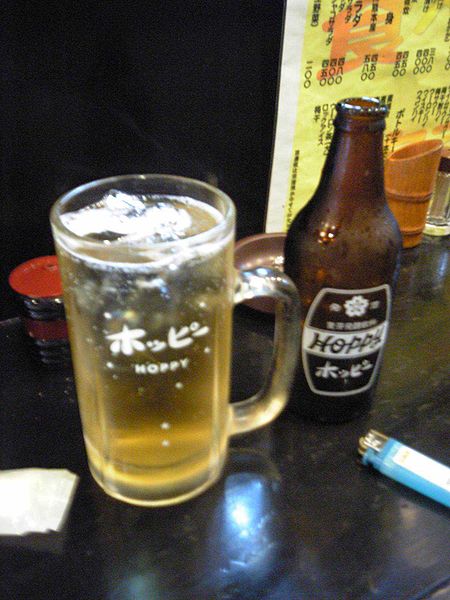
Hoppy, Hykw-a4, Wikimedia Commons ©
The air smells great here due to the wide variety of restaurants, one of which is the ever-popular yakitori (kebab) bar. I also found a small tsukemono-ya, or pickled foods shop. I was all for buying bettarazuke, which is a slightly sweet-tasting pickled daikon. It is a something Tokyo is famous for, but Tai wasn't in the mood, so I'll stop by another day. All in all, Harmonica Alley is very similar to Sangenjaya in Setagaya Ward with its high number of restaurants and local atmosphere.

Sun Road
A covered shopping arcade, this was one of my favorite spots in all of Kichijoji. It really reminded me of Kyoto's downtown covered Shijo Street near Nishiki Market. By far one of the most interesting places here is a small croquette shop called Satou Kichijoji.  If you click this video (Japanese-only), you can see the meat croquettes that have made it so popular. This shop was amazingly busy. I think we discovered it around 2:00, and there was still a line of 50 people waiting to buy meat croquettes. When we left around 7:00, the line was longer if anything. In fact, it was featured on TV the other day. Despite the shop's small size, it sells 3,000 meat croquettes a day.

The other place I really enjoyed was a traditional geta shop. Geta are the Japanese wooden clogs. This shop had ones that were handmade from bamboo and tatami. As well as ones that were wooden. They had everything from the traditional-style geta that are worn with kimono to modern-day styles that are more comfortable for every-day use. We spent a while talking to the shopkeeper about the different styles as this kind of shop fairly rare today.

Geta, Haragayato, Wikimedia Commons ©

Atré
Finally, if you're looking for something a bit more upscale, there are the department stores in the area. I'm particularly fond of Atré, because it has such a eclectic variety of goods. This one had a small chopstick shop, a variety of florists, a stationary and bag shop, among others.

Conclusion


All in all, it was a great day at Kichijoji. It was very easy to see why it is so popular among all age groups. With its easy access to Inokashira Park and its vibrant community, Kichijoji is consistently rated the number 1 place that people want to live in Tokyo. Even I felt that if I wasn't so happy living in Setagaya Ward, that I would be happy to move to Kichijoji in the future. People were very friendly and it definitely had a small-town feel, something you don't get often in urban Tokyo. I know that I'll definitely be going back to eat those delicious croquettes and maybe enjoy a drink or two in Harmonica Alley with the local residents.

Tuesday, January 8, 2013

New Year's Food

I went back to work this Monday after a nice long New Year's break. I went to a temple called Kawasaki Daishi for the annual New Year's Visit. I also went up to a place called Chichibu in the countryside to see Tai's family. It was a lot of fun, and I'm glad I had a break.

On New Year's Eve, people go and eat a soba noodles. This tradition is called toshikoshi soba (年越しそば). Although there are many different ways to eat soba, we ate it with tempura. I also ate a lot of what are called osechi-ryouri (御節料理). This is traditional New Year's food. You eat pretty much all day New Year's Day, and then you continue to eat the leftovers for another day or two.

There are a variety of osechi-ryouri. I've listed a few below that seem to be the most common.

  • ozouni - Hot soup with mochi inside. You have to eat it quickly in small bites or it hardens and you can't swallow
  • kuro-mame - Literally, black beans. These are quite sweet
  • kuri-kinton - Sweet chestnuts. These are yellow and have a sweet paste around them
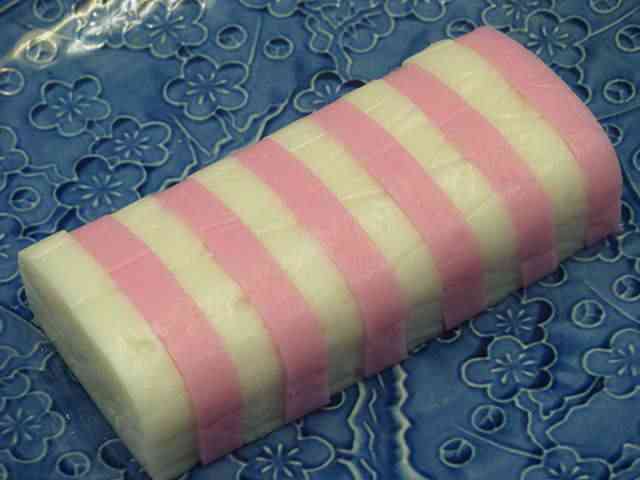
  • kamaboko - Not necessarily a new years food, but those pink fish circles
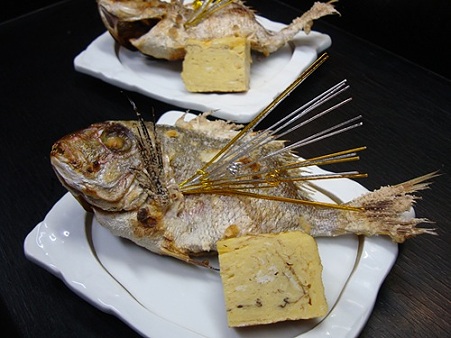
  • tai - This is snapper. It's cooked whole and is eated due to the fact that it sounds like omedetai, a word meaning Congratulations
  • ebi - Shrimp
  • kinpira - a type of cooking style mainly used for vegetables. often sour
  • kuzonoko - herring roe, supposed to increase fertility (They're a little salty for my taste)
  • Tataki-gobou - not really sure how to describe this. It's called the great burdock root in English, but we don't really see it much in the U.S. It's a bit spicy on New Year's
  • datemaki - an egg, but it's rolled...it's hard to translate
  • konbu-maki- rolled seaweed
  • chorogi - A root that is pickled and typically dyed red for the New Year
  • konnyaku - There really isn't an English word for this one. It's called konjak, but that still won't sense to many. It's kind of squishy and doesn't have much taste on its own. It gets flavor from whatever it's cooked with.
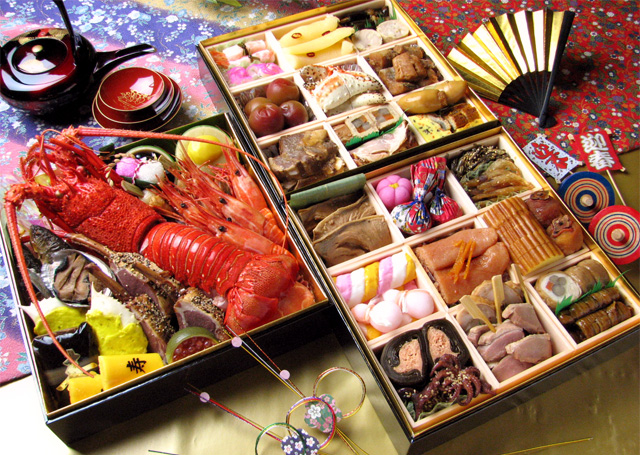
Osechi ryouri are normally arranged in nice lacquer boxes like this or this.

Disclaimer:
None of the pictures in this post belong to me. All rights belong to their original owners.

Tuesday, November 27, 2012

The Politeness Factor

It's been over a month since I last posted on the blog, and for that, I'm sorry. Although I realize that any sort of writing is better than no writing at all, I couldn't find an interesting topic to write about. I'll try to keep up with the blog better for now on.

I often thought about it before I came to Japan, but I didn't think about writing about what I would term the 'Politeness Factor' until a letter from a certain family member  came yesterday.

When I started studying Japanese, I noticed just how awkward the language sounded when it was translated to English. There's "honorable" this and "humble" that. There seems to be no end to the act of raising your partner's status while engaging in self-deprecation on your own side. And therein lies the question, "Does Japanese really sound like that? Does it always sound like you're speaking in what English would consider the 15th century, when you're calling people 'Lord' this and "honorable' that?" And the answer is No, it doesn't, if I'm forced to choose. Much of the language is based on set phrases, just as we have in English.

For example, when you meet someone, or when you are asking for something, you say the phrase "Yoroshiku onegai itashimasu." Although there is truly no equivalent phrase in English, it translates roughly as "Please take care of me" and "Please do this for me." This is merely a superficial translation, but it would be the same in English as saying "Nice to meet you." We don't really think about the meaning of "Nice to meet you" when we say it. Not saying it is rude. The same applies to Japanese.

Let's take another phrase, "Osewa ni natte orimasu" is said when you answer the phone or when someone has done something for your benefit. Failing to this phrase is also rude. Although the original meaning has been lost in some ways, it is still necessary to say it.

"That's fair, but it doesn't cover the need to change your words when you speak to someone higher or lower to you. And what's with all the 'sama' this and that?" you might ask. And that's where the Politeness Factor gets a bit more convoluted.

Let's take one word 'to go' (in Japanese, this is pronounced iku). What a simple word. How can this become difficult? And the answer is, very easily. Let's say I'm speaking with a friend, and I want to say that I'm going to the convenience store. I would use the simplest form of the verb and just say, "Konbini wo iku." But what if I'm speaking to someone a little older than me, or someone that I'm not as close to like his parents. Then, I would say "Konbini wo Ikimasu." These both mean the exactly the same thing, and up this point, Japanese is easy. However, let's say I'm speaking to my boss, or a customer, or someone that I perceive as high status, such as a doctor or the President. In this case, I want to be a bit more polite. To do this, I change the verb to mairimasu. It still means go, but it's a bit more academic and much more humble. Our new sentence is "Konbini wo mairimasu." All of this gets thrown out the window when you start talking about the other person. Then you need one more verb, and this one is to elevate their status. If the doctor is going to the convenience store, then I'll say Konbini wo irasshaimasu. This is where Japanese gets difficult. All of these sentences mean that I (in the first 3) or the doctor (in the last sentence) are going to the store, but the level of politeness differs.

The question is, "Why is it necessary?" Parents have to teach their kids this sort of language. Its full of irregulars, and they cannot pick it up on their own. They normally teach the kids right before they enter the workforce, so in your early 20s, you learn how to sound polite. If it's so difficult, wouldn't it be easier to just eliminate it? Unfortunately, this is not possible. Although dislikes learning it, it's seen as necessary. It's the difference between saying "Buh-bye" and "Have a good day" to a customer on the phone.

The simplest explanation I can give is that all of this depends on the Politeness Factor. If you are talking with someone you do not know, or someone that you perceive as high status, you want to show your respect for them. You speak differently to your family than to a business partner, and the same is true here. It is better to err on the side of politeness than to speak too casually to someone. The same applies in English. These senior-subordinate relationships are much less strict in the U.S., but that doesn't mean that we ignore them. You don't say 'Hey' to your boss; you say 'Hello.'

If you don't know how high of a status someone is - and by the way, you cannot ask what someone does in their job here because income is directly related to job status. It would effectively be like asking how much money someone makes - then, you have to speak politely. Being too polite is rude, but speaking politely is always appreciated no matter the culture. This is what I mean by the Politeness Factor. So, is it difficult to learn? Without a doubt. But is it necessary? Yes. Absolutely.

Tuesday, October 9, 2012

Of a Lack of Dryers

So I was thinking the other day about my first impressions when I came to Japan. Sometimes I forget what things used to be like, where everything new and exciting. It was really more of an adventure at first. Now, I've gotten used to my life here. And I still try new things, but it's more of the way that you try to do things in a city that you've lived in for a while. Anyway, back to the point, I was hanging up my laundry to dry yesterday when a memory came back to me.

I remember when I first came to Japan, I wasn't able to tell wealthy neighborhoods from poorer neighborhoods. Common signs in the States of wealth really don't apply here. For example, dryers are not common in Japan. I've seen them at coin laundries, but never in a home. Most people just hang their clothes to dry up on a pole outside, even in winter.

In the US, if you look up and see row and upon row of apartment buildings and houses with clothes hanging outside, you would normally assume that the area is not wealthy. But it's normal for here. Japanese homes just don't have the space for a dryer. There's also the belief that dryers shrink your clothes. Since the Japanese tend to buy very fitting clothes, they do not want to shrink them.

So the question is how do you tell so-called "wealthy" neighborhoods from their more humble counterparts? The answer to this is the types of stores, building materials, and city layout. Stores do not have to be super "chic" per say, but they do have to sell quality goods. Western stores like Zara, Banana Republic, Chanel tend to be in better areas. This is due to the fact that they have to make a profit due to the high import duties on their products, so they tend to go places like Ginza and Roppongi. However, if you go to Kyoto, the Gion district is one of the most expensive in Japan. The district is old and does not host any "fashionable" stores. Rather, it sells some of the highest quality teas in the country. It prides itself on its traditional roots, and people will pay for the experience.

The second method is by looking at the building materials. Most buildings are now built with flexible steel and other earthquake-proof materials. However, there are still a few traditional wooden houses. These traditional areas are highly prized because they have survived the bombings and previous fires. The techniques to make them have also be lost in the generations. If we look at more modern architecture, buildings with large windows and an open layout are more prized. Rent is expensive here, so if you find large buildings, you know that you're in a nice neighborhood. Family homes that have a car are also a sign of a very well-to-do neighborhood.

Finally, the last thing to consider is the city layout itself. Greenery is a very good sign of the economic health of the neighborhood. Along the train tracks in Kyoto, the neighbors work together to maintain the flowers for their block. Arashiyama is the former entertainment region for the old nobility. It has a large lake and it is surrounded by mountains. In Tokyo, areas like Sangenjaya and Daikanyama are considered upper-class. These areas have widespread green spaces and are well-kept. They are also located in the center of the city near train stations.

All in all, there are many signs of wealth in Japan. You only have to get used to looking to notice them. Although there are far more that I haven't named, it is because in some ways it's difficult to put a finger on it. Over time, you just learn. The important thing to realize is that wealth is not an indication of whether the neighborhood is safe or not. Since you don't find gated communities or the like here, people can walk anywhere. As long as you act normally, the majority of Japan is safe.

Monday, July 2, 2012

Meishi Culture

I also started my first day of work at the Company. I got my business cards (meishi) so I've become an effective member of society now (shakai-jin). Business cards are extremely important at any company, but particularly here in Japan. The business card is seen as an extension of yourself. Therefore, there are a few things to consider so as not to offend the card-holder. These can all be classified under business card exchange (meishi koukan).

The card will be turned to face the recipient so that it is aligned correctly to make it easily readable. You will never give/receive a meishi with your name upside-down from the recipient's point-of-view. In the case that both people are exchanging meishi at the same time, give your card with your left and accept the card with your right. The person going first depends on status. There is no guarantee that the senior individual will provide you with his card. You always want to confirm the name of the individual at the time since the kanji can be difficult.

The card should never be bent, folded, or dirtied in any way. This includes the common practice of flipping your card over and writing your contact information on it. This is a way of slighting the individual. If you soil the card, you are disrespecting the person himself. Writing on your own card shows that you do not respect yourself.

On the same note, do not put any meishi in a pocket without a business card holder (meishi-ire). This is also disrespectful since it could lead to the card's edges getting frayed. If you do not happen to have a meishi-ire, then wait until the person is well out of sight until you put it into a folder to protect it. Creating a little collection of meishi shows your business connections, so it needs to be kept clean for future reference.

Thursday, June 21, 2012

A Personal Seal

I went to the hanko-ya, seal shop, yesterday. I chose the size for my hanko, the type of material it's made from, and the font and case style. I received it today, and I have to say it looks lovely. I can't reveal what the stamp itself looks like for security purposes, but here's a picture of it resting in its case. (I turned the picture sideways once already, but it seems determined to be upright.)


A hanko is pretty important here in Japan. It takes the place of your signature on official documents. Without one, you can't open a bank account or conduct other official business. Once you get a hanko, you're supposed to register it with the government. However, since I don't have an apartment yet, I can't register mine.

Companies are very serious about your hanko. It is someone's job in the company to make sure of the accuracy of the seal. Since each one is slightly different, the company will take out a ruler and measure the stamp made by the seal. If anything is slightly different (i.e. the width of the border, the style of the font), then the company will reject the seal and demand that you bring the correct one. Until the correct seal is brought, they will not do business with you.

On the surface, this seems more than a little unproductive. If you have multiple seals, you have to remember which one you used. This could delay your business for a few days. If you lose the hanko, then no matter how hard you try, you will not be able to complete your business. However, since this is for security purposes, it presents a liability to the company. For this reason, you have to protect your hanko and make sure to never lose it. Otherwise, it presents a huge barrier.

The style of your hanko represents your status. The smaller size is common now. However, if you held a high position, such as the CEO of a company, or if you were a long-established business, you may have a large hanko. This represents pride but can convey arrogance.

In other news, it looks like I'll start looking at apartments Saturday. Tai and his family have been in contact with the realtor (fudousanya) for me. I'll update more in a couple days.