As you all may well know by this point, Japan has been involved with some territorial disputes over the past century. Although these are nothing new to the region, the situation has escalated recently. It all boils down to Japan's imperial times when it wanted to claim land to expand its national resources. Japan is in the precarious position where the only resource it has is fish, and even that is iffy with the recent overfishing and the 3.11 disaster.
Two different situations are escalating at the moment. The first is the issue with China. Japan claims the chain of eight islands as part of its territory. Located in what the Japanese call the Japan Sea, the islands are called the Senkaku Islands. They were found to be uninhabited and subsequently added to Okinawa prefecture in Southern Japan. In the 1970's, Japan announced that the Senkaku Islands were a prime fishing location and that they might have significant oil/gas deposits. China calls the islands the Diaoyu Islands, and insists that they have been used for centuries for fishing.
In September 2010, a Chinese fisherman tried to land on the island. He crashed into two Japanese coast guard vessels and was soon arrested. China cancelled a planned trip by 1,000 Japanese students to China in anger. Japan eventually released the fisherman and his crew, but insisted they not try to land on the islands again.
On August 15, 2012, the situation has escalated further. 14 people from Hong Kong sailed to one of the Senkaku islands and tried to land on it. 7 people managed to get to land. The Japanese Coast Guard released their video of the event. It shows a Coast Guard vessel firing water cannons and Hong Kong activists throwing bricks.
Chinese media has been very critical of the event and has asserted that the Japanese law is "worthless" and not meant to be followed since the lands are claimed by China. There are talks of boycotting Japanese products in China, though whether this will be successful, no one knows. Chinese activists have reportedly burned cars in protest. Another man stole the Hinomaru flag off of the Japanese ambassador's car after two vehicles boxed him in. The Chinese government has denounced the way which the Coast Guard handled the issue. It is also trying to reign in its own citizens before they further complicate the issue.
In contrast, Japanese activists have traveled to the islands to raise the Hinomaru flag on the island to reassert Japanese sovereignty over the land. Activists are stationed on top of a large van in Shibuya, shouting nationalist slogans that the islands belong to Japan and that people should stand up for the territory.
The Tokyo Metropolitan Government has tried to do a survey of the Senkaku Islands, but this proposal was rejected. Instead, the government has offered to buy three of the islands for 2 billion yen from the Kurihara family, who owns the property.
Sources:
"China-Japan Islands Row" (BBC)
"Ishihara's Senkaku survey Request gets thumbs down" (Japan Times)
"Japan Coast Guard releases footage of Senkaku clash with Chinese activists" (Japan Times)
"Chinese media hail activists" (Yomiuri Shinbun)
Showing posts with label news. Show all posts
Showing posts with label news. Show all posts
Saturday, September 1, 2012

Saturday, July 9, 2011
Of Blood Types
There's a fairly strong belief in Japan associated with blood type, or ketsuekigata (血液型) in Japanese. Like people's astrological signs, Japanese tend to identify themselves by their blood type. This is the same as you saying, "I'm a Virgo." Instead, this time, it's "I'm blood type A." Although you may scoff at the astrological signs analogy, perhaps it would be better to bring up the idea that birth order determines personality, which is a fairly common belief in the States. As far as I can find, positive and negative don't factor in to one's blood type personality.
This began around the 1900's while trying to classify ethnic traits. Perhaps the most influential of the writings on the effects of one's blood type can be seen in Takeji Furukawa's study titled "The Study of Temperament Through Blood Type." Despite the fact that Furukawa lacked a significant amount of credentials and the study was limited to about 20 people, the idea took hold. When Japan occupied Taiwan, a search was began for why the Taiwanese resisted so much to Japanese takeover. When it was found that they had type O, interbreeding was suggested in order to dilute the genes that had apparently made them so resistant. In the 1970's, several books were released, this time by Masahiko Nomi, who was a lawyer at the time. Nomi's works also lacked scientific evidence, but the idea remains popular today.
In the modern world, these are everywhere in Japan. Facebook and Twitter allow Japanese users to put up their blood types on their profiles. Matchmaking agencies will ask that their customers reveal their blood type in order to ensure a successful match. References to it are frequently seen in magazines, and Japanese Wikipedia actually lists celebrities' blood type in their info. Friends will often ask you what your blood type is, and not knowing it blood type can lead to mixed degrees of shock.
So what makes these blood types so important? It's believed that they determine one's personality as well as one's compatibility with another individual. People will not date certain blood types because of their "negative" traits.
But surely this is just popular culture right? It's just a bunch of teenage girls with nothing better to do than look in their Cosmo magazine and try to figure out if they match up with their potential crush. Sadly, that's not the case. This is believed by everyone from youths to adults, from the common man to the most educated. In fact, the other day the head of the reconstruction effort up in Touhoku had to resign after only a week in office because he said something extremely insensitive to the victims of the disaster. By stating basically that "the country will not help you until you find decent plans to help yourself," calls for resignation rose. He blamed this on his B blood type, and although no one accepts that from a politician - because it really is a sorry excuse - people will blame their faults on their blood types normally. So, let's look at them shall we? These are divided into their positive and negative traits for each type. Whether one is A+ or A- does not matter to this chart.
A: Positive: Creative, sensible, reliable, patient, responsible, neat, takes care of others before oneself
Negative: Overly detailed, overly earnest, stubborn, tense
B: Positive: Wild, active, creative, passionate, strong, does things that they set their mind to
Negative: Selfish, irresponsible, unforgiving, unpredictable
AB: Positive: Cool, controlled, rational, sociable, adaptable
Negative: Critical, indecisive, forgetful, irresponsible, has a "split personality"
O: Positive: Agreeable, sociable, optimistic
Negative: Vain, rude, jealous, arrogant
Just for your information, type B tends to be the most common here, while back in the States, it's type O.
This began around the 1900's while trying to classify ethnic traits. Perhaps the most influential of the writings on the effects of one's blood type can be seen in Takeji Furukawa's study titled "The Study of Temperament Through Blood Type." Despite the fact that Furukawa lacked a significant amount of credentials and the study was limited to about 20 people, the idea took hold. When Japan occupied Taiwan, a search was began for why the Taiwanese resisted so much to Japanese takeover. When it was found that they had type O, interbreeding was suggested in order to dilute the genes that had apparently made them so resistant. In the 1970's, several books were released, this time by Masahiko Nomi, who was a lawyer at the time. Nomi's works also lacked scientific evidence, but the idea remains popular today.
In the modern world, these are everywhere in Japan. Facebook and Twitter allow Japanese users to put up their blood types on their profiles. Matchmaking agencies will ask that their customers reveal their blood type in order to ensure a successful match. References to it are frequently seen in magazines, and Japanese Wikipedia actually lists celebrities' blood type in their info. Friends will often ask you what your blood type is, and not knowing it blood type can lead to mixed degrees of shock.
So what makes these blood types so important? It's believed that they determine one's personality as well as one's compatibility with another individual. People will not date certain blood types because of their "negative" traits.
But surely this is just popular culture right? It's just a bunch of teenage girls with nothing better to do than look in their Cosmo magazine and try to figure out if they match up with their potential crush. Sadly, that's not the case. This is believed by everyone from youths to adults, from the common man to the most educated. In fact, the other day the head of the reconstruction effort up in Touhoku had to resign after only a week in office because he said something extremely insensitive to the victims of the disaster. By stating basically that "the country will not help you until you find decent plans to help yourself," calls for resignation rose. He blamed this on his B blood type, and although no one accepts that from a politician - because it really is a sorry excuse - people will blame their faults on their blood types normally. So, let's look at them shall we? These are divided into their positive and negative traits for each type. Whether one is A+ or A- does not matter to this chart.
A: Positive: Creative, sensible, reliable, patient, responsible, neat, takes care of others before oneself
Negative: Overly detailed, overly earnest, stubborn, tense
B: Positive: Wild, active, creative, passionate, strong, does things that they set their mind to
Negative: Selfish, irresponsible, unforgiving, unpredictable
AB: Positive: Cool, controlled, rational, sociable, adaptable
Negative: Critical, indecisive, forgetful, irresponsible, has a "split personality"
O: Positive: Agreeable, sociable, optimistic
Negative: Vain, rude, jealous, arrogant
Just for your information, type B tends to be the most common here, while back in the States, it's type O.
Monday, April 11, 2011
Of an "Aftershock"
Japan has been experiencing hundreds of aftershocks since the big quake. Many of them are strong, rivaling what we could call simply another earthquake. Today's hit near Iwaki city which is in Fukushima prefecture, registering at a 7.1. For those up in Touhoku, it's impossible to imagine what they could be going through. Power is being restored, but these quakes keep knocking it out. Some people, sick of being in the evacuation centers, are trying to return to their homes. When they do so though, they're finding even simple life is difficult. Without electricity and running water, they can't really cook their food or a number of other things. I read an article the other day which was talking about a woman who is living in her house, and she talks about how much things have changed. She also mentioned how little luxuries like clean underwear are provided at the evacuation centers, but not necessarily in her home anymore since she's unable to do laundry. People are worrying about health issues.
I watched the news today when the aftershock hit, and I have to say it looked a bit end-of-the-world-ish. The sky was dark, even though it was still fairly early in the evening. It looked like the camera honestly was being shaken by someone. It's hard to imagine the entire ground moving while buildings sway on top. It was lightning and promptly began pouring. I'm honestly wondering how much these plates have moved. A tsunami warning was given, but it's only a meter, so it should be lifted soon if it hasn't been already. I admit, I haven't checked since I live on a plateau between mountains and a 1 meter really shouldn't do that much damage.
I think some schools were planning to resume school today in Miyagi prefecture, but I'm not sure if they did or not.
The evacuation zone was extended to 30 km. No worries, it's still far away, and I think that a significant number of people had already evacuated.
The nuclear reactors were not hurt in the quake. They remain in their current state.
Classes were good today. I had Comprehensive as well as Listening & Speaking. We just talked about hanami, earthquakes, and the nuclear situation. It was more interesting than learning about what we were supposed to learning about. And since my class was only 4 today, it was easily manipulated.
In good news, I'm going to Tokyo this Friday! I'll get to see Tai and his family, and just overall have a good time. I bought my Shinkansen ticket the other day. I'm so excited.
Source:
Japan expands nuclear evacuation zone as new quake hits (Reuters)
I watched the news today when the aftershock hit, and I have to say it looked a bit end-of-the-world-ish. The sky was dark, even though it was still fairly early in the evening. It looked like the camera honestly was being shaken by someone. It's hard to imagine the entire ground moving while buildings sway on top. It was lightning and promptly began pouring. I'm honestly wondering how much these plates have moved. A tsunami warning was given, but it's only a meter, so it should be lifted soon if it hasn't been already. I admit, I haven't checked since I live on a plateau between mountains and a 1 meter really shouldn't do that much damage.
I think some schools were planning to resume school today in Miyagi prefecture, but I'm not sure if they did or not.
The evacuation zone was extended to 30 km. No worries, it's still far away, and I think that a significant number of people had already evacuated.
The nuclear reactors were not hurt in the quake. They remain in their current state.
Classes were good today. I had Comprehensive as well as Listening & Speaking. We just talked about hanami, earthquakes, and the nuclear situation. It was more interesting than learning about what we were supposed to learning about. And since my class was only 4 today, it was easily manipulated.
In good news, I'm going to Tokyo this Friday! I'll get to see Tai and his family, and just overall have a good time. I bought my Shinkansen ticket the other day. I'm so excited.
Source:
Japan expands nuclear evacuation zone as new quake hits (Reuters)
Sunday, April 10, 2011
Of Sushi
Another bright and sunny day here in Kyoto. Spring has finally arrived, and it's beautiful. With that in mind, classes started the other day. Things are going well so far. I'm in B class. They go from F to A, A being the highest before you're put into seiki level, which is when you can take classes in Japanese with Japanese students. As is, I can take classes in English with them, but not their normal Japanese classes. Not gonna' lie, understanding is fine, so I may sneak into a couple this semester anyway if I get the chance. As is, right now I'm taking a Comprehensive Japanese class, a Listening & Speaking class, a Writing course, as well as International Organizations (which focuses on NGOs, etc.), Political Economies of East Asia (comparing Japan, China, Korea), possibly a Women's Studies course which is focused on women in war (I know. Not my specialty, but interesting), and last but not least, hopefully a International Management course (which looks at the logistics and marketing strategies of an international corporation). Overall, a pretty decent schedule if I do say so myself.
To answer a quick question that was posted in comments, classes will continue as normal. Kansai is in fact so fine that nothing will change whatsoever with regard to classes. We may take in some more students though who are refugees. Therefore, no worries with class schedules changing unless something major strikes Kansai. The rest of Japan is obviously a bit more affected. According to Tai, Rikkyo University is only taking in two international students this semester because the rest cancelled due to fears of going to Tokyo. I'd like to say that I'm personally proud of those students and especially one of them since he is also from Miami.
What people aren't understanding abroad is that Japan is quite a big country. The problem is that it's normally compared to California. People therefore get a little nervous because California is only 1 state in a country of 50 of them. However, Japan is also relatively the same size as Italy. Because Italy is a country and not a state (by the American English definition of course), people suddenly become much calmer. Therefore, I'd like to propose comparing Japan to Italy in size for the rest of time.
Due to the belief that Japan is a small country, people are refusing to buy fish from Japan. I understand as much as the next person that when you hear about radioactive materials being dumped into the ocean, the last thing you want to do is go eat fish. Most of Japan's fishing is done farther away from the coast though. This is due to past overfishing problems. But Michelle, you might say, fish swim. They can swim close to the coast. And yes, they can. I don't deny it. But if you're concerned about that, then don't eat fish that live close to shore. Those that live out in deeper waters should of course be checked, but if they make it into your markets, they are safe. Japan's economy depends on exports. They will be responsible in this.
In order to prevent more radiation from escaping to the ocean though, TEPCO has installed steel barriers and silt fences. Although I'm not sure about the effectiveness of this, we can only trust them for now.
I love me a good plate of sushi and honestly, if I can eat it here, then you can eat it thousands of miles away. Furthermore, most sushi restaurants abroad are actually switching to fish from other places. Even Japan is not necessarily making sushi from locally caught fish at times. If you're eating salmon sushi for example, it much more likely that it will be from Norway, and your tuna will likely be from Spain. The term sushi (寿司) refers to fish that is offered with vinegared rice. It is a preparation style, and in no way requires the fish to be harvested from Japanese waters. The only requirement of that fish is that it must be of an exceptionally high quality to serve raw. If it is not, you could end up making your customers sick.
So, this begs the question, which is sushi? In the West, it often refers to what is called makizushi (巻寿司) here in Japan. This is the rolled sushi. It is rice, fish, and sometimes vegetables wrapped with rice in a piece of nori (海苔) or seaweed. A second of type of sushi is nigirizushi (握り寿司). This is hand-formed sushi which is a bit of rice, some wasabi, and fish or something on top. There is also oshizushi (押し寿司), which is literally "pressed sushi." This is specialty in Osaka, where a block-type sushi is formed. There is also inarizushi (稲荷寿司), which is a wrapper made of fried tofu filled with sushi rice. It was believed to be a favorite of the god Inari. I actually find this to be quite sweet, and normally reserve it as a dessert-type sushi for this reason. Second to last, we have chirashizushi (ちらし寿司), which is literally a "scattered sushi." This is when the fish is put on top of rice in a bowl. Lastly, there is narezushi (熟れ寿司), which I actually haven't had yet, but it's been fermented. Considering that Kyoto is known for it's fermented foods, I'll have to check it out.
So, now that we got cleared up. Please don't put your local sushi restaurant out of business. Go support them. It's delicious, and you should at enjoy it when you know its safe.
Oh, and before I go, I'd just like to state that I want a subscription to NIKKEI Shinbun so bad. Because I currently don't have a subscription, their newest articles right now are locked. I have to figure out the cost of it, but I think it'd be nice.
Sources:
Friday, April 8, 2011
Of Jishuku
Well-rested and English working properly again, I feel as if I can write a blog post to everyone now. In a brief update about last night's 7.4 quake, I'd like to note that no significant damage occurred. Only 2 people are known to have died, and a few injured. The Fukushima Daiichi Plant is as stable as it was before the earthquake. Workers were briefly evacuated due to tsunami concerns, but that tsunami warning was lifted, so they went back to fixing the reactor. And before you comment on hearing that there was a tsunami, please understand that it was a meter high. That's nothing. It's like a wave. So, continuing on with things that not overblown in the US news. After doing some silicone gel work, it seems like the leak was slowed and possibly stopped the other day. Not sure on this though because I admit I've been a tad busy as of late.
The lack of food in the Touhoku region is still continuing to hurt the residents there. It's a shame that they've survived through all this only to have to face possible starvation. The government and other groups are distributing food of course, but having the food and having the manpower to distribute the food are different. Japan can get through this, but it's going to take an army of volunteers to do it.
The yen is slowly falling. In a way, this is good. It means that Japanese products will become cheaper for consumers abroad, but at the same time, this is a problem because it's somewhat indicative of a future recession.
Other countries have banned or are checking Japanese products carefully. Although it is understandable, the bans are a shame. The last thing Japan needs right now is for people not to buy its exports. The answer is rather simple in this case. Don't buy things from the area directly near the plant. Kansai and further south are fine. That means things like Kobe beef are safe.
Tourists to Japan are still few. So the Japanese economy is suffering in this way as well.
Actually, the point of this post is to talk about something called jishuku (自粛), or self-restraint. Something amazing has happened to Japan since the quake. In a country which quite frankly prefers expensive goods over cheap ones and brand names over non-brand names, the practice of jishuku was rarer earlier this year. For example, let's look at a fairly common brand name in the States, which is Coach. Coach sells purses, bags, wallets, etc. It's a fine leather maker shop, and it's pretty well-respected in my opinion. In the US, Coach is also considered ridiculously expensive, and for good reason. If you sold bags at the same price in Japan as what you sell in them in the US though, people would not buy them because they would be too cheap for a brand name. That means brand name goods are tripled normally in cost. So if a bag costs $100 in the US, it will cost $300 in Japan. Levi jeans are another good example. I think you can buy them for $20 in the States. The cheapest that I've found them in Japan is $150, and that's the absolute cheapest. I've seen them go for as high as $300. So, what does this have to do with jishuku?
People prided themselves in the past on having luxury goods. It's the same the world round I suppose, but it was definitely theme here in Japan. However, since the earthquake, the practice of jishuku has come back in full force. Watching the TV, hearing the news, and looking at refugees who continue to stream into safer areas, the majority of people have decided to engage in the practice of jishuku. They just don't feel as if they deserve to enjoy a luxury product at the moment when some people don't even have houses, let alone food. In some ways, this has really helped Japan. Japan was supposed to suffer from planned rolling blackouts through April, but because people were conserving so much power, that idea was able to be cancelled. In the summer when energy use increases, we'll see if they're reinstated, but for now, this is definitely a positive. However, the cabinet ministers are urging people not to engage in jishuku when it comes to commodities. Japan needs money to rebuild and it can't do that when people aren't spending money. This of course is a double-edged sword though. If you tell people not to restrain themselves, will they start using goods that they should conserve, like food, water, electricity, gas, etc. If that's true, then it's dangerous to say to stop the feeling of self-restraint. Personally though, I'm for the idea. The economy needs to be boosted, and if you can emphasize still conserving on necessary goods while not necessarily conserving on luxury goods, maybe it would help things out.
Sources:
China concerned at Japan's prolonged nuclear crisis (Reuters)
「自粛ムードやめよう」閣僚から発言相次ぐ (朝日新聞)
The lack of food in the Touhoku region is still continuing to hurt the residents there. It's a shame that they've survived through all this only to have to face possible starvation. The government and other groups are distributing food of course, but having the food and having the manpower to distribute the food are different. Japan can get through this, but it's going to take an army of volunteers to do it.
The yen is slowly falling. In a way, this is good. It means that Japanese products will become cheaper for consumers abroad, but at the same time, this is a problem because it's somewhat indicative of a future recession.
Other countries have banned or are checking Japanese products carefully. Although it is understandable, the bans are a shame. The last thing Japan needs right now is for people not to buy its exports. The answer is rather simple in this case. Don't buy things from the area directly near the plant. Kansai and further south are fine. That means things like Kobe beef are safe.
Tourists to Japan are still few. So the Japanese economy is suffering in this way as well.
Actually, the point of this post is to talk about something called jishuku (自粛), or self-restraint. Something amazing has happened to Japan since the quake. In a country which quite frankly prefers expensive goods over cheap ones and brand names over non-brand names, the practice of jishuku was rarer earlier this year. For example, let's look at a fairly common brand name in the States, which is Coach. Coach sells purses, bags, wallets, etc. It's a fine leather maker shop, and it's pretty well-respected in my opinion. In the US, Coach is also considered ridiculously expensive, and for good reason. If you sold bags at the same price in Japan as what you sell in them in the US though, people would not buy them because they would be too cheap for a brand name. That means brand name goods are tripled normally in cost. So if a bag costs $100 in the US, it will cost $300 in Japan. Levi jeans are another good example. I think you can buy them for $20 in the States. The cheapest that I've found them in Japan is $150, and that's the absolute cheapest. I've seen them go for as high as $300. So, what does this have to do with jishuku?
People prided themselves in the past on having luxury goods. It's the same the world round I suppose, but it was definitely theme here in Japan. However, since the earthquake, the practice of jishuku has come back in full force. Watching the TV, hearing the news, and looking at refugees who continue to stream into safer areas, the majority of people have decided to engage in the practice of jishuku. They just don't feel as if they deserve to enjoy a luxury product at the moment when some people don't even have houses, let alone food. In some ways, this has really helped Japan. Japan was supposed to suffer from planned rolling blackouts through April, but because people were conserving so much power, that idea was able to be cancelled. In the summer when energy use increases, we'll see if they're reinstated, but for now, this is definitely a positive. However, the cabinet ministers are urging people not to engage in jishuku when it comes to commodities. Japan needs money to rebuild and it can't do that when people aren't spending money. This of course is a double-edged sword though. If you tell people not to restrain themselves, will they start using goods that they should conserve, like food, water, electricity, gas, etc. If that's true, then it's dangerous to say to stop the feeling of self-restraint. Personally though, I'm for the idea. The economy needs to be boosted, and if you can emphasize still conserving on necessary goods while not necessarily conserving on luxury goods, maybe it would help things out.
Sources:
China concerned at Japan's prolonged nuclear crisis (Reuters)
「自粛ムードやめよう」閣僚から発言相次ぐ (朝日新聞)
Another Earthquake
I don't want to write about these anymore. They're depressing. But I'll uphold my duty and write about it because otherwise who knows what will appear overseas. Plus, this is a sort of catalogue of my time in Japan, so I should at least catalogue correctly I suppose. Another earthquake just hit Japan. The Japanese news says that it was a 6, about 74 miles from Fukushima. Reuters says it was a 7.4 at the epicenter. There's a tsunami warning, but it looks like it's only around .5 m in the Tokyo and Touhoku areas. Near the reactor though it's closer to 2 m. No worries. Obviously, I still remain nothing of an expert on the topic of earthquakes and tsunami prevention, but the Fukushima Daiichi Plant is on a hill. So things should be ok. I was skyping Tai when it hit. The camera was shaking pretty bad in Tokyo where it registered at a 3, but otherwise it seems like things are ok. The only worry is that it really was a long earthquake. Like it seemed like it went on for a couple minutes. I don't know what's the earthquakes here recently, but the earth should never shake for a couple minutes, get stronger, and then weaken in strength. It's just wild.
Don't be worried though. To be honest, we expected this. The chance of us having another M7 earthquake this month was about 50% or so.
Is there any other news? I'm not sure. It's almost 1 am and I'm exhausted.
Japan is trying to get back on its feet, but these earthquakes are making it more difficult. I urge everyone to continue to donate in order to help those affected.
Still felt nothing in Kyoto. Everything continues to be safe here. Though I almost wish that it would hit here rather than continuing to hit those who are already affected and struggling to return to normal.
Miami apparently cancelled their trip to Japan. They do something called PacRim every year where they go to China, Korea, Japan, but they're not coming to Japan this summer. It's normally only a week that they spend here but it's a shame. In order to fully appreciate the business world, especially in this region, one needs to understand how Japan influences and is influenced by the surrounding countries. They still continue to support us who are studying abroad. No problems there. I understand they don't want to necessarily assure the safety of a large group in an area which has had so many natural disasters recently, but it's a shame. Japan is being hurt by the lack of tourists. Normally, Kyoto would be teeming with tourists who want to see the cherry blossoms. But there are significantly less than normal. Sure it makes the commutes easier, but it's depressing in a sort of way. Japan needs the tourism in order to boost its economy. But taking care of tourists right night would also be a mess. So who knows what the right decision is.
Is my English bad right now? I feel like it is. My grandpa just skyped me and I swear I almost spoke to him in Japanese...That's amazing honestly because my Japanese speaking continues to be at the top of the lousy scale.
Had classes today. It was nice to start class again, but more on that in another post. I'm going to class again tomorrow. Luckily they don't start till later (round 4). Sure the current earthquake will be the topic of conversation there. If you have questions, comment in the posts. I'll do my best to answer them and prevent more unfounded panic. More soon.
Michelle
Don't be worried though. To be honest, we expected this. The chance of us having another M7 earthquake this month was about 50% or so.
Is there any other news? I'm not sure. It's almost 1 am and I'm exhausted.
Japan is trying to get back on its feet, but these earthquakes are making it more difficult. I urge everyone to continue to donate in order to help those affected.
Still felt nothing in Kyoto. Everything continues to be safe here. Though I almost wish that it would hit here rather than continuing to hit those who are already affected and struggling to return to normal.
Miami apparently cancelled their trip to Japan. They do something called PacRim every year where they go to China, Korea, Japan, but they're not coming to Japan this summer. It's normally only a week that they spend here but it's a shame. In order to fully appreciate the business world, especially in this region, one needs to understand how Japan influences and is influenced by the surrounding countries. They still continue to support us who are studying abroad. No problems there. I understand they don't want to necessarily assure the safety of a large group in an area which has had so many natural disasters recently, but it's a shame. Japan is being hurt by the lack of tourists. Normally, Kyoto would be teeming with tourists who want to see the cherry blossoms. But there are significantly less than normal. Sure it makes the commutes easier, but it's depressing in a sort of way. Japan needs the tourism in order to boost its economy. But taking care of tourists right night would also be a mess. So who knows what the right decision is.
Is my English bad right now? I feel like it is. My grandpa just skyped me and I swear I almost spoke to him in Japanese...That's amazing honestly because my Japanese speaking continues to be at the top of the lousy scale.
Had classes today. It was nice to start class again, but more on that in another post. I'm going to class again tomorrow. Luckily they don't start till later (round 4). Sure the current earthquake will be the topic of conversation there. If you have questions, comment in the posts. I'll do my best to answer them and prevent more unfounded panic. More soon.
Michelle
Wednesday, April 6, 2011
Of the Loan
So I really don't want to focus on the nuclear situation this post, but I'll mention it just to keep you all updated. It definitely looks like this will be a process of months to get this plant under control in Fukushima. To try to find all the leak, TEPCO resorted to using bath salts the other day to produce a milky color in the water that could then be traced. The superabsorbent polymer method did not work. I'm not sure when things will be under control. I have a quick revision to my last post. I had mentioned that three mega-banks were going to give a loan to TEPCO. This loan is extremely risky, even for them. The amount that they're loaning is equal to their consolidated net profit. This was actually in that NIKKEI article, but I had to learn the word 匹敵する(hitteki suru) first.
Radiation levels in the ocean have risen significantly. Fish must now be checked in order to be sold.
I attended the Ritsumeikan Entrance Ceremony yesterday. The first half was full of serious speeches. The second was more light-hearted with music, interviews, and club recruiting. It was interesting. I managed to get a high-five from one of the football players.
I also went to 花見 (hanami), flower-viewing, tonight. The cherry blossoms 桜 (sakura) are blooming, so it's really beautiful. It was nice to just spend time with friends, make new friends, and for a little bit just appreciate the beauty around us. It's a stark contrast with the news that we're being surrounded with every day. On campus, the main topic is still the earthquake and what we can do to help. Everyone is checking on their friends, making sure they're ok. What we're finding is that often our friends our ok, but their families and homes are not. However, order remains. And the most common phrase you'll here now is 無事でよかった (buji de yokatta), I'm glad that you're safe.
I have to go to class tomorrow to figure out my classes. The semester starts Thursday.
I'm off now to get some sleep and prepare for a new day. Everyone take care!
Michelle
Radiation levels in the ocean have risen significantly. Fish must now be checked in order to be sold.
I attended the Ritsumeikan Entrance Ceremony yesterday. The first half was full of serious speeches. The second was more light-hearted with music, interviews, and club recruiting. It was interesting. I managed to get a high-five from one of the football players.
I also went to 花見 (hanami), flower-viewing, tonight. The cherry blossoms 桜 (sakura) are blooming, so it's really beautiful. It was nice to just spend time with friends, make new friends, and for a little bit just appreciate the beauty around us. It's a stark contrast with the news that we're being surrounded with every day. On campus, the main topic is still the earthquake and what we can do to help. Everyone is checking on their friends, making sure they're ok. What we're finding is that often our friends our ok, but their families and homes are not. However, order remains. And the most common phrase you'll here now is 無事でよかった (buji de yokatta), I'm glad that you're safe.
I have to go to class tomorrow to figure out my classes. The semester starts Thursday.
I'm off now to get some sleep and prepare for a new day. Everyone take care!
Michelle
Sunday, April 3, 2011
Leak Source Found
The source of the leak or possibly one of the sources of the leak that has led to contaminated water has been found at the Fukushima Plant. Apparently there's a crack in a concrete pit in the No. 2 reactor. They already tried pouring concrete into the pit in an attempt to seal the crack, but this was not successful. So TEPCO has turned to water-absorbent polymers instead. Although this isn't my forte, from what I understand, there's two type of superabsorbent polymers: low and high density. Essentially they link with the hydrogen molecules in water to form a bond. They can hold anything from 50 to 500 times their own weight, acting as a sort of preventative gel or film against further leakage. They've been used in feminine sanitary napkins, baby diapers, disposable bed liners, candles, surgical pads, etc. So far, there's been no word if this has been successful.
Prime Minister Kan is under intense pressure recently to resign and call a snap election. He's been accused by TEPCO and news media for traveling to the affected area too quickly which apparently halted the restabilization effort. Then, he's been accused by everyone for not going and helping the evacuees. Finally, people have become irritated for his disappearance altogether from the political scene. This is just my personal and humble opinion, but I think maybe the Japanese are being a little hard on him. My friend, Jazmin, and I are really debating whether they know how long a prime minister is supposed to stay in office. They seem to get rid of them every two months or so. At the same time though, I do understand where people are coming from. If I didn't know better, Iwould think that Edano, the Cabinet Secretary, was the Prime Minister. He's on the news every couple hours giving a press conference. I really hope he's getting his sleep because without him I don't know what Japan will do.
Produce continues to be stopped from Fukushima, and the little that gets through people will not buy. Farmers are asked to pour their milk into pits because it can't be shipped to the public. I'm not sure what they're doing with the produce. The ground and water is becoming more contaminated. Other farmers in Japan are worried. Overseas, it seems like there's a backlash going on against Japanese produce, and farmers whose food is safe are being hurt. In Japan, people are having to prove that their produce to safe, so apparently, according to Reuters at least, there have been some farmers who have bought Geiger counters (I haven't heard about this anywhere else though.)
Actually, one of the main problems that has come up from this disaster is what to do with the bodies. The death toll has reached 28,000. If they burn the bodies outside, then they are afraid that the contamination will get into the air. If they bury them, it could further contaminate the soil. It's Buddhist tradition to burn the bodies, and to bury the ashes in the family grave. But right now, there's not enough wood or flammable materials to burn all of them. Mass graves have been dug, but whether these will be permanent or not is unsure.
Three mega banks, one of which is Mitsuo Sumitomo, are planning to loan 2 trillion yen (about 23 billion US dollars ) to TEPCO in order to rebuild, restabilize, and compensate all those who have been affected. This is necessary in order for TEPCO not collapse and further affect eastern and northern Japan.
In other news, the cherry blossoms have started blooming. Despite all of the destruction that's occurred, they're beautiful, and since they last for a few days, people are trying to enjoy them. Normally by this time, there would be big friend and company parties but they seem a little toned down this year.
Sources:
Japan says it may take months to end radiation leaks (Reuters)
東電へ2兆円融資、銀行団も背水の陣 (NIKKEI)
Prime Minister Kan is under intense pressure recently to resign and call a snap election. He's been accused by TEPCO and news media for traveling to the affected area too quickly which apparently halted the restabilization effort. Then, he's been accused by everyone for not going and helping the evacuees. Finally, people have become irritated for his disappearance altogether from the political scene. This is just my personal and humble opinion, but I think maybe the Japanese are being a little hard on him. My friend, Jazmin, and I are really debating whether they know how long a prime minister is supposed to stay in office. They seem to get rid of them every two months or so. At the same time though, I do understand where people are coming from. If I didn't know better, Iwould think that Edano, the Cabinet Secretary, was the Prime Minister. He's on the news every couple hours giving a press conference. I really hope he's getting his sleep because without him I don't know what Japan will do.
Produce continues to be stopped from Fukushima, and the little that gets through people will not buy. Farmers are asked to pour their milk into pits because it can't be shipped to the public. I'm not sure what they're doing with the produce. The ground and water is becoming more contaminated. Other farmers in Japan are worried. Overseas, it seems like there's a backlash going on against Japanese produce, and farmers whose food is safe are being hurt. In Japan, people are having to prove that their produce to safe, so apparently, according to Reuters at least, there have been some farmers who have bought Geiger counters (I haven't heard about this anywhere else though.)
Actually, one of the main problems that has come up from this disaster is what to do with the bodies. The death toll has reached 28,000. If they burn the bodies outside, then they are afraid that the contamination will get into the air. If they bury them, it could further contaminate the soil. It's Buddhist tradition to burn the bodies, and to bury the ashes in the family grave. But right now, there's not enough wood or flammable materials to burn all of them. Mass graves have been dug, but whether these will be permanent or not is unsure.
Three mega banks, one of which is Mitsuo Sumitomo, are planning to loan 2 trillion yen (about 23 billion US dollars ) to TEPCO in order to rebuild, restabilize, and compensate all those who have been affected. This is necessary in order for TEPCO not collapse and further affect eastern and northern Japan.
In other news, the cherry blossoms have started blooming. Despite all of the destruction that's occurred, they're beautiful, and since they last for a few days, people are trying to enjoy them. Normally by this time, there would be big friend and company parties but they seem a little toned down this year.
Sources:
Japan says it may take months to end radiation leaks (Reuters)
東電へ2兆円融資、銀行団も背水の陣 (NIKKEI)
Wednesday, March 30, 2011
Of Apologies and TEPCO
I'm sitting here at my desk supposed to studying for the test that's only in a few days, but instead, I'm reading the news. Sometimes you want to stay away from it, you know? Whenever you open it, it's never good anymore, but then you realize that you should at least stay educated about what's happening around you, so you pull it up yet again feeling like you're prepared for the worst, and yet you're never prepared. Posts by friends up on Facebook consist of things like "It's a nightmare, but I firmly believe it won't get worse;" "Ganbatte Nihon (Do your best Japan!);" and just general wanting to help. Although it seems like most of the world has started to focus back on the Jasmine Revolution, that couldn't be further from everyone's minds here. We continue to assure those abroad that we're fine, and the Kansai area remains a place of refuge for all: pregnant women and children, foreigners who have been told to evacuate here from their governments, and the list goes on.
Frustration continues with regard to TEPCO. Since the disaster began, TEPCO officials have continued to state how this sort of catastrophe could not be predicted, but recent news leaks show differently. Most of Japan's reactors tend to be near the coast for the reason or if there was a cooling failure in the plant, they would have quick access to water to cool the reactors. However, this also exposes them to tsunamis. The Fukushima Plant is located on top of a hill, and it was built in mind with the idea that a tsunami would not overcome the 6 m (20 ft) wall up to the plant. When they did the calculations, apparently there was only a 10 percent chance of this happening in the next 50 years. However, the tsunami that hit the plant on March 11 was 14 m high. The government held utilities in charge of the plant responsible for assuring that they could withstand this kind of disaster situation.
Due to public and international doubts, TEPCO's stocks fell 18% the other day. There are thoughts that TEPCO might be nationalized. On a normal day, TEPCO provides enough power to power all of Britain. Therefore, you can't just shut down the company; the effects would be enormous and would compound the problems. If the government doesn't take over TEPCO, the likelihood that the company will collapse is high. According to the Wall Street Journal, the government must take over the company, remove top management, and possibly change the name as well to avoid further adding to Japan's problems.
TEPCO's president in an interview just admitted when asked about the current state of the plant, "Frankly, I'm very sorry. We don't know. First, the most pressing matter is to cool reactors 1-4."「正直申し上げて分からない。まずは1〜4号機を冷却するのが急務だ。」
TEPCO's president along with other high-ranking TEPCO officials just issued an apology to the nation stating approximately, "For all the difficulties with safety/security, I'd like to apologize. We are giving our full effort to the restoration work. While for now it is important to have everyone's support, you have my word that we will compensate for the damage."
Right now the government is debating how to best handle the situation of the contaminated water spreading into the ocean. They are considering using a tanker to collect the water from the underground tunnels, but of course what to do with said water is still up in the air.
Prime Minister Kan is dealing with increased calls for his resignation as well as debating whether to extend the evacuation zone beyond 20 km. Doing so would displace over 100,000 more people, but not doing so could threaten their health.
A quick note, if you want to read a very good summary of how things are today, I'd really recommend going to the last source "Seawater Radiation Level Soars Near Plant" by the WSJ. It is accurate and actually tells how things are at the moment.
A quick note, if you want to read a very good summary of how things are today, I'd really recommend going to the last source "Seawater Radiation Level Soars Near Plant" by the WSJ. It is accurate and actually tells how things are at the moment.
Sources:
原発建屋に布、汚染水回収にタンカー案 政府が検討 (NIKKEI)
東電会社「心からおわび」福島第1原発事故 (NIKKEI)
Monday, March 28, 2011
Of Some Confusion
TEPCO has been less than useful recently. We're told that the area around the Fukushima plant is high in radiation. Workers can only be in the reactors for a few minutes a time and there's radioactive particles in the water in the tunnels where they are working, compounding the issue. Furthermore, a warning bell went off which sent workers out of the reactor the other day. Then, we receive news that this was a malfunction in their system and the radiation actually wasn't that high. Other news sources such as Reuters, MIT, etc. report that even though the radiation is high near the reactor, people further away are fine. The radiation will be diluted by the sea and it will be so minuscule by the time that fish and other aquatic life consume it, it will be virtually nil. They tested water 30 km away for this. Radiation levels in downtown Tokyo are even lower than normal world averages. The water in Tokyo is safe another day for infants to drink, but that's not true in Chiba and some other prefectures that are closer to the reactor. It's gotten to the point here frankly the NY Times, CNN, FOX are just ignored for their continued "imminent doom" proclamations, and Reuters, MIT, and Nikkei are just releasing all information that they can confirm. This means that their reports often seem to be conflicting, but yet calming. The one thing that has risen out of this is the common belief that TEPCO needs to be more open, that the UN needs to help out more, and that everyone is infinitely grateful for those who have gone to the reactors to help. The workers and engineers there are not getting paid anymore than normal, and even though their families urge them not to go, they continue to go because their sense of duty to the safety of the country's people around them is their main priority.
Class schedules continue to be up in the air. We finally received the schedule today, and although everything seems to be on time, even things in Kansai are a little scattered. Students are arriving late, still waiting on their governments to give them permission to come. Some are coming even without that permission though.
I went out and bought the JLPT Registration form today. I've filled it out, and I'll take it to the post office soon to go get that finished. It's official: Level 2. Right now, I definitely can't pass it. But I'll study and do my best to try to be ready.
I have to register for classes back at Miami tomorrow. I can't even explain how far that seems from my mind at the moment.
The one thing that sticks out at the moment though is this recent dedication from everyone to scale back their excesses. Heaters are off, unnecessary lights are off, and people are gathering together to share energy. In a country where they coined the term "hikikomori" (引きこもり), literally, a person who shuts himself in his room to avoid contact with society, this alone is enough to really shock you. People who rarely if ever see each other are now sharing common areas. Although the conversations are coming slowly, the disaster has in a way made people closer and value what truly matters in life. I have to say, it's been a profound experience. And for this reason alone, I'm glad to have remained in Japan.
Class schedules continue to be up in the air. We finally received the schedule today, and although everything seems to be on time, even things in Kansai are a little scattered. Students are arriving late, still waiting on their governments to give them permission to come. Some are coming even without that permission though.
I went out and bought the JLPT Registration form today. I've filled it out, and I'll take it to the post office soon to go get that finished. It's official: Level 2. Right now, I definitely can't pass it. But I'll study and do my best to try to be ready.
I have to register for classes back at Miami tomorrow. I can't even explain how far that seems from my mind at the moment.
The one thing that sticks out at the moment though is this recent dedication from everyone to scale back their excesses. Heaters are off, unnecessary lights are off, and people are gathering together to share energy. In a country where they coined the term "hikikomori" (引きこもり), literally, a person who shuts himself in his room to avoid contact with society, this alone is enough to really shock you. People who rarely if ever see each other are now sharing common areas. Although the conversations are coming slowly, the disaster has in a way made people closer and value what truly matters in life. I have to say, it's been a profound experience. And for this reason alone, I'm glad to have remained in Japan.
Saturday, March 26, 2011
Of the Tokyo Area
I'd like to say that last night I fought a fierce battle between updating the blog and just going to sleep but that unfortunately wouldn't be true. I fell asleep on my bed around 1 without a remotely blog-related thought in my head. To be fair though, nothing's really changed much.
So let's see what might have possibly popped up in the news. It's really very fascinating actually because you hear reports of them having been stabilized, but yet not safe. So it's really rather odd.
Anyway, back to the point. It seems like 3 workers were injured the other day due to being exposed to 10,000 times the normal dose. What they were trying to do was go to an underground level in one of the turbines. Unfortunately, the cooling water which we all know is radioactive has leaked to these levels as well. This means that workers just can't go down to try to fix it. They have to find other ways to deal with the problem.
So, what are other ways? Mainly, the injection of freshwater instead of saltwater to the reactors. I know, I know. Didn't we specifically use for a reason? Yes, but now we have freshwater again, so we're going to use that. Obviously I'm not expert, but from what I understand with my non-nuclear physicist-type brain, the salt can build up on the fuel rods and the container itself. This leads to not only some fairly serious corrosion issues, but also the threat of increasing the heat of the reactors because of a sort of salt casing.
TEPCO and the government are suffering from some accusations that the situation has been handled properly. That's obviously subjective, and I'm not going into that.
Radiation levels in Tokyo's tap water are back down.
Figured out this one again the other day because the U.S. news does not differentiate between cities and prefectures in Japan. It is true that people are being urged in the Tokyo prefecture to leave, but this is not necessarily extending to the city of Tokyo. Understand though that this is still not an order. Citizens were encouraged to leave before, but as some may remember from the whole Katrina fiasco in the States, people don't always listen to suggestions. Therefore, although it is not required for these people to leave, they have been asked once again to leave the area for safety precautions.
For the sake of understanding what's going on, let's refer to a little map of Tokyo. This is 東京都 (Toukyou-to) the Tokyo metropolitan area. It has 23 wards. These wards are big. When I say big, I mean, quite huge actually. Each of these can practically be considered a city in and of themselves. And in fact they are. They govern themselves, and they have all the statuses of a city. The only difference is that the water, electricity, emergency personnel, sewage, etc. are handled by the Tokyo Metropolitan Government. Therefore, although they are cities, they are also not. For practicalities sake, all of these can be considered wards 区 (-ku) of the major Tokyo metropolitan area. The heart of the city is focused in Shinjuku, Shibuya, Chiyoda, Minato, and Chuuou.

To the west of the 23 wards, are numerous cities, towns etc. They can collectively be called the Tama region. These are all considered to be in the prefecture of Tokyo.

Finally, further west than this is the district of Nishitama. Most of this land is mountainous and uninhabitable. It comprises just three towns: Hinode, Mizuho, and Okutama. It also includes the village of Hinohara.
Tokyo also includes several islands. I'm not going to go into them. It will take me all day, and to be honest, it's not my specialty.
Hopefully this will clear things up a bit.
Michelle
So let's see what might have possibly popped up in the news. It's really very fascinating actually because you hear reports of them having been stabilized, but yet not safe. So it's really rather odd.
Anyway, back to the point. It seems like 3 workers were injured the other day due to being exposed to 10,000 times the normal dose. What they were trying to do was go to an underground level in one of the turbines. Unfortunately, the cooling water which we all know is radioactive has leaked to these levels as well. This means that workers just can't go down to try to fix it. They have to find other ways to deal with the problem.
So, what are other ways? Mainly, the injection of freshwater instead of saltwater to the reactors. I know, I know. Didn't we specifically use for a reason? Yes, but now we have freshwater again, so we're going to use that. Obviously I'm not expert, but from what I understand with my non-nuclear physicist-type brain, the salt can build up on the fuel rods and the container itself. This leads to not only some fairly serious corrosion issues, but also the threat of increasing the heat of the reactors because of a sort of salt casing.
TEPCO and the government are suffering from some accusations that the situation has been handled properly. That's obviously subjective, and I'm not going into that.
Radiation levels in Tokyo's tap water are back down.
Figured out this one again the other day because the U.S. news does not differentiate between cities and prefectures in Japan. It is true that people are being urged in the Tokyo prefecture to leave, but this is not necessarily extending to the city of Tokyo. Understand though that this is still not an order. Citizens were encouraged to leave before, but as some may remember from the whole Katrina fiasco in the States, people don't always listen to suggestions. Therefore, although it is not required for these people to leave, they have been asked once again to leave the area for safety precautions.
For the sake of understanding what's going on, let's refer to a little map of Tokyo. This is 東京都 (Toukyou-to) the Tokyo metropolitan area. It has 23 wards. These wards are big. When I say big, I mean, quite huge actually. Each of these can practically be considered a city in and of themselves. And in fact they are. They govern themselves, and they have all the statuses of a city. The only difference is that the water, electricity, emergency personnel, sewage, etc. are handled by the Tokyo Metropolitan Government. Therefore, although they are cities, they are also not. For practicalities sake, all of these can be considered wards 区 (-ku) of the major Tokyo metropolitan area. The heart of the city is focused in Shinjuku, Shibuya, Chiyoda, Minato, and Chuuou.
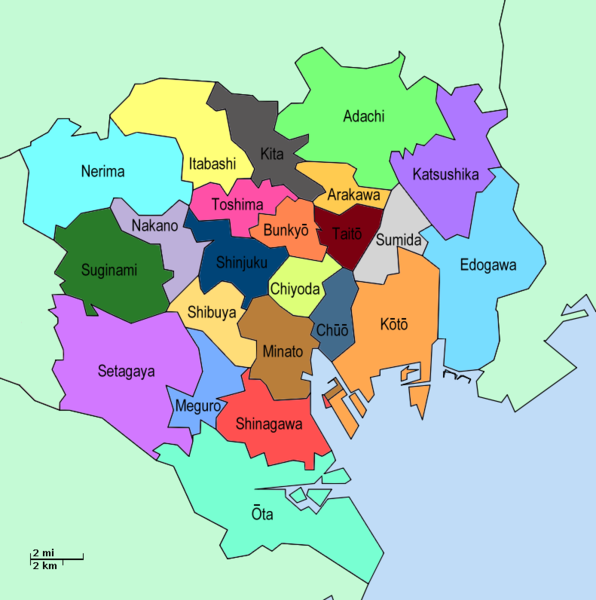
To the west of the 23 wards, are numerous cities, towns etc. They can collectively be called the Tama region. These are all considered to be in the prefecture of Tokyo.

Finally, further west than this is the district of Nishitama. Most of this land is mountainous and uninhabitable. It comprises just three towns: Hinode, Mizuho, and Okutama. It also includes the village of Hinohara.
Tokyo also includes several islands. I'm not going to go into them. It will take me all day, and to be honest, it's not my specialty.
Hopefully this will clear things up a bit.
Michelle
Thursday, March 24, 2011
Of a Hero
Sorry. I wanted to add one more article today for everyone to look at. This one is sad but definitely worth a read. It's about a firefighter in one of the Japanese towns which was hit by the tsunami.
Fire bridge members in tsunami-ravaged town stood ground until the end
東日本大震災:鳴らし続けた半鐘•••消防団11人死亡•不明
Fire bridge members in tsunami-ravaged town stood ground until the end
東日本大震災:鳴らし続けた半鐘•••消防団11人死亡•不明
Of a Return to Normalcy?
Not quite so. Those here in Japan right now are trying their hardest to return to normal life. Companies are attempting to stay open, people are going to work, and students are preparing to start school again, but things aren't quite normal. In fact, they definitely aren't normal. Companies are closing around 6, even here in Kansai where the power outages have not been put in place. Workers are still staying home sometimes, finding it difficult to get to work, or their companies are asking them to do work from home. Students, despite getting ready for school, still have the feeling in the back of their minds that their classes might be delayed. And some even know that their classes are delayed. Those of us in Kansai aren't really sure how to react. We watch our neighbors up in Kantou and Touhoku suffer power outages, etc. We hear of food shortages, possible radiation, but yet we're - at least directly - unaffected. The collections for the earthquake and tsunami continue, but we all wish we could do a bit more.
Possibly the first US death was identified the other day. It was a young woman, serving as a JET here in Japan. She had stayed at school despite people telling her to leave. Her reason? She felt that she had to make sure her students all made it home safely. After the last one left with their parents, she started to bike home. Around 10 or 15 minutes later, the tsunami hit.
To those that fled Japan or fled to safe-havens, they are finding it difficult to return to work. Their coworkers are ostracizing them for abandoning their community when they were needed the most. It's a shame. On one hand, you completely understand their flight. They wanted to ensure their safety and reassure their families and friends as well. On the other hand, those people that fled would have been extremely useful in helping to rescue survivors, hand out food and supplies, or just generally help the community with whatever it needed.
Those in Tokyo have been advised not to give their infants (less than a year old) tap water for fear of radioactive iodine. That requirement does not hold for anyone older.
Here in Kyoto, classes at Rits will start up in just 13 days. The placement test for Japanese level is in 8. I'm studying for the JLPT, hoping that will also count as studying for this placement test. Those around me are also job hunting. The job hunting process has been delayed as well, which is rather telling of the effect of this disaster. I'm actually considering buying some job hunting books. When you apply to a company here, like many in the States, you take a test that is extremely similar to the SAT or ACT. These tests are basically full of math that you have not used in years, language skills, problem and puzzle solving. Since I'm planning to come back here to work, I'll likely have to take these. I looked at some online, and they are helpful, but I'll be honest, I haven't done some of these things since high school, and even middle school if you consider word analogies. Anyway, the point of this is that the books are not only helpful for preparing for those tests, but they also help me to learn and use words that I might not use normally.
I've been keeping up with the U.S. news recently and there seems to be this fear that the radiation from Japan will reach the U.S.' West Coast. I admit, I'm a little upset by the whole matter. There have been so many people who have died from this quake. The estimates for the initial cost of the quake alone to infrastructure is in the hundred billions. I believe I saw 300 bil on the WSJ yesterday? There are even people who survived the quake only to die in the shelters from the cold and starvation. I know of course that this is not the majority of the population, and that this also extends to people out in Europe, parts of Asia, etc. but all some of these people can think about is how they might possibly be exposed to a tiny amount of radiation. With everything that's going on here, it's frankly just upsetting to see that it's come to this. To all those news sources that are supplying the nonsense, or the chain letters fueling the panic, I'd just like to point out that if you don't have anything constructive to say, then perhaps you shouldn't say anything at all?
So moving back to the original topic of this post. When will the return to normalcy occur? Weeks? According to news sources, it looks like most of the important work of dealing with the nuclear reactor will take another couple weeks. Months? It will certainly take that long to continue to build houses. Years? For the Japanese economy and for those who have lost everything, it will definitely take years. Just like the earthquake that occurred in Kobe in 1995, this earthquake will haunt people's memories. So, therefore, the complete return to normalcy? Perhaps never. People will remember what happened to their family, friends, and complete strangers as they made frantic phone calls while watching their tvs or listening to their radios.
But Japan survived, and even thrived after the atomic bombs. It rebuilt Kobe after the earthquake. The Japanese have proven they can overcome seemingly impossible hardships in the past, and so, with time, they too can overcome this one. It certainly won't be easy, but by no means is it impossible. This earthquake will live on as a horrible tragedy, but it will also be learned from and used to develop new methods to protect people in the future.
Possibly the first US death was identified the other day. It was a young woman, serving as a JET here in Japan. She had stayed at school despite people telling her to leave. Her reason? She felt that she had to make sure her students all made it home safely. After the last one left with their parents, she started to bike home. Around 10 or 15 minutes later, the tsunami hit.
To those that fled Japan or fled to safe-havens, they are finding it difficult to return to work. Their coworkers are ostracizing them for abandoning their community when they were needed the most. It's a shame. On one hand, you completely understand their flight. They wanted to ensure their safety and reassure their families and friends as well. On the other hand, those people that fled would have been extremely useful in helping to rescue survivors, hand out food and supplies, or just generally help the community with whatever it needed.
Those in Tokyo have been advised not to give their infants (less than a year old) tap water for fear of radioactive iodine. That requirement does not hold for anyone older.
Here in Kyoto, classes at Rits will start up in just 13 days. The placement test for Japanese level is in 8. I'm studying for the JLPT, hoping that will also count as studying for this placement test. Those around me are also job hunting. The job hunting process has been delayed as well, which is rather telling of the effect of this disaster. I'm actually considering buying some job hunting books. When you apply to a company here, like many in the States, you take a test that is extremely similar to the SAT or ACT. These tests are basically full of math that you have not used in years, language skills, problem and puzzle solving. Since I'm planning to come back here to work, I'll likely have to take these. I looked at some online, and they are helpful, but I'll be honest, I haven't done some of these things since high school, and even middle school if you consider word analogies. Anyway, the point of this is that the books are not only helpful for preparing for those tests, but they also help me to learn and use words that I might not use normally.
I've been keeping up with the U.S. news recently and there seems to be this fear that the radiation from Japan will reach the U.S.' West Coast. I admit, I'm a little upset by the whole matter. There have been so many people who have died from this quake. The estimates for the initial cost of the quake alone to infrastructure is in the hundred billions. I believe I saw 300 bil on the WSJ yesterday? There are even people who survived the quake only to die in the shelters from the cold and starvation. I know of course that this is not the majority of the population, and that this also extends to people out in Europe, parts of Asia, etc. but all some of these people can think about is how they might possibly be exposed to a tiny amount of radiation. With everything that's going on here, it's frankly just upsetting to see that it's come to this. To all those news sources that are supplying the nonsense, or the chain letters fueling the panic, I'd just like to point out that if you don't have anything constructive to say, then perhaps you shouldn't say anything at all?
So moving back to the original topic of this post. When will the return to normalcy occur? Weeks? According to news sources, it looks like most of the important work of dealing with the nuclear reactor will take another couple weeks. Months? It will certainly take that long to continue to build houses. Years? For the Japanese economy and for those who have lost everything, it will definitely take years. Just like the earthquake that occurred in Kobe in 1995, this earthquake will haunt people's memories. So, therefore, the complete return to normalcy? Perhaps never. People will remember what happened to their family, friends, and complete strangers as they made frantic phone calls while watching their tvs or listening to their radios.
But Japan survived, and even thrived after the atomic bombs. It rebuilt Kobe after the earthquake. The Japanese have proven they can overcome seemingly impossible hardships in the past, and so, with time, they too can overcome this one. It certainly won't be easy, but by no means is it impossible. This earthquake will live on as a horrible tragedy, but it will also be learned from and used to develop new methods to protect people in the future.
Of a Quick Update
Hello all,
Just sending out a quick post. First off, in reply to yesterday's post. I want to semi-correct something. Although Sendai is definitely in northern Japan, there is a Sendai reactor down in southern Japan. However, that Shibuya Eggman thing is still nonsense.
Power has been restored to all of the reactors.
Just sending out a quick post. First off, in reply to yesterday's post. I want to semi-correct something. Although Sendai is definitely in northern Japan, there is a Sendai reactor down in southern Japan. However, that Shibuya Eggman thing is still nonsense.
Power has been restored to all of the reactors.
Tuesday, March 22, 2011
Of More Absurd Reporting
In classic style, the news has blown me away yet again.
My personal favorites of the day are "Radiation Over U.S. is Harmless, Officials Say" from the NY Times. It goes on to describe in great detail how there is a "radioactive plume" over the U.S. and it uses the word "plume" no less than 8 times in the entire article, I counted.
Another one featured from CNET the other day was "Where are the robots in Japan's nuclear crisis?" It then goes on with virtually no facts whatsoever but a perceived logical argument that because Japan is a modern high-tech country robots should be handling this crisis and not people. However, it also gives a reason why robots are impossible at the moment.
Rampant throughout the States right now is this "people are wearing masks to avoid radiation" theory. It's also untrue. People wear masks when they get sick. There's a lot of people in Japan. And those people don't like to be coughed, sneezed, etc. on. Therefore, you wear a mask. The only thing this is revealing is that there is bad case of colds or hay fever in Japan at the moment.
And then finally, my all-time favorite is Fox News' latest mistake. They released this map the other day, clearing pointing out a nuclear reactor in the middle of Tokyo's Shibuya Ward, titled the Shibuya Eggman. The best part of this: That's a concert hall. Even better? If you go to the Eggman's website, it says, "Shibuya Eggman has no nuclear plant. Our electricity's powered only by music."I'd also like to point out that Sendai is definitely in northern, not Southern Japan.

EDIT:
There is a Sendai in Southern Japan, but the one we've been referencing has been in the north.
Source:
http://www.nytimes.com/2011/03/22/world/asia/22plume.html?_r=1
http://news.cnet.com/8301-17938_105-20044970-1.html
My personal favorites of the day are "Radiation Over U.S. is Harmless, Officials Say" from the NY Times. It goes on to describe in great detail how there is a "radioactive plume" over the U.S. and it uses the word "plume" no less than 8 times in the entire article, I counted.
Another one featured from CNET the other day was "Where are the robots in Japan's nuclear crisis?" It then goes on with virtually no facts whatsoever but a perceived logical argument that because Japan is a modern high-tech country robots should be handling this crisis and not people. However, it also gives a reason why robots are impossible at the moment.
Rampant throughout the States right now is this "people are wearing masks to avoid radiation" theory. It's also untrue. People wear masks when they get sick. There's a lot of people in Japan. And those people don't like to be coughed, sneezed, etc. on. Therefore, you wear a mask. The only thing this is revealing is that there is bad case of colds or hay fever in Japan at the moment.
And then finally, my all-time favorite is Fox News' latest mistake. They released this map the other day, clearing pointing out a nuclear reactor in the middle of Tokyo's Shibuya Ward, titled the Shibuya Eggman. The best part of this: That's a concert hall. Even better? If you go to the Eggman's website, it says, "Shibuya Eggman has no nuclear plant. Our electricity's powered only by music."I'd also like to point out that Sendai is definitely in northern, not Southern Japan.

EDIT:
There is a Sendai in Southern Japan, but the one we've been referencing has been in the north.
Source:
http://www.nytimes.com/2011/03/22/world/asia/22plume.html?_r=1
http://news.cnet.com/8301-17938_105-20044970-1.html
Monday, March 21, 2011
Of March 21
So I should probably have something to report about the reactors today. Let's see. They're cooling down. And some radioactive iodine was supposedly found as well in the air, but this should be solved quickly hopefully. The amount is minimal, but it's not sure what effect it will have.
It also apparently was a national holiday today. I know this because things were either closed or closed exceptionally early. It think it was the spring solstice.
In other news, I had delicious sushi today. And it was delicious. A nice assortment and for a reasonable price as well down by Loft.
Michelle
It also apparently was a national holiday today. I know this because things were either closed or closed exceptionally early. It think it was the spring solstice.
In other news, I had delicious sushi today. And it was delicious. A nice assortment and for a reasonable price as well down by Loft.
Michelle
Sunday, March 20, 2011
Of News
So I decided it's time to change the blog titles, or people will never be able to navigate anything later.
I woke up this morning and for the first time since the quake hit, Japan was not on the front page of every English paper. This means either that Japan has ceased to provide interesting news to the rest of the world or bigger news has come along. Today, it was entirely focused on Libya again. I actually had to go to Japanese newspapers to learn anything. And it looks like things are still improving. The recovery process is slow, but starting soon, houses will be built for those displaced by the quake and tsunami.
In bad news, trace amounts of radiation were found in some spinach and milk from the Fukushima region. In the good news, the radiation that was found is not harmful to people. To give people an idea of this, you would receive far more radiation on the plane flight overseas than you would in what is currently being detected. Obviously, caution continues though.
I found something that should never be shared in polite conversation the other day, but something that I think is still somewhat cute. This is how Japan is explaining the nuclear crisis to its children. Nuclear Boy
If you didn't appreciate that, go to the Prayforjapan.jp link on the right. It will make you cry instead.
Today CNET featured a completely absurd article just for the record. Which was, "Where are the Robots in Japan's Nuclear Crisis?" I'm not even joking. It was the most bogus article I've ever read. It basically amounted to "Japan is a high-tech society. We've seen that they have robots in the past. They should use robots to fix the nuclear reactors." No, CNET, no. Not you too. Don't make up things just because you have stereotypes of another country. It's not accurate, and it's definitely not news.
I sent off another friend last night with some karaoke. To Laura, I'll miss you dearly. You better come back to Japan, and if not, I'll see you in the future either in Japan, the States, or Ireland!
My friends made fun of me of course because we took a cab home, and I made friends with the taxi driver. I can't do the whole sit quietly in the cab thing. It's awkward. You're like a foot apart. You should make conversation. Imagine, all he does is sit in his cab all day and everyone else ignores him. Do your duty, blame it on being foreign if you have to, but at least cheer up his day.
Michelle
I woke up this morning and for the first time since the quake hit, Japan was not on the front page of every English paper. This means either that Japan has ceased to provide interesting news to the rest of the world or bigger news has come along. Today, it was entirely focused on Libya again. I actually had to go to Japanese newspapers to learn anything. And it looks like things are still improving. The recovery process is slow, but starting soon, houses will be built for those displaced by the quake and tsunami.
In bad news, trace amounts of radiation were found in some spinach and milk from the Fukushima region. In the good news, the radiation that was found is not harmful to people. To give people an idea of this, you would receive far more radiation on the plane flight overseas than you would in what is currently being detected. Obviously, caution continues though.
I found something that should never be shared in polite conversation the other day, but something that I think is still somewhat cute. This is how Japan is explaining the nuclear crisis to its children. Nuclear Boy
If you didn't appreciate that, go to the Prayforjapan.jp link on the right. It will make you cry instead.
Today CNET featured a completely absurd article just for the record. Which was, "Where are the Robots in Japan's Nuclear Crisis?" I'm not even joking. It was the most bogus article I've ever read. It basically amounted to "Japan is a high-tech society. We've seen that they have robots in the past. They should use robots to fix the nuclear reactors." No, CNET, no. Not you too. Don't make up things just because you have stereotypes of another country. It's not accurate, and it's definitely not news.
I sent off another friend last night with some karaoke. To Laura, I'll miss you dearly. You better come back to Japan, and if not, I'll see you in the future either in Japan, the States, or Ireland!
My friends made fun of me of course because we took a cab home, and I made friends with the taxi driver. I can't do the whole sit quietly in the cab thing. It's awkward. You're like a foot apart. You should make conversation. Imagine, all he does is sit in his cab all day and everyone else ignores him. Do your duty, blame it on being foreign if you have to, but at least cheer up his day.
Michelle
Saturday, March 19, 2011
Earthquake 11
I'm hoping this is one of the last posts with this title. Of course recovery will be a long process of years, but it's expected that the nuclear reactor will be under control soon. They are finally making progress.
After poisoning the reactor with boron and seawater, then using helicopters to dump seawater, and finally firetrucks, the end of the mess may finally be in sight. In reactors 1-4, the temperature has dropped below 100 C. Cables were successfully laid to reactors 1,2, and 3 today at the Fukushima Daiichi plant. It is hoped that the power through these will be able to support the cooling systems. Reactors 4-6 will have cables laid tomorrow. It is possible though that 5 and 6 may also have cables laid today though, but making sure that the reactors are safe is the first priority. According to Touden's Equipment Department, "We cannot say for certain if everything is better because we must check to make sure that there is not even one piece of equipment that does not work properly." Which is plain and non-Japanese English basically means, "Things are getting better, but we don't want to raise spirits too high yet because we want to make sure that everything is right first."
Also, MIT has made a lovely website to help everyone understand. It's in definitely more advanced scientific English, but if you have the time and you want to fully understand what's going on, go there. It's in the sources below.
To another day and the gradual improvement of the situation in Japan.
Michelle
Sources:
1・2号機へ送電復旧、19日にも 福島第一原発 (Asahi Shinbun)
1~4号機「表面温度100度以下に」 防衛相が発表 (Nikkei)
3号機に注水成功 官房長官「一定の安定状態に」 (Nikkei)
MIT NSE Nuclear Information Hub
After poisoning the reactor with boron and seawater, then using helicopters to dump seawater, and finally firetrucks, the end of the mess may finally be in sight. In reactors 1-4, the temperature has dropped below 100 C. Cables were successfully laid to reactors 1,2, and 3 today at the Fukushima Daiichi plant. It is hoped that the power through these will be able to support the cooling systems. Reactors 4-6 will have cables laid tomorrow. It is possible though that 5 and 6 may also have cables laid today though, but making sure that the reactors are safe is the first priority. According to Touden's Equipment Department, "We cannot say for certain if everything is better because we must check to make sure that there is not even one piece of equipment that does not work properly." Which is plain and non-Japanese English basically means, "Things are getting better, but we don't want to raise spirits too high yet because we want to make sure that everything is right first."
Also, MIT has made a lovely website to help everyone understand. It's in definitely more advanced scientific English, but if you have the time and you want to fully understand what's going on, go there. It's in the sources below.
To another day and the gradual improvement of the situation in Japan.
Michelle
Sources:
1・2号機へ送電復旧、19日にも 福島第一原発 (Asahi Shinbun)
1~4号機「表面温度100度以下に」 防衛相が発表 (Nikkei)
3号機に注水成功 官房長官「一定の安定状態に」 (Nikkei)
MIT NSE Nuclear Information Hub
Friday, March 18, 2011
Earthquake 10
Today marks one week since the great 9.0 earthquake that hit Japan on March 11. I looked up at the clock today, and it was a little surreal, since it was exactly 2:46 p.m., the time when the earthquake hit last Friday. My friend's boyfriend who was in Sendai during the quake was with us, and he looked up and was also a little uneasy. It seems that most of the clocks up there are stuck at 2:46.
We went out last night to grab a couple drinks at our local bar, celebrate that he was still alive, and reflect on everything that's happened. Since that time a week ago, Japan has experienced the tsunami, countless smaller earthquakes, and the nuclear threat. Oddly enough, something good has come out of this though. People in neighborhoods, etc. have become much closer, and there's a sense of community that perhaps wasn't there before. Last semester, I felt as if I was in Japan purely to study and to perhaps make a few good friends along the way. Now though, I've come to think of Japan as another home. People on the streets who before wouldn't talk to you are now not only willing to strike up a conversation, but they want to share their experiences and know your thoughts as well. Everyone is supporting each other, and for that reason, I'm thankful. If it wasn't for that, I don't know how Japan could have survived the disasters.
The nuclear threat is of course ever-present and it's the topic of conversation among everyone throughout the country. They have continued to pour water on the reactors and pools from the air, but this has not necessarily been successful. Right now, they are focusing on trying to return power to the plant in an effort to restart the automatic cooling systems. Considering these were damaged in the quake and subsequent tsunami, it is not known yet whether this will be successful, but it is the main goal. Of course, in the back of their minds, they are considering encasing the plant in sand and concrete in order to prevent further radiation escaping.
The Touhoku region is slowly recovering. Roads are being rebuilt, and electricity and running water are gradually being restored. People are still without homes though, so they are continuing to stay in evacuation centers like schools gyms, etc. They are still rationing food and water though. People are eating half an onigiri (rice ball) for lunch. Gasoline has run out, and kerosene, which they're using to heat the homes, is also dwindling. Despite the shortages, everyone is donating to try to help. Apparently there's a company now willing to take up goods by truck, so I'll investigate that and try to donate goods such as paper cups, miso, water, etc. which they desperately need. If that doesn't seem to work, then we can continue to donate organizations such as the Red Cross, etc. Konbini, schools, everyone is trying to raise funds for the north. It's nice to feel as if we're able to help a little bit.
I read something earlier, which was really touching. I wanted to share it with everyone so they could see Japan's thoughts on the disasters and how everyone is dealing with it. This site is a collection of those tweets:
Prayforjapan.jp
So to all those helping, I wanted to say thank you. Even if you can't afford to give anything to the cause, your prayers or thoughts are enough. Thank you again, and we'll all get through this together.
Michelle
We went out last night to grab a couple drinks at our local bar, celebrate that he was still alive, and reflect on everything that's happened. Since that time a week ago, Japan has experienced the tsunami, countless smaller earthquakes, and the nuclear threat. Oddly enough, something good has come out of this though. People in neighborhoods, etc. have become much closer, and there's a sense of community that perhaps wasn't there before. Last semester, I felt as if I was in Japan purely to study and to perhaps make a few good friends along the way. Now though, I've come to think of Japan as another home. People on the streets who before wouldn't talk to you are now not only willing to strike up a conversation, but they want to share their experiences and know your thoughts as well. Everyone is supporting each other, and for that reason, I'm thankful. If it wasn't for that, I don't know how Japan could have survived the disasters.
The nuclear threat is of course ever-present and it's the topic of conversation among everyone throughout the country. They have continued to pour water on the reactors and pools from the air, but this has not necessarily been successful. Right now, they are focusing on trying to return power to the plant in an effort to restart the automatic cooling systems. Considering these were damaged in the quake and subsequent tsunami, it is not known yet whether this will be successful, but it is the main goal. Of course, in the back of their minds, they are considering encasing the plant in sand and concrete in order to prevent further radiation escaping.
The Touhoku region is slowly recovering. Roads are being rebuilt, and electricity and running water are gradually being restored. People are still without homes though, so they are continuing to stay in evacuation centers like schools gyms, etc. They are still rationing food and water though. People are eating half an onigiri (rice ball) for lunch. Gasoline has run out, and kerosene, which they're using to heat the homes, is also dwindling. Despite the shortages, everyone is donating to try to help. Apparently there's a company now willing to take up goods by truck, so I'll investigate that and try to donate goods such as paper cups, miso, water, etc. which they desperately need. If that doesn't seem to work, then we can continue to donate organizations such as the Red Cross, etc. Konbini, schools, everyone is trying to raise funds for the north. It's nice to feel as if we're able to help a little bit.
I read something earlier, which was really touching. I wanted to share it with everyone so they could see Japan's thoughts on the disasters and how everyone is dealing with it. This site is a collection of those tweets:
Prayforjapan.jp
So to all those helping, I wanted to say thank you. Even if you can't afford to give anything to the cause, your prayers or thoughts are enough. Thank you again, and we'll all get through this together.
Michelle
Earthquake 9
Kyoto is still fine. Kansai is still fine. I'm aware of the 50 m radius that the US State Department has recommended people to evacuate from, but Kyoto is nowhere near that. Not even Sendai, which is in the Touhoku region, is in that. That includes parts of Yokohama, Tokyo, Nagoya, etc. We are still fine here.
University e-mailed me today recommending students should "strongly consider" coming home, but they linked to that link, though I'm wondering if they read it themselves. Since I'm personally several HUNDRED miles away, it's more than a little irritating. I'll continue to stay here where I'm safe.
Of course, I'm not being foolish. I've checked every news site known to man (that I consider reliable) and have re-registered with the State Dept (since they seem to have lost my info the first time) and am swamped with news media. No worries there. This is of course an informed decision, and it will continue to be so.
For a quick update to all those concerned:
Kansai cannot devote power to Kantou. This is because the Kansai region is on a 50 watt German system while the Tokyo region is on a 60 watt American system. There are places which can convert power, but it's only around 1,000 watts a day.
I still expect us to get some power rationing though since we've been urged to not use too much.
Management of the plant might be turn more toward American forces. TEPCO and the SDF are still trying their best.
Again, everything is fine here. Thank you for worrying about me, and please stay away from the sensational journalism that is causing unnecessary panic.
Michelle
University e-mailed me today recommending students should "strongly consider" coming home, but they linked to that link, though I'm wondering if they read it themselves. Since I'm personally several HUNDRED miles away, it's more than a little irritating. I'll continue to stay here where I'm safe.
Of course, I'm not being foolish. I've checked every news site known to man (that I consider reliable) and have re-registered with the State Dept (since they seem to have lost my info the first time) and am swamped with news media. No worries there. This is of course an informed decision, and it will continue to be so.
For a quick update to all those concerned:
Kansai cannot devote power to Kantou. This is because the Kansai region is on a 50 watt German system while the Tokyo region is on a 60 watt American system. There are places which can convert power, but it's only around 1,000 watts a day.
I still expect us to get some power rationing though since we've been urged to not use too much.
Management of the plant might be turn more toward American forces. TEPCO and the SDF are still trying their best.
Again, everything is fine here. Thank you for worrying about me, and please stay away from the sensational journalism that is causing unnecessary panic.
Michelle
Subscribe to:
Posts (Atom)