Pages

Showing posts with label Tokyo. Show all posts

Friday, July 4, 2014

A Visit to Kichijoji

I traveled to a neighborhood called Kichijoji(吉祥寺) for the first time the other day. Kichijoji is located in Musashino, one of the suburbs of Tokyo. This is an older part of town, and it has a pretty rich history.

History


For those that have been following my blog for a while, you may recognize the ending of "-ji" there in the name. This final character is used to name temples, and Kichijoji itself roughly translates to "The Temple of Lucky/Auspicious Omens." This Buddhist temple was moved to Bunkyo on the orders of Tokugawa Ieyasu - the first shogun of the Tokugawa shogunate and the man credited with the expansion and reconstruction of much of traditional Edo (what is now Tokyo). Bunkyo is a ward within Tokyo that today holds the Tokyo Dome, the Headquarters of the Judo community, and the University of Tokyo Hongo Campus.

As was prone to happen in those days, a small town built up around the temple. It was therefore named Kichijoji-Monzenchou (吉祥寺門前町), literally "The town built around Kichijoji." Traditional city planning measures allowed homes to be built very close together. Even today, you can see older areas of the city that have only centimeters of space between the buildings. Homes and shops were made to be light in order to withstand the frequent earthquakes in the area. They were therefore built out of wood. Due to the high volume of wooden buildings in a small space, coupled with the dry summers and winters here in Tokyo, the city was very prone to large and destructive fires. The most famous of which was the Great Fire of Meireki in March 1657. This fire lasted three days, claimed the lives of over 100,000 people, and destroyed up to 70 percent of the city. By the time the fire was extinguished, the temple and its surrounding town were destroyed.

A new era of reconstruction began. The shogunate decided to repurpose the land for daimyo residences. The previous residents of Kichijoji-Mozenchou in Bunkyo were moved to the present-day Kichijoji in Musashino. Although this present-day neighborhood does not hold the Kichijoji temple, it did keep the name as a tribute to the original town.

Highlights


Inokashira Park
By far one of the most popular things in the area is Inokashira Park. This park is busiest in spring due to its large number of cherry blossom trees, but it is enjoyed year-round by Tokyo residents for its beauty and greenery.

Inokashira Park Spring, J. Peterson, Wikimedia Commons ©

Side Alleys
Called Yokochou (横町) in Japanese, these backstreets and side alleys hold a variety of small bohemian-style shops and restaurants. If you are looking for a place to relax and enjoy the traditional side of Tokyo, this is definitely it. Due to its distance from the city center, you can find things a bit cheaper here. I found a great pair of running shoes for roughly 5,000 yen. You would normally have to spend between 8,000 to 10,000 yen to find the same item in other parts of Tokyo. I even found a small shop that sold only handmade goods. There were handmade linen tablecloths, handmade wooden spoons, and handmade cups and plates.

Harmonica Alley
This is one of Kichijoji's most famous yokochou. Here you can find small bars where you can sip beer or hoppy, a favorite of older Japanese businessmen. Hoppy has a taste similar to beer, but it is made with shochu and contains about 1% alcohol. It was especially popular in the past when beer was considered too expensive for the general populace.
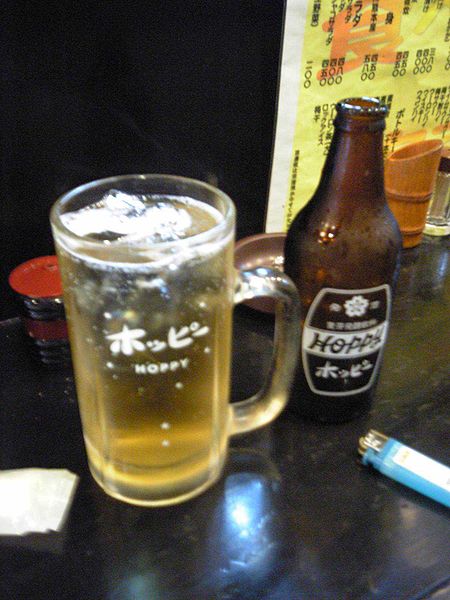
Hoppy, Hykw-a4, Wikimedia Commons ©
The air smells great here due to the wide variety of restaurants, one of which is the ever-popular yakitori (kebab) bar. I also found a small tsukemono-ya, or pickled foods shop. I was all for buying bettarazuke, which is a slightly sweet-tasting pickled daikon. It is a something Tokyo is famous for, but Tai wasn't in the mood, so I'll stop by another day. All in all, Harmonica Alley is very similar to Sangenjaya in Setagaya Ward with its high number of restaurants and local atmosphere.

Sun Road
A covered shopping arcade, this was one of my favorite spots in all of Kichijoji. It really reminded me of Kyoto's downtown covered Shijo Street near Nishiki Market. By far one of the most interesting places here is a small croquette shop called Satou Kichijoji.  If you click this video (Japanese-only), you can see the meat croquettes that have made it so popular. This shop was amazingly busy. I think we discovered it around 2:00, and there was still a line of 50 people waiting to buy meat croquettes. When we left around 7:00, the line was longer if anything. In fact, it was featured on TV the other day. Despite the shop's small size, it sells 3,000 meat croquettes a day.

The other place I really enjoyed was a traditional geta shop. Geta are the Japanese wooden clogs. This shop had ones that were handmade from bamboo and tatami. As well as ones that were wooden. They had everything from the traditional-style geta that are worn with kimono to modern-day styles that are more comfortable for every-day use. We spent a while talking to the shopkeeper about the different styles as this kind of shop fairly rare today.

Geta, Haragayato, Wikimedia Commons ©

Atré
Finally, if you're looking for something a bit more upscale, there are the department stores in the area. I'm particularly fond of Atré, because it has such a eclectic variety of goods. This one had a small chopstick shop, a variety of florists, a stationary and bag shop, among others.

Conclusion


All in all, it was a great day at Kichijoji. It was very easy to see why it is so popular among all age groups. With its easy access to Inokashira Park and its vibrant community, Kichijoji is consistently rated the number 1 place that people want to live in Tokyo. Even I felt that if I wasn't so happy living in Setagaya Ward, that I would be happy to move to Kichijoji in the future. People were very friendly and it definitely had a small-town feel, something you don't get often in urban Tokyo. I know that I'll definitely be going back to eat those delicious croquettes and maybe enjoy a drink or two in Harmonica Alley with the local residents.

Tuesday, January 15, 2013

Snow Day in Tokyo

It snowed in Tokyo yesterday. I woke up to find myself in a winter wonderland, and it snowed all day. This was pretty good timing because yesterday was Seijin no Hi (成人の日). Essentially, this is a day for all those that have turned, or are about to turn 20 years old within the past year. Each ward/city puts on a celebration where the governor and other important officials speak. The new adults wear traditional clothing. Unfortunately, due to some drinking issues after the ceremonies, attendance has been declining.

Tokyo got about 7 cm of snow over the course of the day, and some places got as much as 13 cm. (For reference, 7 cm is about the height of your hand if you are of average height.) I spent the day hanging out watching my favorite show Aibou - a detective drama - with Tai. We did clear the snow from the trees and sidewalk though. We didn't want his or his grandmother's trees to break. I also didn't want to break our necks when everything turned to ice - which was about 2 hours later. I'm really glad we cleared a path because when we went out for dinner, the streets were a mess. Slush was all over the streets, and I managed to step in more than one puddle. By the end, my boots held more water than the road. When we got back to his house, I ended up borrowing some of his boots so that I could walk home in dry shoes. Although his feet aren't that much bigger than mine, his boots are mysteriously huge. I looked like a strange rendition of Popeye in these giant brown work boots clunking up the streets of Tokyo. Over all, it was a lot of fun, and I'm glad we got to enjoy the snow on our day off.

The streets were still a bit icy on my way to work today, but it was all in good fun. Ice-skating in heels is an interesting but thrilling challenge. By the time I returned home, the roads were fairly clear. Surprisingly, no station in Tokyo predicted this huge snow storm. They were all saying that we would just have rain, so no one was prepared. The non-essential trains halted service, and the core trains continued but with delayed service. There were no high-speed trains like normal. The roads went to ice, and the sidewalks were pretty dangerous. Thankfully, the police were patrolling to help out anyone who got stuck and everyone pitched in to help clear the streets to make things safer. Overall, it was a lot of fun, and Tokyo was exceptionally beautiful covered in snow. Children made snow men, which are made up 2 balls instead of 3 like the American version). Others went sledding. I even saw a girl carrying a snowboard on the bus home. It was nice to see people slow down and enjoy the day.

Saturday, January 12, 2013

Of Tokyo Trains and Rush Hour

One of the things to remember whenever traveling to Tokyo is that you should never take the trains during rush hour. Schools and companies start work at 9 a.m., which means that this normally falls between 7:30~9:15. The reason for this is that most people do not own cars. If they do, they do not drive them to work normally. Parking is too expensive in a major city such as Tokyo. The trains are almost always on-time (Over 8 seconds means they're late). That means that everyone takes the trains.

Depending on the line the degree of crowding varies. However, it is not uncommon for trains such as Yamanote Line and Toyoko Line to run at 200 or even 300 percent capacity during rush hour. This is due to what I call the 'city mindset.' In the city mindset, you must never be late for anything. That means if you know that you have to take a certain train, regardless of how crowded it is, you will take that train. Most days this results in a fairly normal level of crowding where people are tightly packed, but you have a small little bubble around you of space. Other days, this logic flies out the window.

Large transfer stations normally hire what they call oshiya (押し屋). The word comes from the verb osu, meaning "to push" and the word ya (store, or in this sense, a position). So, the oshiya is someone that the train company has hired to push people until they fit into the train so that the train can depart on time.

The question you are probably asking is "Why? Why don't they just take the next train?" And that's where the city mindset comes in. The train is already running at 150 or 200 percent capacity. What's one more person? The problem with this way of thinking is that 20 other people waiting to get in the same door as you are thinking that exact same thing. So instead of saying, there's 100 people in that car, and I'll be the 101st person, you are now likely to become the 120th person.

Here's a video below to illustrate my point. (Note: This video is not mine.)
Tokyo Oshiya

As you can clearly see in that video, the train is packed. You can't even see in because the windows are fogged up from people's breath. It's absolutely ridiculous how many people are in that train already, and all of those people want to get in. In fact, there's even a guy who arrives late who tries who get in. (Luckily they turn him away).

The oshiya's job is not to be rude or to force people in. Rather, he's trying to make sure that the train runs on time. There are trains every couple minutes during rush hour. Normally, as soon as one train leaves, the next arrives. This is because it takes a bit longer than normal to board because of the sheer number of people needing to get to work. The oshiya helps everyone to make sure that their bags fit and to ensure that everyone is safe so that you don't lose anything going into the tunnels. They also help to open the door for anyone that may have something trapped and make sure that there's no one who (un)intentionally falls onto the tracks. They're really just there for everyone's security. Unfortunately, at major stations, this is not an uncommon rush hour sight. There are even words to describe this feeling. The most common is manin-densha (満員電車), meaning a packed train. Another is sushi-dume (すし詰め), meaning packed in like sushi.

The feeling in the train is probably akin to feelings of claustrophobia. You arrive at the platform to find a girl against the window on the door nearest you. And as messed up as it is, the longer you're here, the more you think, "Well, this is gonna' suck, but I gotta' get on that train." The idea of taking the next train is just unfathomable. You don't want to be late you see. Ironically, by choosing to get on this train, you are contributing to the messed up schedule. You will make your train late; therefore, the next train will be late, and so on and so on. But you don't want to wait the 5 minutes that it takes for the next train to leave either, so you choose to take the current one.

You all flow toward the train like some massive wave of people. And you squish in. The rule is, is that if you can find room for your feet, then you can stay. You can contort your body into all shapes and sizes to get on that train. Lift your elbows up, suck in your stomach, and just endure. It will be a long ride, but at least you're on your way. On the worst days, that girl that was plastered against the window will now be on the opposite side of the train, with the other side of her face plastered against the opposite door.

Meanwhile, you sit there with your chest hurting from the mass of people pressed against you and praying that you breathe normally soon. Many of Tokyo's trains were used for shipping of coal and livestock in the past. The most-used lines have been fixed so that they are comfortable, but every now and then you'll find a section that's still a little rough where you want to hang onto something (hint: Toyoko Line). If there's anything good that comes from these rush hour trains, it's that you can't fall over. You are literally packed in too tightly to fall. In fact, your feet aren't even below you sometimes. Your left foot may be extended way toward the front, and your back foot is somewhere on the right. And where your feet should be is where someone else's feet are. But you don't really have to worry about that. You don't need feet. If it's crowded enough, the surrounding people will keep you upright.

So, how do you survive the trains during rush hour?
1. Don't take them. Go early or go late. Five minutes makes a huge difference in these settings.
2. Don't be afraid. Just get on the train and everything else will follow. You leave shame at the station entrance.
3. Always face outward regardless of what door you're exiting from. If you face inward, you will be looking directly into someone else's face, and that makes you both uncomfortable. At least when everyone's facing the same way, you can pretend to breathe your own air. (Note: This is also very important for men who do not want to be accused of sexual harassment to women.)
4. Don't make eye contact with anyone. Avert your eyes up or down to avoid that awkward moment. This will also help with trying to breathe your own air.
5. Wrap a scarf or something around your mouth/nose. The key is to drown out the smell of the sweaty people next to you, or to try to avoid the overpowering smell of perfume/cologne from someone who chose a little incorrectly that morning. The smell of yourself will calm you into thinking that you can survive this 10 minutes in transit hell.
6. Don't resist the flow of people. As of the time the train takes off, you are a rag doll. Follow the wave of people and it will be easier to endure.
7. Even if it's not your stop, if you are by the doors, get off. Someone will be needing to get out behind you, and they cannot go through you. If you ever have trouble getting off, a simple "Sumimasen. Orimasu" (Excuse me, I'm getting off) will suffice.

I hope this helps and good luck surviving rush hour. Remember, if you have the choice to travel at another time, take it. No one will punish you for choosing to avoid the infamous Tokyo rush hour traffic.

Wednesday, July 25, 2012

Trains

One of the really convenient aspects of living in Tokyo is the convenience of transportation. You can get pretty much anywhere in this city with a train. Just to give you an idea, check out the Tokyo train map. Keep in mind that this is only the JR Railway network.

The JR railway network is by far the largest in Japan, but there are more than just JR trains here. There are still plenty of private lines that run to more rural areas. If I were to include those though, you wouldn't be able to see anything. I know on this map, it looks pretty difficult to understand, but you start to get the hang of it after a few times of riding the lines. If you don't know where you're going, you can use Yahoo to select the fastest and cheapest route.

The great thing about the stations here is that the subway and normal trains are connected. You don't have to go to a different place to catch the next line. This means that the stations go really deep because you're able to catch sometimes 7 or 8 different lines in the same station. The stations themselves are similar in some ways to airports. They're large and spread out, but they're well marked. And unlike the airport, you can catch another train within a couple minutes, and it won't affect your ticket price at all.

With that said, there's a mindset that there's always room for one more person on the train. This leads to serious overcrowding, with the trains running at 200 to 300 percent capacity at rush hours. The station attendants that "assist" people into trains to make sure bags and other things don't get caught are real, especially at the larger stations.

You can also catch multiple different speeds to your destination. If your station is considered a hub, then you can take semi-express or express trains. This means that you can skip all of the stations that you don't want to stop at. This can shave several minutes off of your travel time. I normally take the kakutei (or every stop) trains though, because my home is not a hub. All in all, it's a pretty convenient system. I can get to work in 8 minutes. And unlike driving, I can just sleep until my destination. That's convenient.

Tuesday, July 17, 2012

Of the Foreigner ID

The foreigner ID (在留カード) is a peculiar thing. In some ways, it looks a lot like your driver's license. It serves as your official identification if you live in Japan for longer than 3 months, and it's necessary to get anything from a cell phone to an apartment contract. Despite its necessity, it's fairly difficult to obtain. I began the process as soon as I came to Japan, and I just received it after nearly a month of living here. When I was a student, I received it within a couple weeks. Since they changed the system a few days ago, no one really understands the correct process now. Not even the government.

I initially waited to get the card because  in the past you had to be at your permanent address before you were allowed to apply for it. My realtor kept asking for the paperwork even though I told him that I wasn't able to receive it. Finally, he told me that I wouldn't be able to apply for any apartment without the paperwork, so I went to the office and gave my temporary address. I learned that this was completely okay. When I asked about the changing card process, I was told not to worry and that everything would be handled. All I needed to do was take the paperwork to my new ward office after I moved, and they would handle the rest.

After the move, I contacted the Company and asked for permission to go early Monday morning before work so that I could handle the last of this government process. As I traveled to my local ward office (kuyakusho), I expected to miss only an hour of work max. I could easily make it up with some overtime that night. Little did I know what I was getting myself into.

I made it to the kuyakusho and asked the nice guard waiting outside for directions to the office. The map was something of a maze and wasn't to scale, so I figured it would be easier to just ask someone. When I got to the desk, I handed the gentleman my paperwork and explained that I recently moved. He informed me that I had to go to the prefectural office. Why? I asked, The system changes today. The local ward offices are supposed to issue the cards now. The man had no idea of the system change and told me just to go to the other office about an hour away by train. When I asked for directions, he told me he had no idea how to get there but he'd search for a map. The search took roughly 20 minutes. The map I received was more than a little frightening. It told me to get off on the wrong bus stop, so I walked about 25 minutes to the office after spending about half an hour by train and another 5 minutes on a bus. I walked on the sides of overpasses, past giant abandoned factories, and through neighborhoods that no woman should walk alone. But I did it all to receive this card.

I finally made it to that office and was told to fill out the same paperwork that I was currently carrying copies of because they needed originals. I figured this was just another example of the bureaucracy and quickly filled out my paperwork and headed upstairs. Little did I know that I know that I would wait in that line for 3 hours. I finally saw a person and she informed me that I needed to cancel my previous registration so that I could register again for this card. She wrote everything out for me on a piece of paper, told me to copy it to another piece of paper (signing under her handwriting wasn't allowed), and wait to be called again to receive my card. I called the Company, and told them that there was no way I was making it to work today. I'd work overtime the rest of the week to make up for it.

I waited another 4 hours. I only had a rice ball for breakfast; I never ate lunch. I rationed my little bottle of lemon tea like I was stranded on a desert island and it was the last ounce of liquid for a 1,000 miles. After 4 hours, I was called up again. "Write your name on this envelope please," I was told. "The computer system has regrettably gone down. We can't do anything else today." I'd been in this office for 7 hours. There was no way I was leaving without anything. Please, I need this paperwork for my company, I told her. Please is there anything you can do? Yoroshiku onegai itashimasu (Please do this for me. I'm putting myself in your care.) She talked to her boss. Her boss asked why I didn't take care of this at the local ward office. She talked to her boss's boss. No, there was nothing she could do. "Fill out the envelope please. We'll mail the card to you in a few weeks."


It's been another week. I finally received the card, but the address is wrong. I'll have to head to my local ward office in the morning. Here's hoping this time it works.

Yoroshiku onegai itashimasu.

Friday, June 29, 2012

Apartment Round-Up

I'm planning to make an apartment decision tomorrow. The realtor worked hard to find me a couple other apartments to compare with, so I will look and make a decision afterwards. Even after I make a decision, it will take approximately a week to complete all of the necessary paperwork to move in. I've already offered to start paying rent to the family here, but they insist that I take my time and make a proper decision. I truly am blessed to have found such wonderful people no matter where I go in the world.

I visited the one apartment I'm interested in again today. I'm thinking I'll take the loft apartment if I don't see something I like better tomorrow. I'd like the space, and I might just put a little roll-out futon up there to sleep, leaving the main room for clothing and a table. I discovered that both apartments have a small balcony today, which is great. I can dry clothes!

I also went to the Company today to try to find the way there and to properly introduce myself. I went with Tai's mother, because she's already learned I have no sense of direction. Those who know me here have changed my surname to Maigo (meaning a lost/stray child). Not surprisingly, even with his mother we got hopelessly lost and asked the local fire station and a dry-cleaning shop for directions. The Company is located in Ebisu, which is a very nice business district located in Shibuya, Tokyo. The area has tons of restaurants, some famous. It is popular for Yebisu (pronounced Ebisu) Garden, which is a popular drinking area. Sapporo's headquarters are located here. Before anyone gets the idea I'm focused on alcohol here, I want to mention that this is the first thing people comment about when I work in Ebisu. It truly is a nice area though, and it has lots of fun little shops. I look forward to looking through them whenever I'm not in work.

After having been here already for study abroad, there is very little about Japan that surprises me now. I normally just accept everything I see. I don't always understand it, but I accept it. Today, I had a rare "only-in-Japan" moment. I was watching a informational show, where a popular actor goes around and tries lots of food from famous local shops and he went into a shop that specializes in sushi. Not just any sushi though. It's understandable that you want to have the freshest fish possible, so special shops will let you choose your fish, and then make your meal appropriately. In this episode, the actor chose squid (ika). As the chef plunged his hand into the tank to catch the squid barehanded, a familiar song began playing. I've never thought of the song "Dude Looks Like a Lady" applying to catching squid Mr. Miyagi-style, but it was oddly catchy.

I'm off to go eat some eel (unagi) now.

Sunday, June 5, 2011

Of Kobe

There was an earthquake the other day in Kyoto prefecture. It was a M3 at its epicenter, but it hit us around an M2. Basically, this means it was just enough to feel, but nothing serious. I was underground in class at the time, and things shook a bit, but it was over within a second. Since Kyoto never really gets these, it was somewhat unusual, but it was fine.

Kan's promised to step down after settling the budget for this upcoming year. He didn't even make it a year without calls for him to step down, which is rather sad.

I went the Kobe yesterday, and had a great time. It was my friend's first time there, so it was a good experience. Slowly, but surely, I'll learn to make my way around Kobe. It's actually rather simple to navigate, much easier than Kyoto. Then again, anything is easier than Kyoto. People who visit here frequently comment on how easy it seems to navigate, in comparison to Tokyo and the like. However, once they manage to get themselves lost once, they learn just how hard it is to get un-lost (yes, I'm making that a word). Kyoto is in some ways convenient. It's set up on a grid pattern, but the problem is navigating where you are on that grid. All of the houses look fairly similar due to the building laws here, and the streets that are fortunate enough to have names frequently end in something-something-temple. Since you can walk anywhere in Kyoto and run into a temple almost as often as you run into a konbini, this makes the city almost impossible to navigate. I actually discovered the other day that there's a song or rhyme that the elderly teach to the youth in order for them to learn the streets. It goes from north to south, and east to west. Learning this song months ago would have been good for me. Needless to say, Kobe is easy to navigate, and I'm really thankful that I was able to go again yesterday.

Sunday, April 24, 2011

Of Japanese Delicacies

It's rained for the past three days, and it's beginning to affect my mood. Since it's supposed to rain all next week as well, I'm beginning to wonder if we're entering the rainy season. It's supposed to be in June and July, but it seems to be a little early this year. In a way, it'd be good to get it over now. At the same time though, the weather is fairly nice, so it'd be wonderful to enjoy the cool weather without getting soaked. I really need to learn that whole bike with one hand and hold the umbrella with the other thing. Although illegal, it is exceptionally convenient and looks pretty impressive. Since I can't even manage to bike safely with two hands though, I'll have to continue to learn that first though. I managed to get a lot done: paper written, speech planned, kanji and grammar studied. I'd actually planned to have a drink or two today after working so hard as well. I had my drink nice and cold, and it was going to be delicious, but since the rain was ruining my otherwise cheerful mood, I decided I'd put it off to another day.

I actually need to get back to studying, but I decided first to enlighten everyone on some Japanese delicacies.

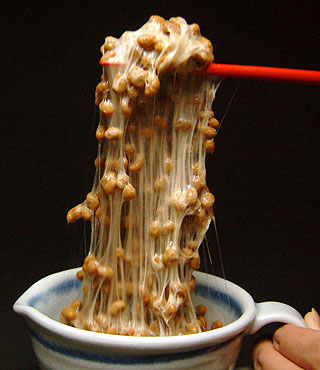
  1. Nattou (納豆)- These are literally fermented soy beans. It's characterized by its smell, which I feel is closest to something along the lines of tire grease, if there is such a thing. It's also very sticky, and clumps together. Despite this, nattou is delicious. Normally eaten in the Kantou region, where it is found often as a breakfast-type food, nattou has gained due popularity. It tastes like beans, really really delicious beans, and everyone should enjoy them. It's especially good with kimchi or tabasco. The most fun part of eating it is that you get to whip it up with mustard and some other stuff like what was previously mentioned. Pictures can be found here and here.
  2. Umeboshi (梅干し) - Pickled plums are another favorite, especially in the Kantou region. Served sometimes with a little salt, they are extremely refreshing, if a little sour. They can be served on their own, in the ball form, or a raisin-like form, or they also be used to make umeshu (梅酒), which is pickled plum alcohol. A picture is here.
  3. Tsukemono (漬け物 )- This is just pickled foods. Kyoto is famous for them, and actually they are deemed Kyouzuke here for that reason. They come in a variety of types: everything from eggplant on. 
  4. Uni (ウニ)- Sea urchin. I had this recently actually at Tai's house. To be honest, I eat most of these Tai's house, except for tsukemono. He doesn't seem to be too fond of that one. I can't really describe uni. The only thing it tastes like is uni. It can be eaten either as sashimi or sushi though. It looks like this though.
  5. Tofu (豆腐)- Kyoto is known for its tofu. We have more tofu shops than anywhere else in Japan I think. It also come cooked in a variety of ways. Unfortunately, I'm still not really fond of it, not due to its taste, but its texture.
  6. Fugu (ふぐ)- Blowfish/Pufferfish. I still haven't tried this one actually. There's actually a season for this, so I haven't been able to try it yet. Since it is potentially lethal though, it must be prepared carefully by extremely skilled and licensed chefs.
And actually, not a delicacy, but something worth adding as a recent personal favorite is
  1. Ochazuke (お茶漬け)- This is something else that I had at Tai's the previous weekend, but I'd just like to add it to the list of absolutely delicious food in the world. It's a relatively simple dish. You fill a bowl with hot white rice, pour in some green tea, and top with nori (seaweed), nattou, fish, or other simple spices. You have to eat it quickly so that the rice does not absorb all of the tea and become soggy, but it's a great meal, and it's really healthy for you. This isn't a completely standard recipe, but I found one that you might enjoy abroad here.
Take care all.

Michelle

Friday, April 22, 2011

Of Life

It's already midnight and I need to get to sleep soon, but I thought I'd make a quick update first. Classes are going well, and I'm learning a lot. The JLPT is in 3 months so I seriously need to crack down on the studying.

Tai's busy with job hunting. He's been going to seminars, interviews, and continuing his job search every day. I hope he'll be successful.

Speaking of him, his gift still hasn't come. I'm beginning to wonder if customs got a hold of it to be honest...I hope not. It was a mess dealing with them last time.

My work on my senior thesis project is coming along. I'm currently trying to find an advisor, and running into some problems with that. We'll see how it goes. No worries though. This is something I want to do, and I'll find a way to make it work. I feel as if it will be a culmination of my time in school, in Japan, and life goals in general, so it needs to be done. This just proves that anything worth doing is difficult, so I'll just work harder to make it possible.

I've received some wonderful care packages recently. Normally I advise against such things since I honestly don't need anything, but it was nice and I really appreciate them. From my loving parents, I have received makeup as well as some other essentials. Makeup in Japan is often laced with a bleaching agent since Japanese women (and many other women in this part of the world) like to have white skin. I'm not comfortable with that idea since I view it as extremely dangerous and unhealthy so I really do appreciate the care package. My grandmother also sent me some candy the other day. Thanks to all of you!

By the way, did everyone hear? They've apparently developed a powder that can collect the radiation from the water. The question is what to do with that powder then. I was watching a show in Tokyo about it and they were talking about shooting it in dry-ice-encased missiles down to the sea floor. If it's true, they think that the ice will not disintegrate at the depth. Obviously they're still searching, but it's an idea.

It's late now, and I'm starting to get stuck between English and Japanese, so I'm going to go to bed. To be honest, I'm not too sure which language is which when I'm tired now.

Bye all!

Michelle

Monday, April 18, 2011

Of a Trip to Tokyo

I got back from Tokyo last night around 10 by Shinkansen. It was a wonderful trip. I got to see Tai and his family, and we got to spend some quality time together, the first in 4 months to be honest. It was great, and I can't express how happy I am that I was able to take the trip.

Things in Tokyo were actually relatively normal considering all that's happened. I actually didn't go into any supermarkets or konbini so I can't tell you the status of those. However, it seemed like the food supply was restored, especially considering we ate things like sushi and clam miso soup which I'm pretty sure was not ok before. You do notice some change in what's provided though. There's more things from the Kansai and southern areas of Japan. Produce from the Fukushima and other severely affected areas is not really seen.

Honestly, the biggest difference is the continue prevalence of the 自粛 (jishuku) mood (refer to previous posts for a definition). People are keeping power off in a city where most things run on power. Lights are off, and A/C is off as well despite the fact that it's getting warmer and therefore more humid in Japan. People are just opening windows instead. Shops are still continuing to close early. Trains are running normally though. The biggest problem is when the weather gets warmer and people are forced to use power in order to keep cool in the worst of the Tokyo summer. For example, with regard to the jishuku mood, Tai and I were at a vending machine, and the lights came on inside. We spent a couple minutes trying to turn them off because it's unnecessary power that can be better spent elsewhere. Eventually, they turned off on their own. But here in Japan, where electricity used to be taken as a common item, the difference to it today is rather startling.

I experienced my first earthquake. It was a M3. It was fascinating to watch the earth shift left and right. You're standing on it, and you know, the earth shouldn't move. And here I am watching the car bounce around on its wheels, and the fence at his grandmother's house sway, and feeling this kind of weird not-weightless parsay, but a definite feeling of unsteadiness. Earthquakes here have also become commonplace, but yet are a little more untrusted now. People are nervous that there will be another large one, so they're not sure how to respond when the little buzzer goes off on the TV or their phone warning them that an earthquake is approaching. If you know you're safe, you can enjoy it. You can watch the earth move and just be amazed at what's happening beneath your feet. But if you don't know if you'll be safe, they could easily be terrifying. For my brief time experiencing one, it was a positive experience, but for those that endured the big quake, I can't even begin to imagine how they must have felt. I truly wish them the best.

Tai and I spent our time going to the river and playing some catch with the football, which was more of Tai teaching how to throw and catch and me failing miserably, but it was still fun. I'm pretty sure I can get throwing down, catching with take some more time.

We also watched some movies, which were fantastic. We went to Rikkyo University's baseball game as well, and it was a blast. Japanese baseball games are tons of fun. People shout things like "NAME かっこいい! (NAME, you're cool/hot!)" to cheer on their players while catcalling the other team with phrases like "可笑しい! (You're strange/weird/funny!)" There's also lots of songs, and just general fun for the team and fans. I have a feeling baseball was like in this in the past, but somewhere it lost that spirit in the States. It really was fun though, and I recommend anyone to go to a game here in Japan if they get the chance cause they'll love it.

Overall, it was a wonderful trip to Tokyo.

Michelle

Friday, April 15, 2011

Of Suzumebachi

Before we begin the main topic of this post, I just wanted to link a little something here for everyone to appreciate back home. It's about the contaminated food, specifically milk that people are worried about overseas. According to this article, it'd take you 58,000 glasses of milk to reach the level that would be considered harmful. Last time I checked, even people who love milk don't drink 58,000 glasses in a rapid period. Here's the article for you to enjoy: Radioactive Milk.

And now onto the main event: Suzumebachi. Suzumebachi are one of those terrifying things in Japan that Japan doesn't want to admit exist to anyone outside of Japan. This is because "terrifying" does not even begin to describe them. Suzumebachi is Japanese for "sparrow hornet." These hornets are several inches long with a wingspan to match. In comparison, make a fist. The hornet is about the length of that.

The suzumebachi are particularly aggressive, especially toward lawnmowers, and other loud noise. They will attack bikers and other people passing too close to the nest though. Unfortunately, since they're hornets, the nest is the trees where you can't see it. You only know you're close to the nest when you start seeing suzumebachi.

Being stung by one will require you to go to the hospital. Since the venom deals with the nervous system, it's fairly dangerous. If you get stung just a few times, you can die. Every year, there are dozens of people who die from them.

Perhaps the worst part of all of this is that the suzumebachi does not live necessarily in a remote area away from people. Of course they're in the forests, but they also live in the cities. For some reason, they really seem to like the area around Ritsumeikan University. I remember the first time I saw one, my friend stopped me and told me about them. The second time, I was walking to the bank with a friend, and I stopped and stared at the largest hornet I had ever seen in my life. These things just hover in the air, looking ridiculously threatening. In my opinion, you should never be able to the see the stinger of a hornet. When you can, you know it's going to be bad.

They also live in Tokyo and other major cities around Japan. Basically, if you find a nest, you call someone to get rid of it. It's not a good idea to take it down yourself.

These hornets became pretty famous recently due to videos that have been circulated around the web. 30 hornets went and destroyed a nest of 30,000 bees. If you're a beekeeper, these things are your worst enemy. Because I believe that everyone should have equal access to appreciate the terror, here's the video: 30 hornets vs 30,000 bees.

However, if you're a beekeeper who keeps Japanese honey bees, you're better off. These bees have developed a strategy to take out the hornets. Literally, they can withstand a higher body temperature, so they'll swarm the hornet and overheat it until it dies. The video is HERE. So, this begs the question, why not keep Japanese honey bees instead? The answer to this is that Japanese honey bees do not produce as much honey, so it's more profitable to keep the others.

If you're feeling adventurous, here are some pictures:
Suzumebachi
Wiki's Suzumebachi Page (Japanese Only)

One Japanese bug down. At least one more to go. If you want a sneak peek, check out Mukade. In the meantime, I'm off to Tokyo tomorrow! Take care all!

Michelle

Monday, April 11, 2011

Of an "Aftershock"

Japan has been experiencing hundreds of aftershocks since the big quake. Many of them are strong, rivaling what we could call simply another earthquake. Today's hit near Iwaki city which is in Fukushima prefecture, registering at a 7.1. For those up in Touhoku, it's impossible to imagine what they could be going through. Power is being restored, but these quakes keep knocking it out. Some people, sick of being in the evacuation centers, are trying to return to their homes. When they do so though, they're finding even simple life is difficult. Without electricity and running water, they can't really cook their food or a number of other things. I read an article the other day which was talking about a woman who is living in her house, and she talks about how much things have changed. She also mentioned how little luxuries like clean underwear are provided at the evacuation centers, but not necessarily in her home anymore since she's unable to do laundry. People are worrying about health issues.

I watched the news today when the aftershock hit, and I have to say it looked a bit end-of-the-world-ish. The sky was dark, even though it was still fairly early in the evening. It looked like the camera honestly was being shaken by someone. It's hard to imagine the entire ground moving while buildings sway on top. It was lightning and promptly began pouring. I'm honestly wondering how much these plates have moved. A tsunami warning was given, but it's only a meter, so it should be lifted soon if it hasn't been already. I admit, I haven't checked since I live on a plateau between mountains and a 1 meter really shouldn't do that much damage.

I think some schools were planning to resume school today in Miyagi prefecture, but I'm not sure if they did or not.

The evacuation zone was extended to 30 km. No worries, it's still far away, and I think that a significant number of people had already evacuated.

The nuclear reactors were not hurt in the quake. They remain in their current state.

Classes were good today. I had Comprehensive as well as Listening & Speaking. We just talked about hanami, earthquakes, and the nuclear situation. It was more interesting than learning about what we were supposed to learning about. And since my class was only 4 today, it was easily manipulated.

In good news, I'm going to Tokyo this Friday! I'll get to see Tai and his family, and just overall have a good time. I bought my Shinkansen ticket the other day. I'm so excited.

Source:
Japan expands nuclear evacuation zone as new quake hits (Reuters)

Friday, April 8, 2011

Another Earthquake

I don't want to write about these anymore. They're depressing. But I'll uphold my duty and write about it because otherwise who knows what will appear overseas. Plus, this is a sort of catalogue of my time in Japan, so I should at least catalogue correctly I suppose. Another earthquake just hit Japan. The Japanese news says that it was a 6, about 74 miles from Fukushima. Reuters says it was a 7.4 at the epicenter. There's a tsunami warning, but it looks like it's only around .5 m in the Tokyo and Touhoku areas. Near the reactor though it's closer to 2 m. No worries. Obviously, I still remain nothing of an expert on the topic of earthquakes and tsunami prevention, but the Fukushima Daiichi Plant is on a hill. So things should be ok. I was skyping Tai when it hit. The camera was shaking pretty bad in Tokyo where it registered at a 3, but otherwise it seems like things are ok. The only worry is that it really was a long earthquake. Like it seemed like it went on for a couple minutes. I don't know what's the earthquakes here recently, but the earth should never shake for a couple minutes, get stronger, and then weaken in strength. It's just wild.

Don't be worried though. To be honest, we expected this. The chance of us having another M7 earthquake this month was about 50% or so.

Is there any other news? I'm not sure. It's almost 1 am and I'm exhausted.

Japan is trying to get back on its feet, but these earthquakes are making it more difficult. I urge everyone to continue to donate in order to help those affected.

Still felt nothing in Kyoto. Everything continues to be safe here. Though I almost wish that it would hit here rather than continuing to hit those who are already affected and struggling to return to normal.

Miami apparently cancelled their trip to Japan. They do something called PacRim every year where they go to China, Korea, Japan, but they're not coming to Japan this summer. It's normally only a week that they spend here but it's a shame. In order to fully appreciate the business world, especially in this region, one needs to understand how Japan influences and is influenced by the surrounding countries. They still continue to support us who are studying abroad. No problems there. I understand they don't want to necessarily assure the safety of a large group in an area which has had so many natural disasters recently, but it's a shame. Japan is being hurt by the lack of tourists. Normally, Kyoto would be teeming with tourists who want to see the cherry blossoms. But there are significantly less than normal. Sure it makes the commutes easier, but it's depressing in a sort of way. Japan needs the tourism in order to boost its economy. But taking care of tourists right night would also be a mess. So who knows what the right decision is.

Is my English bad right now? I feel like it is. My grandpa just skyped me and I swear I almost spoke to him in Japanese...That's amazing honestly because my Japanese speaking continues to be at the top of the lousy scale.

Had classes today. It was nice to start class again, but more on that in another post. I'm going to class again tomorrow. Luckily they don't start till later (round 4). Sure the current earthquake will be the topic of conversation there. If you have questions, comment in the posts. I'll do my best to answer them and prevent more unfounded panic. More soon.

Michelle

Saturday, March 26, 2011

Of the Tokyo Area

I'd like to say that last night I fought a fierce battle between updating the blog and just going to sleep but that unfortunately wouldn't be true. I fell asleep on my bed around 1 without a remotely blog-related thought in my head. To be fair though, nothing's really changed much.

So let's see what might have possibly popped up in the news. It's really very fascinating actually because you hear reports of them having been stabilized, but yet not safe. So it's really rather odd.

Anyway, back to the point. It seems like 3 workers were injured the other day due to being exposed to 10,000 times the normal dose. What they were trying to do was go to an underground level in one of the turbines. Unfortunately, the cooling water which we all know is radioactive has leaked to these levels as well. This means that workers just can't go down to try to fix it. They have to find other ways to deal with the problem.

So, what are other ways? Mainly, the injection of freshwater instead of saltwater to the reactors. I know, I know. Didn't we specifically use for a reason? Yes, but now we have freshwater again, so we're going to use that. Obviously I'm not expert, but from what I understand with my non-nuclear physicist-type brain, the salt can build up on the fuel rods and the container itself. This leads to not only some fairly serious corrosion issues, but also the threat of increasing the heat of the reactors because of a sort of salt casing.

TEPCO and the government are suffering from some accusations that the situation has been handled properly. That's obviously subjective, and I'm not going into that.

Radiation levels in Tokyo's tap water are back down.

Figured out this one again the other day because the U.S. news does not differentiate between cities and prefectures in Japan. It is true that people are being urged in the Tokyo prefecture to leave, but this is not necessarily extending to the city of Tokyo. Understand though that this is still not an order. Citizens were encouraged to leave before, but as some may remember from the whole Katrina fiasco in the States, people don't always listen to suggestions. Therefore, although it is not required for these people to leave, they have been asked once again to leave the area for safety precautions.

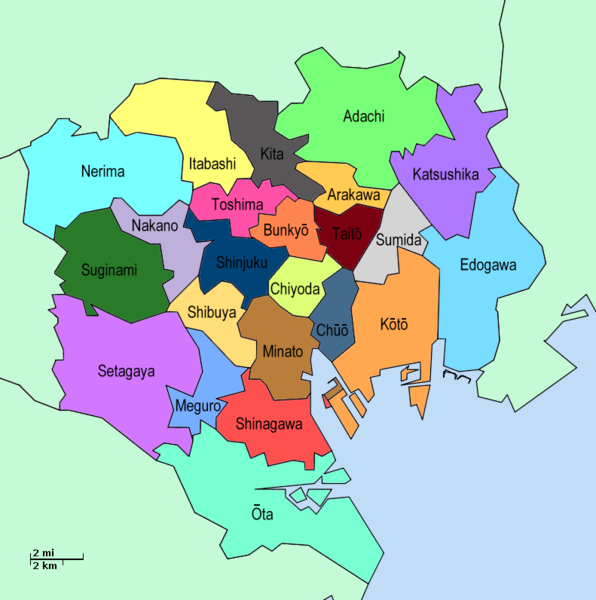
For the sake of understanding what's going on, let's refer to a little map of Tokyo. This is 東京都 (Toukyou-to) the Tokyo metropolitan area. It has 23 wards. These wards are big. When I say big, I mean, quite huge actually. Each of these can practically be considered a city in and of themselves. And in fact they are. They govern themselves, and they have all the statuses of a city. The only difference is that the water, electricity, emergency personnel, sewage, etc. are handled by the Tokyo Metropolitan Government. Therefore, although they are cities, they are also not. For practicalities sake, all of these can be considered wards 区 (-ku) of the major Tokyo metropolitan area. The heart of the city is focused in Shinjuku, Shibuya, Chiyoda, Minato, and Chuuou.


To the west of the 23 wards, are numerous cities, towns etc. They can collectively be called the Tama region. These are all considered to be in the prefecture of Tokyo.


Finally, further west than this is the district of Nishitama. Most of this land is mountainous and uninhabitable. It comprises just three towns: Hinode, Mizuho, and Okutama. It also includes the village of Hinohara.

Tokyo also includes several islands. I'm not going to go into them. It will take me all day, and to be honest, it's not my specialty.

Hopefully this will clear things up a bit.

Michelle

Thursday, March 24, 2011

Of a Return to Normalcy?

Not quite so. Those here in Japan right now are trying their hardest to return to normal life. Companies are attempting to stay open, people are going to work, and students are preparing to start school again, but things aren't quite normal. In fact, they definitely aren't normal. Companies are closing around 6, even here in Kansai where the power outages have not been put in place. Workers are still staying home sometimes, finding it difficult to get to work, or their companies are asking them to do work from home. Students, despite getting ready for school, still have the feeling in the back of their minds that their classes might be delayed. And some even know that their classes are delayed. Those of us in Kansai aren't really sure how to react. We watch our neighbors up in Kantou and Touhoku suffer power outages, etc. We hear of food shortages, possible radiation, but yet we're - at least directly - unaffected. The collections for the earthquake and tsunami continue, but we all wish we could do a bit more.

Possibly the first US death was identified the other day. It was a young woman, serving as a JET here in Japan. She had stayed at school despite people telling her to leave. Her reason? She felt that she had to make sure her students all made it home safely. After the last one left with their parents, she started to bike home. Around 10 or 15 minutes later, the tsunami hit.

To those that fled Japan or fled to safe-havens, they are finding it difficult to return to work. Their coworkers are ostracizing them for abandoning their community when they were needed the most. It's a shame. On one hand, you completely understand their flight. They wanted to ensure their safety and reassure their families and friends as well. On the other hand, those people that fled would have been extremely useful in helping to rescue survivors, hand out food and supplies, or just generally help the community with whatever it needed.

Those in Tokyo have been advised not to give their infants (less than a year old) tap water for fear of radioactive iodine. That requirement does not hold for anyone older.

Here in Kyoto, classes at Rits will start up in just 13 days. The placement test for Japanese level is in 8. I'm studying for the JLPT, hoping that will also count as studying for this placement test. Those around me are also job hunting. The job hunting process has been delayed as well, which is rather telling of the effect of this disaster. I'm actually considering buying some job hunting books. When you apply to a company here, like many in the States, you take a test that is extremely similar to the SAT or ACT. These tests are basically full of math that you have not used in years, language skills, problem and puzzle solving. Since I'm planning to come back here to work, I'll likely have to take these. I looked at some online, and they are helpful, but I'll be honest, I haven't done some of these things since high school, and even middle school if you consider word analogies. Anyway, the point of this is that the books are not only helpful for preparing for those tests, but they also help me to learn and use words that I might not use normally.

I've been keeping up with the U.S. news recently and there seems to be this fear that the radiation from Japan will reach the U.S.' West Coast. I admit, I'm a little upset by the whole matter. There have been so many people who have died from this quake. The estimates for the initial cost of the quake alone to infrastructure is in the hundred billions. I believe I saw 300 bil on the WSJ yesterday? There are even people who survived the quake only to die in the shelters from the cold and starvation. I know of course that this is not the majority of the population, and that this also extends to people out in Europe, parts of Asia, etc. but all some of these people can think about is how they might possibly be exposed to a tiny amount of radiation. With everything that's going on here, it's frankly just upsetting to see that it's come to this. To all those news sources that are supplying the nonsense, or the chain letters fueling the panic, I'd just like to point out that if you don't have anything constructive to say, then perhaps you shouldn't say anything at all?

So moving back to the original topic of this post. When will the return to normalcy occur? Weeks? According to news sources, it looks like most of the important work of dealing with the nuclear reactor will take another couple weeks. Months? It will certainly take that long to continue to build houses. Years? For the Japanese economy and for those who have lost everything, it will definitely take years. Just like the earthquake that occurred in Kobe in 1995, this earthquake will haunt people's memories. So, therefore, the complete return to normalcy? Perhaps never. People will remember what happened to their family, friends, and complete strangers as they made frantic phone calls while watching their tvs or listening to their radios.

But Japan survived, and even thrived after the atomic bombs. It rebuilt Kobe after the earthquake. The Japanese have proven they can overcome seemingly impossible hardships in the past, and so, with time, they too can overcome this one. It certainly won't be easy, but by no means is it impossible. This earthquake will live on as a horrible tragedy, but it will also be learned from and used to develop new methods to protect people in the future.

Wednesday, March 16, 2011

Earthquake 8

I'm surprised that somehow we've gotten to number 8 of these posts. Eventually I feel like I should give them a new name, but by this time it's sort of a them, and I suppose it helps all of you to keep track since some days I post twice and some days I only post once. Anyway, that's really beside the point.

Woke up this morning to find another another blast and another fire. The radiation temporarily rose high enough by the reactor that workers withdrew. 50 workers remained to manage the plant. A helicopter was going to pour water into the pools to decrease the temperature, but the radiation level directly above the reactor was high, so the helicopter withdrew. They will try again tomorrow. The fire was brought under control and the pressure and radiation has decreased again so that they can work on it, but we are very thankful to those workers.

Of things that are currently irritating:
1. The decision by Americans on the West Coast to buy iodine tablets because they are afraid of radiation. Kyoto, which is in Japan, is safe. Therefore, you are are a thousand miles away are also safe. Northern Japan needs them. Please donate.
2. The sensationalist journalism that is currently happening abroad. This is only serving to scare people, and is creating mass panic. Stop that newspapers. If we can be calm in the middle of this, then so can the people halfway around the world. Provide news and not rumors please.
3. A bunch of British scientists came over to Japan to try to help. They made it to their embassy to go do some last-minute paperwork and their embassy rejected them, saying it was too dangerous and for them to return home. Anyone who is willing to help should be able to. I understand right now there are shortages of things in northern Japan, and so that does not mean everyone should come and help. However, people such as scientists who can solve the problem should be welcomed, and not prohibited by their own government.

There are shortages in Tokyo and other regions of basic necessities such as bottled water, toilet paper, etc. Although these things are without a doubt needed, I urge you to talk to your local Red Cross of other chapter instead. Donating money which can be directed toward the item most needed at the time is more helpful.

In other news, this has been making the rounds on Twitter. I thought I'd post it here just so people could see.
国民感情一覧w - (A summary of the nation's current sentiments)
東電職員頑張れ (Touden Staff: Do your Best)
枝野は寝ろ (Edano: Get some sleep)
管は起きろ (Kan: Wake up)
自衛隊は食べろ (Japanese Self Defense Forces: Eat/Pass out Food)
フジテレビは自重しろ (Fuji TV: Step back! You're too close)
石原黙ってろ (Ishihara: Be quiet)

Thank you to everyone who is continuing to help. We really do appreciate everything you are doing here. Let's all work hard and solve this matter together.

Michelle

Sources:
http://www.asahi.com/national/update/0316/TKY201103160330.html
http://abcnews.go.com/Health/japan-nuclear-crisis-americans-buy-anti-radiation-pills/story?id=13142674
http://www.bbc.co.uk/news/uk-12756366

Friday, March 11, 2011

Earthquake 2

Quick update:

The death toll due to the earthquake is at 93 due to the National Police Agency on Asahi News.

200~300 bodies have been found in Miyagi prefecture, where Sendai is located due to the tsunami.

444 buildings have been completely destroyed so far, and the numbers continue.

Everyone that I know of is fine.

It seems like power is slowly being restored in the Tokyo area. I'm not sure about the others. Sendai may still be out of power though, which is bad because it seems that it's started snowing there.

The fire is still out of control in Chiba prefecture.

Phone and internet connection is still unstable.

Source:
http://www.asahi.com/national/update/0311/TKY201103110628.html

Earthquake

I apologize for the delay in updating, but I felt that it was due especially considering recent news.

Today, on March 11, a major earthquake struck Japan, registering an 8.9 on the Richter scale near the epicenter. It was around 10 kilometers deep, located on a sinking tectonic plate. It registered at an 8.4 in Sendai, which is in northern Honshu (the main island). In Chiba prefecture, an oil refinery caught on fire and the flames are reportedly several meters tall. They are still battling them.  At Tokyo Tower, which shook from the quake, the earthquake was measured at a 6. But in the rest of Tokyo, it was said to be at a 5 magnitude. In Tokyo's waterfront Odaiba district, a building caught on fire. Storefronts in Yokohama were seen collapsing.

In Japan, where buildings are under strict requirements to be resistant to these types of earthquakes, it is rare to see buildings shake so badly and rarer still to see the Japanese so excited about it. But this is the biggest earthquake to hit Japan this century.

It seems that most of the damage was done in the aftershocks though, which triggered landslides, destroyed older buildings, and caused widespread reports of tsunamis. Sendai experienced a tsunami up to 10 meters tall. Much of the airport has been wiped out, and a whirlpool is fast developing. Tokyo experienced a tsunami that was a couple meters.

The death toll stands right now at 29. Most people seem to be ok, but there are obviously reports of injuries, etc. The trains, Shinkansen, buses, subways, etc. have all stopped. Power has shut off in Tokyo to prevent fires, and phone service is limited. It seems as if messages go through every now and then, but none of the calls are possible. The nuclear reactors also around the country have shut down, thank goodness due to failsafes.

I'll give more information as it comes.

Michelle

Tuesday, January 11, 2011

Of Christmas & New Years Part II

Well, it's that's time again. The time when I keep my promise and write part II of my adventures over the holidays. Because I'm supposed to be studying for a test, writing essays, and preparing for exams, and instead I'm procrastinating with this blog, you all should feel very special. No worries, don't feel guilty. Just special. I'm enjoying the procrastination as much as you are.

December 31st, also known as New Year's Eve, is a pretty relaxed day in Japan. People continue to make their New Year's foods, osechi-ryouri (おせち料理), but these are just the final preparations. Once the clock hits about 8 or so, the real fun begins. I can only really describe it as in the States during the Macy's Day Parade on on New Year's when we sometimes have singers as they count down to the New Year, there's that sort of thing here. Put on by NHK, top singers from around the country are invited. Depending on their gender, they are put into either the red (female) or white (male) team. They then compete with their top song of the year, and people vote for one or the other at the end. The event, which is called Kouhaku (紅白), goes on until 11:45. Almost everyone watches it, and although there are times when you're sleepy, I admit that it is pretty fun.

At 11:45, all programs switch to the New Year's celebrations, which means that they go to temples and such. At midnight, bells around the city can be heard. These bells, which will be rung 108 times to signify the 108 earthly temptations/desires that one must overcome in order to reach nirvana (enlightenment) in Buddhism. It's tradition at this time to all get back in normal clothes, and trek to the neighborhood shrine. Once there, you make an offering and a wish/prayer for the new year. (At this point, I was the only foreigner in the temple, so it was a little interesting.) After this, a nice gentleman walks up and hands you amazake (甘酒), literally "sweet sake/rice wine." It's called sweet for a reason, and I don't recommend drinking a lot of it, but somehow I seem to have had 3 to 4 glasses of it that night. Luckily, it's not very strong, so there were no bad effects. Amazake is only drunk at the New Year though, so families will make their own, and you end up drinking a ton of the stuff. When you're done drinking amazake, or maybe while you're drinking amazake, you eat soba (おそば), which is a type of thin noodle. On New Year's Day though, it's called toshikoshisoba (年越しそば), literally "End of the Year Soba."

The next day, you wake up and deliver a round of "Happy New Year!" (明けましたおめでとうございます) to everyone you meet. You partake in a little bit of sake, literally a drop, giving thanks and welcoming the New Year. At this point, we went to another shrine and took some arrows with us. Used to ban evil from the household, you throw these away and get new ones for the new year. We also got omikuji (おみくじ), which is a sort of fortune. They can either be good or bad. If they're good, you take them home with you. If they're bad, you tie them to a tree or rope and leave them there so you won't bring the bad luck home with you.

After we returned home, we finished preparations and then ate dinner with the extended family. It was a great night, and I seem to remember more amazake, sake, whiskey, wine, and beer being passed around. Otoshidama (お年玉) was also given, which translates as a New Year's monetary gift that you give children.

In the next few days, we went to Kawasaki Daishi (川崎大師), a really famous temple. We ate dinner off the street vendors there, and I got to have my favorite baby castella (べービーカステル) for dessert. Taisuke bought them for me, and I got an entire bag for only 500 yen! It was the best 500 yen a person has ever spent. I don't need nice things, just baby castella for the rest of my life. Unfortunately, I was pretty stuffed at this point, so I ate a few and put the rest inside my jacket for future snacking. Some people hide keys or rings or useful things in their breasts. I hide baby castella. Every five minutes, I'd unzip my coat, take them out, and eat one. Then, I'd put them back where they'd be nice and warm. I got some strange looks from the Japanese people around me, but it was worth it. They just didn't understand my joy.

Finally, we went to the Rice Bowl, which is the biggest football event in Japan. The top university team plays against the top company team. The company teams are basically the Japanese equivalent of the NFL. This year it was Ritsumeikan Panthers against the Obic Seagulls. The Seagulls won, but it was still a lot of fun.

We also went to DisneySea, which is the only DisneySea in the world. It's owned by a Japanese company actually, and everything is centered around the volcano in the middle. It's not so much focused on the rides as it is the scenery, so we had a great time.

I should probably get back to studying, so I'll update again another time.

Michelle

Friday, January 7, 2011

Of Christmas & New Year Part I

So I took a little trip to Tokyo for the holidays. It was a great experience to see people and to also experience a little culture and some traditions as well. Of course, I'd like to post the entire experience here, but it could probably make up a book, so instead I'll do the highlights in a series of posts.

First off, I went and saw a really cool movie called 相棒 (Aibou), meaning "Partners." It was based on a very popular TV series here in Japan, which I believe is on its ninth season now. The series is about a couple detectives, who are extremely smart. In fact, they're despised most of their division because they tend to just take cases they want and never take cases that they are assigned. However, since they always solve their cases, they're never fired. The movie is focused on a hostage situation, and the results that come from it. I'm not going to lie. It was not exactly easy to understand, but it was very good for my Japanese. I did get a fair amount, but by no means everything. Since it was a suspense-type movie, there was lots of plot twists and such, so although I did get most of the key stuff, by no means did I get everything. However, I watched a lot of the TV series after as well, and it was a blast. I'm really happy I got to see it, and for anyone interested who speaks Japanese, I'd strongly recommend it. You can find the movie's website and trailer here: Aibou Official Website.

After that, I went with Taisuke to Yokohama(横浜). Yokohama is really a beautiful port city. Not only does it have a lot of history - for those history buffs out there, you'll remember it as the place where Commodore Perry's Black Ships landed to open up Japan to the rest of the world - it also is extremely modern and a lot of fun explore. We went obviously in the hopes of seeing the ocean, but also to see Yokohama's famous Chinatown. It's the biggest in Japan, I believe. Although it was a little cold, the trip was definitely worth it!

Yokohama's Famous Skyline
We went on a huge pier to go look at the sea, and I snapped this picture
There was also an outdoor ice skating rink. Although I'm really lousy at it, it was a blast! I can't remember the last time I went ice skating, and this is by one of the main monuments. That big red warehouse is famous for being a big red brick warehouse. I don't know why it's famous though.
Chinatown. We had some delicious Chinese food here.
Making mochi for the new year. This is rice that has been hammered into a sticky substance kind of like goo. It's very delicious and is one of the many osechi-ryouri (おせち料理), or one of the traditional New Year's foods.

We also went to Chichibu( 秩父), a country town outside of Tokyo. It took us about 2 hours to drive there, and it was probably my favorite part of the trip! Tokyo is really a convenient city since it's so big you can find anything and you can get anywhere quickly, but it's also very crowded, especially around the holidays. So, it was really nice to get out of Tokyo and into the country for a little bit. It was my first time in the country in Japan, and I'm so happy I got to go! While I was there with Taisuke and his family, I got to meet his extended family and we also went exploring. Got to love exploring!

We went off and climbed the mountains behind his grandparents' house. It was great to go hiking again and to get some fresh air. We were able to see everything below us, the houses, the scenery, and the river flowing through it all. I can't even begin to describe how beautiful it was!

Some sort of farm. We thought it might be for rice, but rice doesn't grow in the winter, so we're not sure what it was.

Because they had just rerouted the river, we did go and play by it, but it was really cold. So we ended up walking on the original riverbed instead for most of it, skipping rocks in puddles, and playing on the ice patches. It was really interesting to see the original riverbed, since the rocks were worn smooth over time.

In classic Mego style, I realized that I'd never played with bamboo before, so Taisuke and I set off on an adventure to go gather some. Although we saw something that I thought was bamboo, it was only sasa (ささ), which is a type of bamboo, but it's not the big kind. Rather, it's only a thin flexible type that can't really be used for what we wanted. So we hike to where there was a bamboo forest, takebayashi (竹林) ,
in the past, but it had been cut down. Luckily, all of the bamboo was still there, so we sorted through the piles to collect a good one. This piece of bamboo is about 15 feet (3 meters) long. And we carried it down the mountain and back to the house. Taisuke, in his "I can make anything with a pocketknife" attitude, announced that he would teach me how to make cups and chopsticks. While he was at it, he'd make a flower vase for good measure.
The finished product after a couple hours work.

Since it was really very cold, we decided to head back inside to warm up under the kotatsu. A kotatsu is a type of table which has a heater underneath. It also has blankets fastened to it to keep the heat in. Basically, you sit with your legs beneath is, curl up, talk with people, and more than likely, take a nap. I found them absolutely fascinating since it was my first experience with one, so I kept checking underneath to see how it worked. There's a little switch that you flip on, and it heats. There's no worries about getting burned or anything, since the heater is covered, but you definitely stay warm. 
The kotatsu and one of the rooms in his grandparents' house. Their house is designed in the traditional fashion, so it's really beautiful. The floor is tatami mats and wood.

Unfortunately, the Chichibu dialect (秩父弁) is extremely difficult to understand, so I felt bad because I couldn't understand everything his grandparents said, but it was a lot of fun, and I'm glad I was to go. Here's a final shot of everyone, excluding his mother because she was taking the picture at the time.

And that's the end of the first few days.

Michelle